
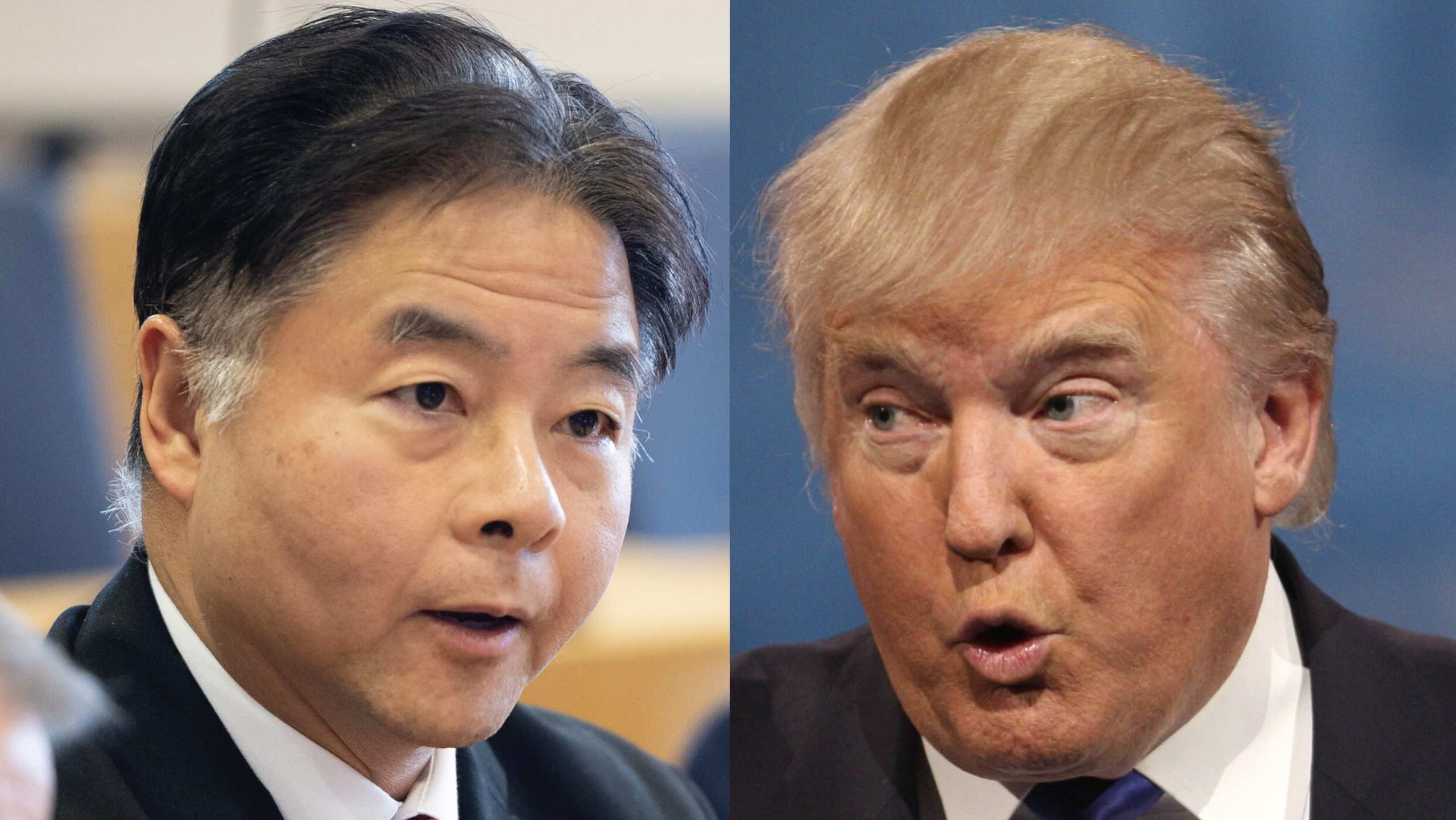
U.S. Representative Ted Lieu (D-Calif.) launched a sharp public rebuke of President Donald Trump on Thursday, accusing the president of ignorance and dishonesty after Trump called for tariffs to be imposed on Iran as part of a Senate sanctions package targeting Russia. Lieu’s statement, posted to X at 12:15 p.m. on July 30, 2026, argued that the United States already maintains a decades-old trade ban with Iran, rendering Trump’s tariff proposal functionally meaningless.
Lieu’s post read in full: “The President of the United States is ignorant and is a liar. We have a trade ban with Iran. Tariffs would do nothing. Iran is laughing at trump for this ridiculous threat. And Senator Graham would not have cared if there were tariffs on Iran because of the existing trade ban.”
The congressman’s post was a direct response to a video clip of Trump speaking with reporters, in which the president pushed for Iran to be added to a pending sanctions bill. In the clip, Trump said: “I’d like them to add Iran as tariffs, not just sanctions. That’s what Lindsey wanted. I’d like to see tariffs on Iran. That’s really what Lindsey wanted.”
Context Behind Trump’s Remarks
Trump’s comments came as he pressed lawmakers to amend the Lindsey O. Graham Sanctioning Russia and Iran Act of 2026, a bill named for the late Senator Lindsey Graham (R-S.C.), who died on July 11, 2026, at age 71. The Senate passed the legislation in an 86-12 vote, and the bill grants the president authority to apply tariffs of up to 100 percent on the top five purchasers of Russian energy, military equipment, or nations facilitating Russian sanctions evasion, alongside a 500 percent tariff on Russian imports to the United States. The package primarily targets China, India, and other Southeast Asian countries.
Trump has pushed to have Iran folded into the tariff authority as well, framing the addition as an homage to Graham, who lobbied extensively for a hardline posture toward Tehran before his death. According to reporting on the matter, U.S. trade with Iran is already minimal, with the United States importing only $1.4 million worth of goods from Iran in 2025.
Lieu’s Argument: Tariffs Are Redundant Given Existing Sanctions
At the center of Lieu’s criticism is the assertion that the United States already operates under a comprehensive trade embargo with Iran, making new tariff authority symbolic rather than substantive. Lieu argued that because virtually no legal trade currently flows between the two countries, tariffs — which function as a tax on imported goods — would have no practical effect on Iran’s economy or behavior. He extended that reasoning to Graham himself, asserting the late senator “would not have cared” about adding tariff language to the bill specifically because the existing trade ban already accomplishes the goal of economic isolation.
Lieu, who represents California’s 36th Congressional District and sits on the House Judiciary and Foreign Affairs Committees, has been a consistent critic of the Trump administration’s Iran policy throughout the year. He has previously questioned administration officials, including U.S. Ambassador to the United Nations Mike Waltz, over casualty figures and claims related to the U.S. military campaign against Iran during a House Foreign Affairs Committee hearing.
The History of the U.S.-Iran Trade Ban
The U.S. trade embargo with Iran traces back nearly four decades. President Ronald Reagan first imposed an import ban on Iranian-origin goods and services through Executive Order 12613 on October 29, 1987, citing Iran’s support for international terrorism and its actions against non-belligerent shipping in the Persian Gulf. That order was authorized under Section 505 of the International Security and Development Cooperation Act of 1985.
The embargo was significantly broadened in 1995, when President Bill Clinton signed a pair of executive orders — 12957 and 12959 — prohibiting U.S. involvement in Iranian petroleum development and substantially tightening sanctions under the International Emergency Economic Powers Act. In 1997, President Clinton signed Executive Order 13059, which clarified the earlier orders and confirmed that virtually all trade and investment activities with Iran by U.S. persons, regardless of location, are prohibited.
These restrictions are enforced through the Iranian Transactions and Sanctions Regulations, administered by the Treasury Department’s Office of Foreign Assets Control. Under current OFAC rules, all U.S. transactions with Iran involving energy products are banned, and imports of Iranian-origin goods and services into the United States are prohibited whether direct or routed through third countries. Limited humanitarian exceptions exist for food, medicine, and medical devices, along with narrowly defined licenses for telecommunications equipment intended to help Iranian citizens access the internet.
Broader Sanctions Landscape Amid Ongoing Conflict
The debate over tariff authority unfolds against the backdrop of the sixth month of active U.S. military conflict with Iran, part of the broader Operation Epic Fury campaign. The Graham-named sanctions bill itself is designed primarily to target Russia’s war effort in Ukraine by pressuring the largest purchasers of Russian energy, while also extending the Iran Sanctions Act of 1996 through 2031 to prevent a lapse in secondary sanctions authority against non-U.S. companies doing business with Iran.
Senate Majority Leader John Thune and the bill’s cosponsors have said they intend to name the final package after Graham, and lawmakers have expressed confidence it will clear remaining procedural hurdles despite concerns raised by some Democrats over expanding the president’s unilateral tariff authority. The Senate’s overwhelming 86-12 vote reflected both bipartisan support for pressuring Russia over its war in Ukraine and broad affection for Graham following his death.
Democratic Pushback on War Powers and Iran Policy
Lieu’s statement adds to a pattern of Democratic criticism of the administration’s approach to Iran that has intensified throughout 2026. The House passed a War Powers Resolution on July 23, 2026, in a bipartisan rebuke of Trump’s continued military operations in Iran — the second such vote of the year. That resolution followed an earlier War Powers vote on June 3, 2026, which passed 215-208 with four Republicans joining all Democrats in directing the president to remove U.S. armed forces from unauthorized hostilities in Iran.
Other House Democrats have echoed concerns about the economic toll of the conflict alongside its constitutional implications. Following the June vote, lawmakers cited rising gas prices — which climbed toward $5 a gallon nationwide during the height of the conflict — as evidence that the war has driven up costs for American families while isolating the United States internationally.
Administration’s Position on Iran Strategy
The White House has consistently defended its posture toward Iran as one of “maximum pressure” aimed at preventing the country from obtaining nuclear weapons. In recent public remarks, Trump has emphasized U.S. naval control of the Strait of Hormuz and accused Iran of bad-faith negotiating tactics, stating on one occasion that Iranian officials have denied discussing nuclear issues even when talks were ongoing.
The administration has also touted a preliminary 60-day memorandum of understanding with Iran reached in June 2026 as a step toward ensuring Iran cannot obtain a nuclear weapon, with Senate Republicans including Jim Banks and Marsha Blackburn publicly praising the framework as evidence of the president’s negotiating strength.
What Comes Next
The Graham-named sanctions package remains under negotiation as lawmakers weigh whether to formally add Iran-specific tariff language at Trump’s request, a move that would require reconciling the Senate-passed version with House priorities before a final vote. With the Senate facing a limited number of session days before the November midterms and a looming government funding deadline, the bill’s ultimate scope — and whether it satisfies Trump’s demand for tariff, rather than sanctions-only, authority over Iran — remains unresolved. Lieu’s statement signals that Democratic lawmakers are likely to continue scrutinizing the practical impact of any expanded tariff authority given the trade restrictions already in place.