
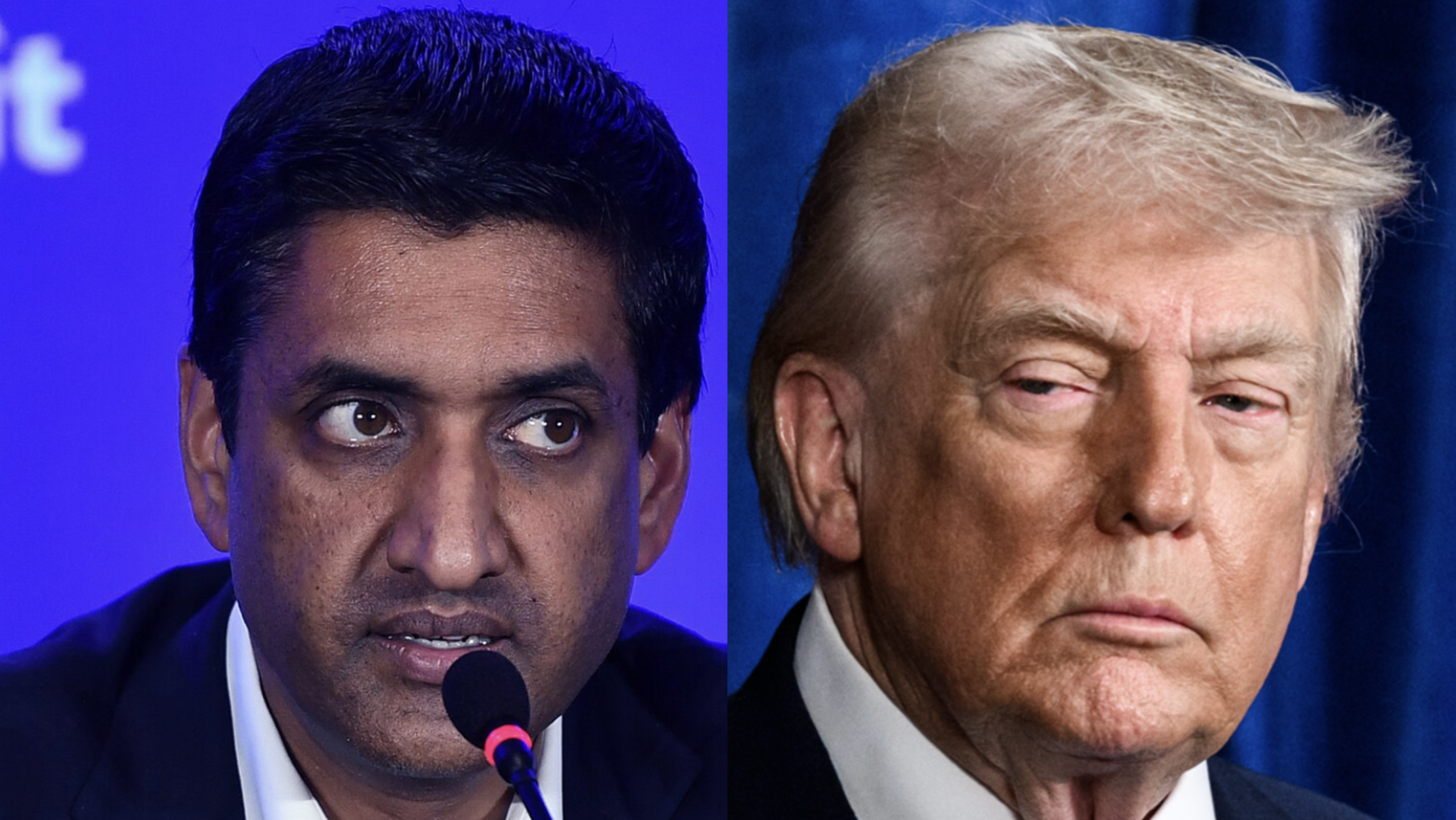
California Democratic Rep. Ro Khanna took to social media Monday and published a detailed op-ed on Fox News arguing that while the end of U.S. military operations against Iran is a welcome development, the ceasefire deal negotiated by President Donald Trump and Vice President JD Vance is materially weaker than the Obama-era nuclear agreement Trump spent the better part of a decade publicly dismantling. In an X post on June 22, 2026, Khanna linked his Fox News op-ed with a blunt summary: “It’s good we stopped fighting Iran. But Trump’s ceasefire deal is worse than the JCPOA. The facts.”
A Ceasefire Built on a “Self-Inflicted Disaster”
In his Fox News op-ed, Khanna acknowledged the public value of the ceasefire while placing the conflict itself squarely at the feet of the current administration. “The war Trump started was a self-inflicted disaster that cost American lives and burned through taxpayer dollars,” he wrote. “Now, the ceasefire deal he and Vice President Vance negotiated delivers Iran a better deal than the Joint Comprehensive Plan of Action (JCPOA) Trump spent years ridiculing.” Khanna estimated the financial toll of the conflict at a potential $200 billion, describing it as more than the cost of funding free college for every American, universal childcare at $10 per day, and the establishment of one thousand trade schools combined. At least 13 American servicemembers, he wrote, lost their lives “in another senseless Middle Eastern war.”
The MOU and What Congress Received
The op-ed came days after the White House formally transmitted the full text of a 14-point Memorandum of Understanding (MOU) to Congress on June 18, 2026. The document, negotiated in Islamabad, declared an “immediate and permanent termination of military operations on all fronts, including in Lebanon,” and committed both nations to finalize a comprehensive agreement within 60 days. The MOU also outlined the removal of the U.S. naval blockade within 30 days, the restart of Iranian oil exports, and a commitment by the United States and regional partners to develop a reconstruction and economic development plan for Iran worth at least $300 billion. It was the release of those specific terms that Khanna directly addressed in his op-ed, arguing they represented a significant step backward from what President Barack Obama had secured in 2015.
Five Ways Vance “Woefully Misled” Americans
Khanna structured much of his Fox News piece around a methodical rebuttal of the administration’s claims that the Trump-Vance deal surpassed the JCPOA. “The details of the ceasefire released this week show that Vice President Vance woefully misled Americans on at least five accounts when he claimed the administration’s deal was better than the JCPOA that President Obama negotiated in 2015,” he wrote.
On nuclear material, Khanna pointed out that under the terms of the MOU, Iran’s stockpile of highly enriched uranium is set to be diluted inside Iran — not destroyed — and only contingent on what could be years of further diplomatic negotiations. The JCPOA, he noted, required Iran to ship 98 percent of its enriched uranium out of the country while capping the remainder at 3.67 percent enrichment, well below the weapons-grade threshold.
On oil exports, Khanna wrote that under Trump’s deal, Iran is permitted to immediately restart exporting oil — roughly 90 percent of which flows to China — generating a wave of petrodollars that would directly fund the Iranian regime. By contrast, the Obama administration only allowed those exports after Iran had shipped its enriched uranium abroad and was verified to have dismantled core elements of its nuclear program.
On frozen assets, Khanna noted that after years of criticizing Obama for unfreezing roughly $50 billion in Iranian assets, Trump’s deal unfreezes more than $100 billion in blocked Iranian assets, payable to any recipient chosen by Tehran.
On reconstruction funding, Khanna pointed to the MOU’s commitment of at least $300 billion to finance Iran’s rebuilding, warning that such sums could flow toward rearming Iran’s military — including ballistic missiles and drone production — and toward funding its proxy networks across the region.
On the Strait of Hormuz, Khanna described the fifth concession as the most historically significant. Under the terms of the deal, Iran could charge tolls on foreign ships transiting the strait after 60 days — a provision Khanna called “a historic concession, surrendering a principle that American sailors have died defending while handing Beijing a dangerous new precedent for coercion in the Indo-Pacific.”
“America Had All the Cards”
Khanna’s verdict on the deal was pointed. “In short, the president who proclaims to be a master dealmaker has shown once again that negotiating real estate deals simply does not translate into the world of international politics,” he wrote. “America had all the cards, and the president played them like an amateur.” He argued that a stronger deal would have been anchored in reassembling the global coalition of allies that Obama built, reinstating intrusive IAEA inspections of Iran’s remaining nuclear infrastructure, and using Iran’s temporary military losses as leverage for broader regional diplomatic goals — including restarting negotiations over a two-state solution for Israelis and Palestinians with Hamas disarmed.
A Long Record of Opposition to the War
Khanna’s Monday op-ed and X post were not his first public statements challenging the administration’s handling of the Iran conflict. When Trump announced U.S. strikes on Iran in 2025, Khanna released an immediate statement: “Stopping Iran from having a nuclear bomb is a top priority, but dragging the U.S. into another Middle East war is not the solution. Trump’s strikes are unconstitutional and put Americans, especially our troops, at risk.” He called for Congress to return to Washington to vote on a bipartisan War Powers Resolution he had co-led alongside Rep. Thomas Massie (R-KY).
That resolution, H. Con. Res. 38, directed the president to terminate the use of U.S. Armed Forces against Iran unless explicitly authorized by Congress, and it grew to include 76 Democratic co-sponsors along with Massie as the only Republican co-lead. In June 2025, Khanna and members of the Congressional Progressive Caucus held a press conference demanding passage of the resolution, with Khanna stating: “Americans do not want another costly and disastrous war in the Middle East. They want peace abroad and good-paying jobs at home.”
A Clash With Hegseth Over War Costs
In April 2026, Khanna confronted Defense Secretary Pete Hegseth directly during a House Armed Services Committee hearing, challenging the Pentagon’s $25 billion cost estimate for the war and pressing the administration on the real economic impact of the conflict on American households. Khanna cited estimates suggesting the war could cost the U.S. economy as much as $631 billion, or roughly $5,000 per household. When Hegseth deflected a question about enriched uranium levels, Khanna pressed: “Do you know how much the enriched uranium was after you ripped up the JCPOA?” — noting that Iran’s enrichment had dramatically escalated since Trump withdrew from the Obama-era agreement. Khanna concluded the exchange with a direct rebuke: “You know what? I’m sad. I’m sad for all the people who voted for Trump, I’m sad for them, because you betrayed them. You betrayed a lot of that MAGA base.”
An Early Signal of Khanna’s Position on the Ceasefire
Before his more detailed Fox News breakdown, Khanna had offered an initial reaction to the ceasefire framework in an earlier X post, taking a tone that was supportive of ending the fighting but critical of the terms. “The ceasefire agreement with Iran with the opening of the Strait of Hormuz is welcome news. Democrats should support it,” he wrote. “As expected, Trump failed to bring about regime change. The terms seem no better than what Obama secured under the JCPOA nearly a decade ago. America lost 14 precious service members and wasted billions of dollars on this foolish endeavor.” He added that the moment also demonstrated the power of legislative pressure: “It also shows that when the Congress votes to end war — as we did last week — it can be a wake up call for the President to listen to the anti-war sentiments of the American people.”
The Cost of War as a Domestic Issue
Khanna has also tied the financial toll of the Iran war to a broader domestic economic argument throughout his tenure as a leading voice against the conflict. In an April 2026 speech at the National Press Club, he stated that the money spent on the war could have funded free public college and trade school for every American. “Every bomb we drop overseas is a student who does not get a scholarship, a rural hospital that is not staying open, childcare that parents are not able to get,” he said in the speech, which outlined his vision for what he called a “Marshall Plan for America.” His Fox News op-ed repeated a version of that same case, arguing that future U.S. leadership should pivot toward “reindustrializing our heartland in places like Middletown, Ohio and Johnstown, Pennsylvania” rather than expensive foreign military campaigns.
What Comes Next
Despite his sharp criticism of the deal’s terms, Khanna acknowledged in his op-ed that the ceasefire itself represents a meaningful if incomplete outcome. “The good news for Americans is that, while the Trump-Vance deal is materially weaker than the JCPOA, the fighting has now stopped,” he wrote. He argued that future administrations will face the task of securing United Nations Security Council backing to guarantee freedom of navigation through the Strait of Hormuz and enforcing Iran’s nuclear disarmament through the IAEA. Khanna closed with a broader warning about American leadership: “The greatest threats to America’s future will not be solved by another Middle Eastern war. The American people want us to focus on Team America. They want us to rebuild our industry, invest in our people, strengthen our alliances to enforce agreements, and provide moral leadership in the world to solve the problems of conflict, hunger, and disease. Leadership that falls short of those aims would be an unforgivable dereliction of duty.”
Ro Khanna represents California’s 17th congressional district and serves as Ranking Member of the House Select Committee on Strategic Competition between the United States and the Chinese Communist Party.