
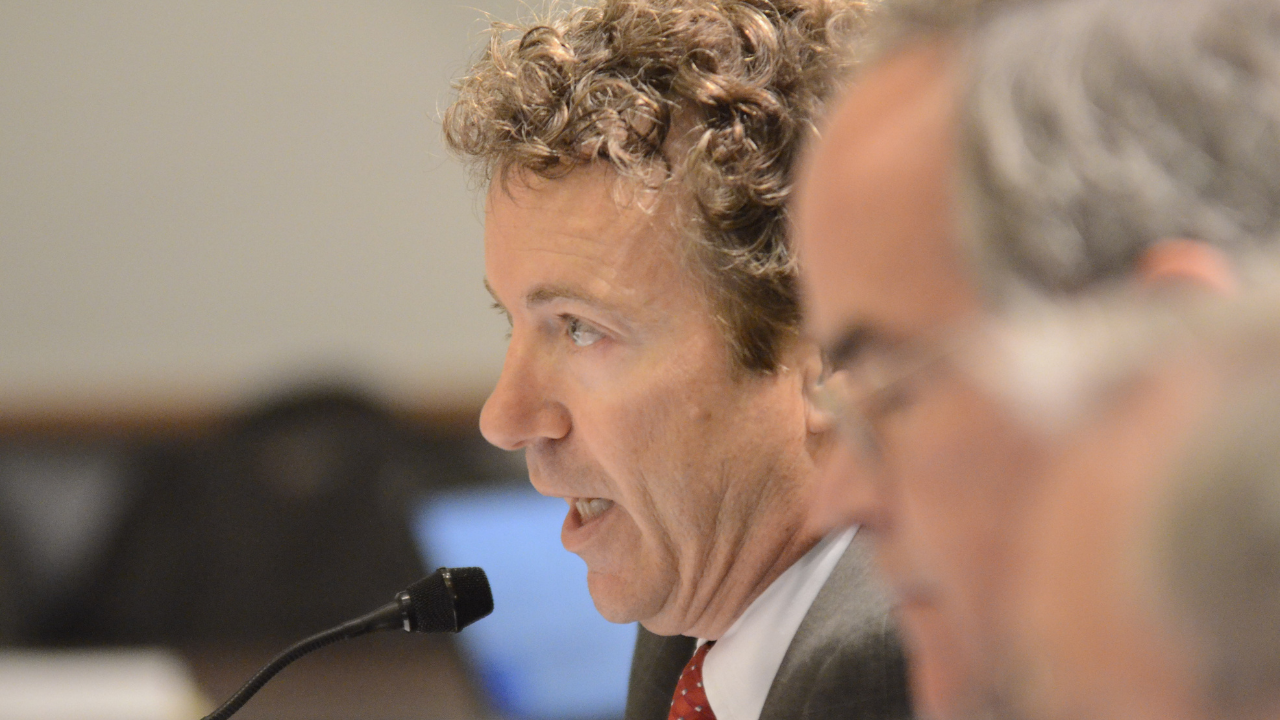
Sen. Rand Paul has spent recent weeks zeroing in on a single argument as the core of his case against the Iran war: that the conflict has produced a militarized Strait of Hormuz for the first time in the waterway’s history, and that reversing it may prove far harder than anyone in the administration is acknowledging. “If you look at the militarization of the Strait of Hormuz, that’s never happened before,” Paul told reporters on Capitol Hill in late July. “There’s not an easy way to un-militarize the strait.”
The Argument in His Own Words
Paul returned to the same point in a Morning Joe interview on MS NOW on August 4, using it as the centerpiece of his broader “worse off” case. “One step forward, we decimated their military, but two steps backwards in that they’ve militarized the strait,” he said. “The strait has never been militarized. And I think really no negotiations go forward until you can get a demilitarization of the strait, and you will still have to negotiate to get any nuclear achievement despite the military victory.”
What Makes This Different From Past Tensions
Iran has threatened the Strait of Hormuz for decades without ever fully acting on it, which is precisely what Paul says makes the current situation historically distinct. Speaking on Bloomberg’s “Balance of Power: Late Edition” in July, Paul laid out the comparison directly: “Do you see us as closer or farther away from getting rid of militarization? So, let’s just make the argument, are we better off now or before the war? So, before the war, there had been a discussion, but never had been a militarization before. People have talked about it for decades, but it never happened. So, now the Strait of Hormuz is militarized.” The distinction he’s drawing is between rhetorical threats, which the region has absorbed for a generation, and the current reality of active naval control, blockades, and mines — an operational condition rather than a diplomatic posture.
What “Militarized” Looks Like on the Water
The scale of the disruption has been substantial. Iran’s Revolutionary Guard Corps closed the strait to foreign shipping at the war’s outset, transmitting warnings that “no ship is allowed to pass,” and by early March had declared “complete control” of the waterway, permitting only Iran-approved vessels — largely those bound for China and India — to transit, in some cases under military escort. The U.S. responded with its own naval blockade of Iranian ports and later a naval escort operation for U.S.-aligned shipping. The result has been a waterway that normally carries roughly a fifth of the world’s oil and a fifth of global liquefied natural gas now operating under dueling military postures from both sides — precisely the kind of dual militarization Paul argues never previously existed.
Why He Says Reversing It Is So Hard
Paul has been specific about the scale of effort he believes would be required to genuinely de-militarize the strait rather than simply negotiate a temporary shipping arrangement around it. “If you really want to control the Straits of Hormuz, you would have to send a couple hundred thousand troops in,” he said on Bloomberg. “I don’t think the president’s inclined to do that. And I think the Iranians know that.” The implication of that argument is that any near-term deal — including the kind of narrower safe-passage arrangement U.S. and Qatari officials have been negotiating with Iran and Oman in recent days — addresses shipping access without addressing the underlying militarization Paul says is the war’s most lasting cost.
How This Fits His Broader Case
Paul treats the Hormuz militarization as the load-bearing evidence for his larger claim that the war has left the U.S. “worse off” than before it began, distinguishing it from the war’s other, more favorable outcomes for the U.S. He has acknowledged the military campaign succeeded on its own narrower terms — badly degrading Iran’s air force, navy, and missile production capacity — while arguing that success has not translated into the kind of stable regional outcome that would justify the war’s costs. “You could argue we have some leverage because we defeated them militarily,” Paul said in late July, “but so far we haven’t seen the advantage play out in negotiations.”
The Costs He Ties to It
Paul has connected the strait’s militarized status directly to consumer prices. With roughly a fifth of global oil supplies normally moving through Hormuz, the disruption helped push the national average gasoline price to $4.003 a gallon by late July — more than 30 percent above pre-war levels — while Brent crude climbed toward $100 a barrel amid the shipping constraints and a related Houthi attack on Saudi oil tankers in the Red Sea threatening the nearby Bab el-Mandeb Strait as well.
A Position That Predates the Latest Diplomacy
Paul’s Hormuz argument has remained consistent even as the administration’s public diplomatic posture has shifted week to week. His core claim — that no meaningful negotiation is possible until the strait itself is demilitarized — sits in direct tension with the more limited safe-passage arrangements that have dominated recent U.S.-Qatar-Oman-Iran discussions, which have focused on restoring shipping volume rather than addressing the underlying military presence Paul says is the actual problem.
His Voting Record Reflects the Same Concern
Paul has translated this argument into a consistent voting pattern on Senate war powers resolutions aimed at ending U.S. involvement in the conflict, supporting several such measures over the course of the war, including a joint resolution that, per its official Congress.gov record, passed the Senate 50-48 in June — the first time such a measure cleared both chambers of Congress since the war began — before later voting present on a subsequent version, a shift he tied to ongoing negotiation leverage rather than any change in his underlying assessment that the war has made the U.S. less secure, not more.
A New Institution Born From the Conflict
The militarization Paul describes has produced lasting institutional changes as well as military ones. Wartime reporting on the conflict has documented the formation of a “Persian Gulf Strait Authority” as part of the broader effort to manage shipping and security through Hormuz during the fighting — the kind of new, standing apparatus that underscores Paul’s point that the current state of the strait represents a structural shift rather than a temporary wartime condition that will simply lapse once active combat ends.
A Toll on Shipping Itself
Beyond the military postures on either side, the human and commercial cost of the standoff has been significant. Reporting on the broader Hormuz crisis has documented at least 17 merchant ships damaged during the conflict, with seven abandoned by their crews, two vessels captured, and roughly a dozen seafarers killed or reported missing — casualties that illustrate why Paul argues the strait’s current condition cannot simply be waved away as a diplomatic footnote once a ceasefire or shipping arrangement is reached.
The Unresolved Question
Paul’s framing leaves an open question that the administration’s own diplomatic timeline has not yet answered: whether a short-term deal restoring shipping traffic through Hormuz would count, in his terms, as genuine demilitarization, or merely as a temporary accommodation layered on top of a military standoff that remains, in his words, without “an easy way to un-militarize.”