
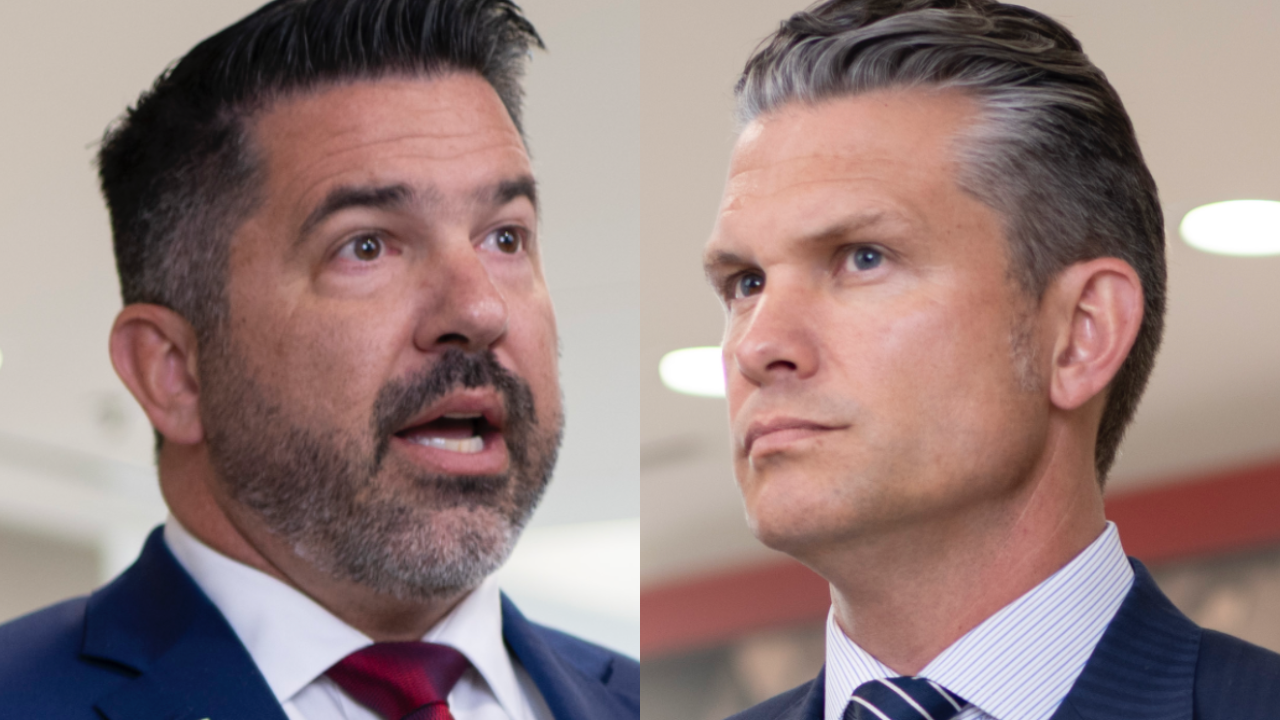
Pentagon chief spokesman Sean Parnell released a motivational video crediting Defense Secretary Pete Hegseth with elevating the department’s public affairs function after what he described as two decades of neglect, even as press freedom groups say the same period has seen unprecedented restrictions on independent journalists’ access to the Pentagon.
“Thanks to Secretary Hegseth’s leadership, the era of putting public affairs on the back burner is over,” Parnell wrote on X, sharing the video.
In the video, Parnell told department public affairs personnel their work had transformed the field’s standing within the Pentagon. “For two decades, public affairs was the most overlooked, under-resourced, and frankly, ignored department in the Pentagon,” Parnell said. “But through your professionalism, your refusal to fail, and with the full backing of a secretary who is 100% behind us, we shattered that dynamic once and for all. During Absolute Resolve, our teams right here worked around the clock providing real-time, transparent updates, and demonstrated our readiness, our commitment to mission success. You all told that story to the American people, and you continue to tell it. In Epic Fury, you are capturing the power and joint force integration of combat operations, showing the world our forces are just unmatched in their lethality. We proved that we are not support staff. We are operational assets. We proved that the information domain is a battleground, and you all are the operators who dominate.”
Parnell’s video referenced two named military operations: Operation Absolute Resolve, the Jan. 3 raid that captured Venezuelan President Nicolás Maduro, and Operation Epic Fury, the U.S. military’s formal designation for its ongoing air and missile campaign against Iran, which began Feb. 28.
Parnell’s characterization of an elevated, more assertive public affairs posture aligns with a documented shift in how the Pentagon manages press relations under Hegseth, though press freedom advocates describe the same changes very differently. Hegseth announced new credentialing restrictions on May 23, 2025, limiting reporters’ access to areas of the building historically open to credentialed press across both Republican and Democratic administrations, including the offices of the secretary, his top aides and the Joint Chiefs chairman, according to NPR reporting at the time. The Pentagon Press Association called the move “a direct attack on the freedom of the press and America’s right to know what its military is doing.”
The restrictions tightened further in September 2025, when the department distributed new rules requiring journalists to pledge not to gather or release information without explicit authorization, even if unclassified, and warning that press credentials could be revoked if a reporter was “reasonably determined to pose a security or safety risk.” Dozens of Pentagon correspondents refused to sign the pledge and were forced to surrender their press badges by October, according to the U.S. Press Freedom Tracker. Hegseth defended the policy on X at the time, writing, “The ‘press’ does not run the Pentagon, the people do. The press is no longer allowed to roam the halls of a secure facility. Wear a badge and follow the rules, or go home.”
The New York Times sued the Pentagon in December 2025 over the policy, in a case captioned New York Times v. Department of Defense. U.S. District Judge Paul Friedman, a Clinton appointee, ruled for the Times on March 20, 2026, finding the policy amounted to unconstitutional viewpoint discrimination. “The record evidence supports the conclusion that the Policy discriminates not based on political viewpoint but rather based on editorial viewpoint, that is, whether the individual or organization is willing to publish only stories that are favorable to or spoon-fed by Department leadership,” Friedman wrote, according to a Fox News report on the ruling. Friedman also found the policy unconstitutionally vague under the Fifth Amendment, writing that it “makes any newsgathering and reporting not blessed by the Department a potential basis for the denial, suspension, or revocation of a journalist’s” credential, providing “no way for journalists to know how they may do their jobs without losing their credentials.” Parnell responded to the ruling in a same-night post on X: “We disagree with the decision and are pursuing an immediate appeal.”
The Pentagon’s response to Friedman’s order triggered a second round of litigation. After initially agreeing to reinstate barred journalists’ credentials, the department announced it would confine reporters to a separate annex and require an escort to enter the Pentagon itself, a policy the Times argued defied the court’s order. Friedman agreed, ruling on April 9 that the revised “interim policy” was equally unlawful. “With the issuance of the Interim Policy, the Department has invoked slightly different language to achieve the same unconstitutional result,” Friedman wrote, according to the Reporters Committee for Freedom of the Press, which had filed a brief supporting the Times. Friedman separately noted the timing of the case’s stakes directly, writing, “especially in light of the country’s recent incursion into Venezuela and its ongoing war with Iran, it is more important than ever that the public have access to information from a variety of perspectives about what its government is doing.”
The Pentagon has held fewer than 10 on-the-record briefings since the start of 2026, according to reporting from The Hill, and Hegseth’s last on-camera briefing was in June 2025.
The changes have also affected Stars and Stripes, the military newspaper that has operated with congressionally mandated editorial independence since 1991, which saw its access similarly tightened under the new arrangement.
Supporters of the administration’s approach have argued the changes reflect necessary modernization of strategic communications amid active combat operations and a contested information environment, prioritizing direct, controlled channels, official videos, X posts and department-produced content, over traditional press briefings.
Critics, including the Pentagon Press Association and media law experts, have described the same shift as reducing independent oversight of military operations and limiting the public’s ability to verify the department’s own account of events through traditional adversarial reporting.
Parnell, a former Army captain who served in Afghanistan and author of the book “Outlaw Platoon,” was appointed Assistant to the Secretary of War for Public Affairs in early 2025 and serves as chief Pentagon spokesman and a senior adviser to Hegseth. He has become a frequent user of the department’s social media accounts for both operational updates and morale-focused content mirroring Hegseth’s broader messaging themes.
Neither the Pentagon Press Association nor independent Pentagon correspondents have issued a direct response to Parnell’s video.