
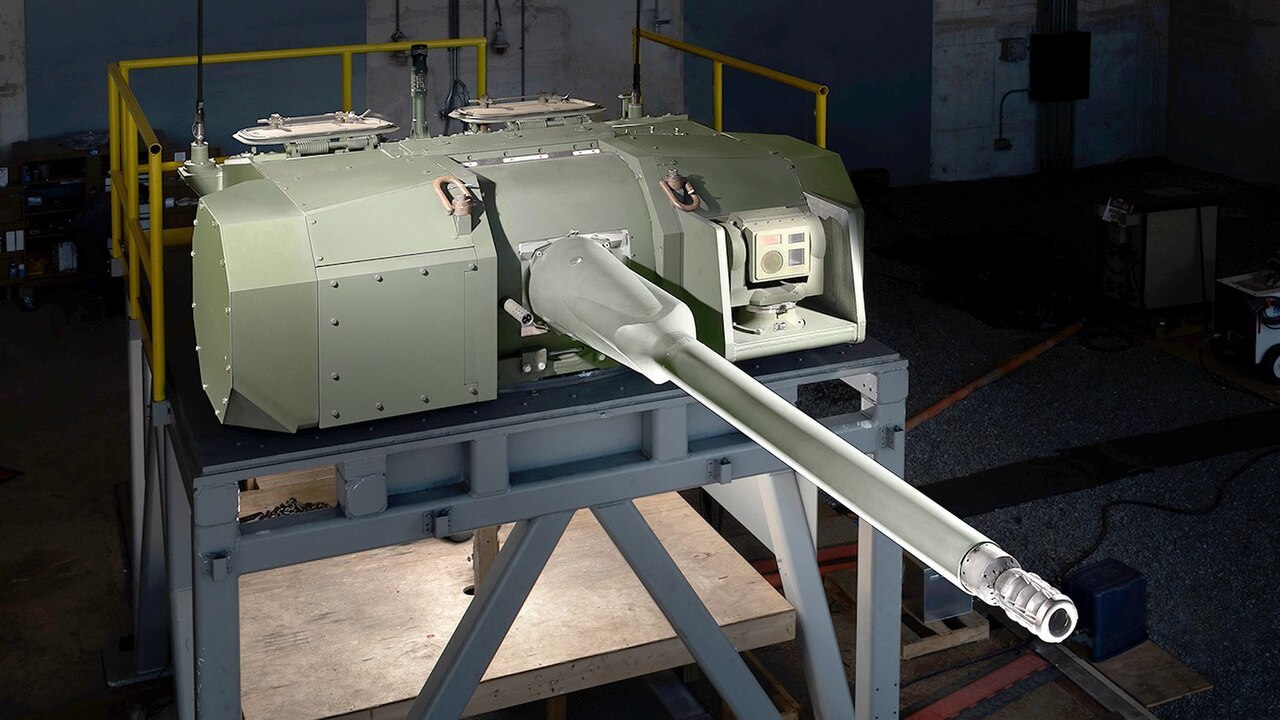
A guided 50mm projectile built to knock down aerial threats with a cannon instead of a missile has been through a flight test. Northrop Grumman says it fired test rounds for its Raid Hunter gun-based air defense system from an XM913 Chain Gun at Dahlgren, Virginia, and that the rounds returned high-fidelity data for nearly every shot. The test measured how the projectile flies; it was not an intercept, and no targets were engaged.
The round is still in development. What the company is building toward is a guided, proximity-fuzed 50mm shell, pitched as a cheaper way to handle large, mixed raids than firing interceptor missiles at each threat.
Northrop Grumman described the test in a Sept. 16, 2026, company release datelined Dahlgren. The company said it “recently completed an aeroballistic test for a new 50mm projectile for Raid Hunter,” and that the test rounds generated data “confirming pre-test predictions and performance expectations.” The release did not give the number of rounds fired, the date of the firing, or any accuracy figures.
What an aeroballistic test proves, and what it does not
Northrop Grumman said the aeroballistic test was about the projectile itself, “validating projectile performance and generating critical flight data to advance its development.” By the company’s account, the rounds flew the way its pre-test predictions said they would, which is the foundation any guided shell’s steering and fuzing have to be built on.
The release makes no claim that the round’s guidance was exercised against a target, that the proximity fuze was triggered by anything, or that any drone or missile was destroyed. The results “advance Northrop Grumman’s development of a new guided, proximity-fuzed 50mm round for Raid Hunter,” the company said, which places the round in development rather than in service.
The Raid Hunter pitch
Northrop Grumman unveiled Raid Hunter in an Aug. 11, 2026, company release as a 50mm gun-based system meant to counter cruise missiles, drone swarms and other aerial threats. In that release, Kenn Todorov, the company’s vice president and general manager of command and control and weapons integration, said, “Raid Hunter addresses a critical short-range defense gap by delivering rapid, high-capacity protection against complex, mass aerial threats.”
The company’s Raid Hunter product page goes further, describing “a first-of-its-kind steerable 50mm munition” that performs “multiple continuous inflight maneuvers to enhance lethality” when fired in small salvos. The page says the system is controlled through Northrop’s AiON C2 software, is designed for palletized and future vehicle-mounted configurations, and can be carried by C-130. It also claims Raid Hunter “provides a cost-effective alternative to traditional missile interceptors.” Those are the company’s claims; the September test did not measure lethality or cost per engagement, and Northrop has published no price for the round.
The XM913 behind the round
The gun used for the test is not new to the program. Northrop’s 50x228mm Bushmaster page calls the XM913 its largest medium-caliber chain gun, firing 50x228mm ammunition, and describes it as “the cannon designated as the primary weapon on the U.S. Army’s Next Generation Combat Vehicle.” The company lists it as a step beyond the earlier Mk44S and Bushmaster III designs.
The Army’s own ground-vehicle plans already call for a cannon of that size. When the Army awarded XM30 Mechanized Infantry Combat Vehicle prototype contracts to General Dynamics Land Systems and American Rheinmetall Vehicles in June 2023, worth about $1.6 billion combined, it listed “a 50mm cannon and a remote turret” among the key features for the vehicle meant to replace the M2 Bradley. Raid Hunter puts that caliber to a different job, pointing it at the sky.
For now, the record consists of a completed aeroballistic flight test and a company development plan. Northrop Grumman has not announced a date for a guided-flight or live-intercept test of the Raid Hunter round.
Top image: A U.S. Army 50mm chain gun on a test stand. Image Credit: U.S. Army photo — Public domain / army.mil via Wikimedia Commons
This article was produced with the assistance of AI and reviewed by Combat Rated editors prior to publication.