
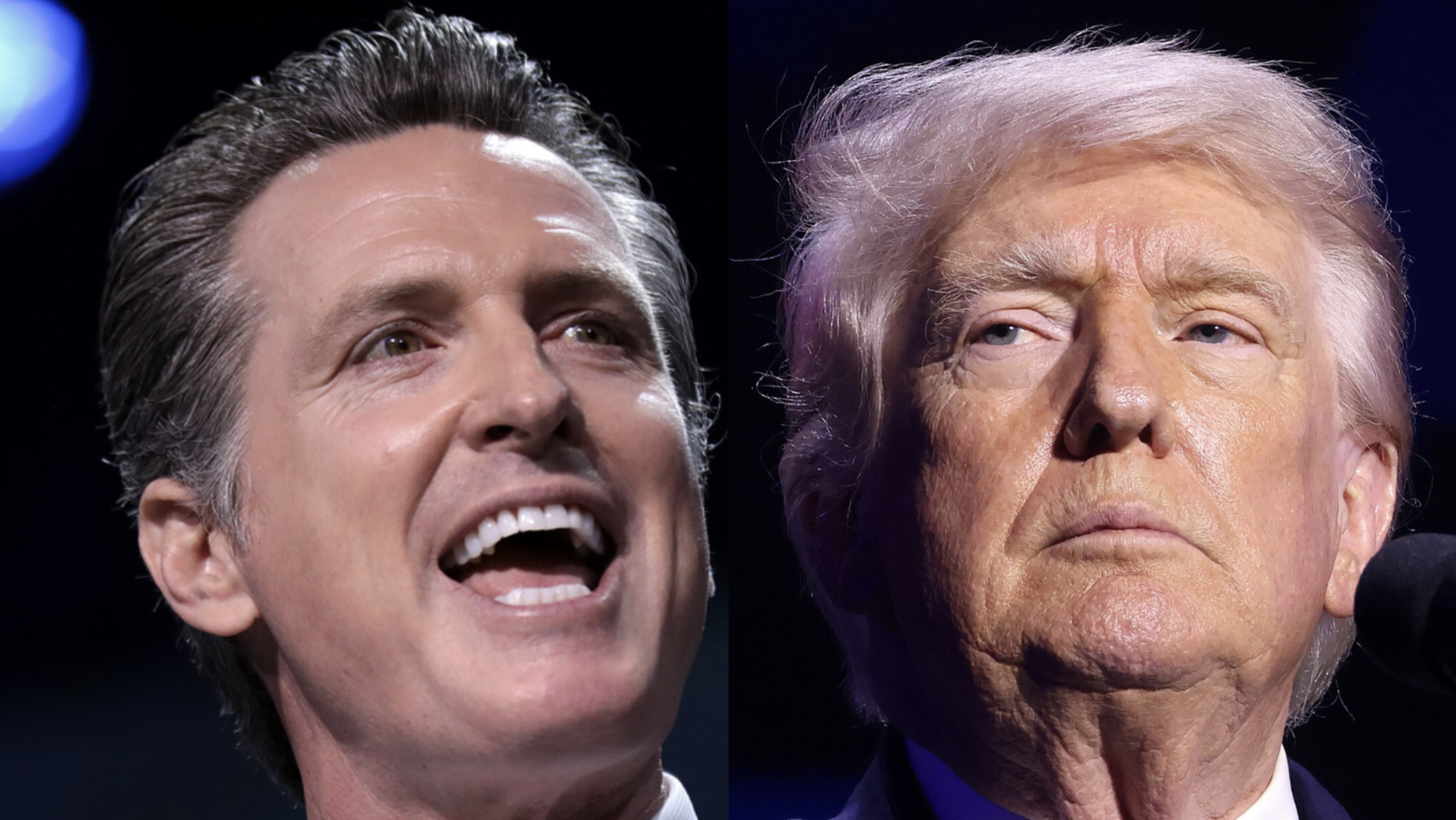
California Governor Gavin Newsom called Tuesday’s Supreme Court ruling upholding birthright citizenship “a win for American democracy,” capping an 18-month period in which the governor, widely viewed as a potential 2028 presidential contender, repeatedly clashed with President Donald Trump over the administration’s attempt to redefine constitutional citizenship.
The Supreme Court ruled 6 to 3 on Tuesday to strike down Trump’s executive order, which sought to deny automatic citizenship to children born in the United States to parents who were undocumented or present only temporarily. Writing for the majority, Chief Justice John G. Roberts Jr. held that the framers of the Fourteenth Amendment “extended that promise to ‘every free-born person in this land,'” adding, “We keep that promise today.”
Newsom responded on X at 10:03 a.m., framing the ruling in sweeping terms. “Today is a win for American democracy,” Newsom wrote. “This SCOTUS decision preserves a promise that has defined America for generations: Birthright citizenship is a constitutional guarantee, plain and simple. The Constitution prevailed. We have all prevailed.”
Tuesday’s statement was the latest in a string of public responses from Newsom dating back to the day Trump signed the order. On Jan. 20, 2025, hours after Trump issued the executive order titled “Protecting the Meaning and Value of American Citizenship,” Newsom’s office released a statement that was characteristically blunt: “This is unconstitutional.” The brief response was widely covered at the time as one of the most direct rebukes from a Democratic governor on the day the order was signed.
California subsequently joined a coalition of 18 Democratic state attorneys general who sued to block the order the following day, describing it as unconstitutional. The order sought to deny citizenship to babies born on U.S. soil to parents who had entered the country illegally, as well as to children born to parents present on lawful but temporary visas, including student, work and tourist visas. Federal courts blocked the order from taking effect almost immediately, issuing the first preliminary injunction in New Hampshire in February 2025, with additional injunctions following in Washington, Maryland and Massachusetts.
The case that ultimately reached the Supreme Court, Trump v. Barbara, stemmed from a nationwide class-action lawsuit filed after the Supreme Court’s June 2025 ruling in a separate case, Trump v. CASA, Inc., which limited the use of so-called universal injunctions but left it to lower courts to determine whether broad relief remained appropriate specifically in birthright citizenship litigation. The ACLU and its partners responded by filing a new class-action suit on behalf of all children born on U.S. soil to undocumented or temporarily present parents, forming the basis of the case decided Tuesday.
Oral arguments in the case took place April 1, with Trump becoming the first sitting president to attend Supreme Court arguments in person. He remained in the courtroom for more than an hour before leaving shortly after attorneys opposing his order began their presentation, and wrote afterward on Truth Social that the United States was “the only Country in the World STUPID enough to allow ‘Birthright’ Citizenship!” During the arguments, Roberts had directly challenged the administration’s solicitor general over his reading of the Fourteenth Amendment’s “subject to the jurisdiction” clause, calling some of the examples used to support a narrower interpretation “very quirky.”
In Tuesday’s opinion, Roberts wrote that the administration’s position amounted to “a dramatically revisionist view” of the amendment, citing the 1898 case United States v. Wong Kim Ark, in which the court held that a man born in San Francisco to Chinese immigrant parents who had not naturalized was a U.S. citizen. Roberts was joined by Justices Sonia Sotomayor, Elena Kagan, Ketanji Brown Jackson, Amy Coney Barrett and Brett Kavanaugh. Justices Clarence Thomas, Samuel Alito and Neil Gorsuch dissented, with Thomas calling it “extraordinary” for the court to overturn a presidential order on the issue.
Newsom’s reaction Tuesday adds to a now-lengthy record of public statements positioning him as one of the more outspoken Democratic governors on the administration’s immigration agenda, a posture that has coincided with his emergence as a frequently discussed name in early speculation about the 2028 Democratic presidential field. On Polymarket, the prediction market where users trade on the probability of political outcomes, Newsom was shown in betting odds cited around the time of the ruling trailing both Secretary of State Marco Rubio and Vice President JD Vance in markets tracking the 2028 race, with Newsom’s odds at roughly 12 percent compared to Rubio at roughly 14 percent and Vance at roughly 20 percent. Newsom has not formally announced a 2028 campaign, but his frequent public clashes with the Trump administration, including his Tuesday statement on birthright citizenship, have repeatedly drawn attention as part of his broader national profile.
The Supreme Court’s ruling closes out a legal battle that began the day Trump returned to office and ran for roughly 18 months through multiple rounds of district court injunctions, an emergency appeal to the Supreme Court over the scope of those injunctions, and finally oral arguments and a full merits decision. For Newsom, who issued one of the earliest and most direct condemnations of the order on the day it was signed, Tuesday’s ruling represented vindication of a position California had staked out from the very start of Trump’s second term.