
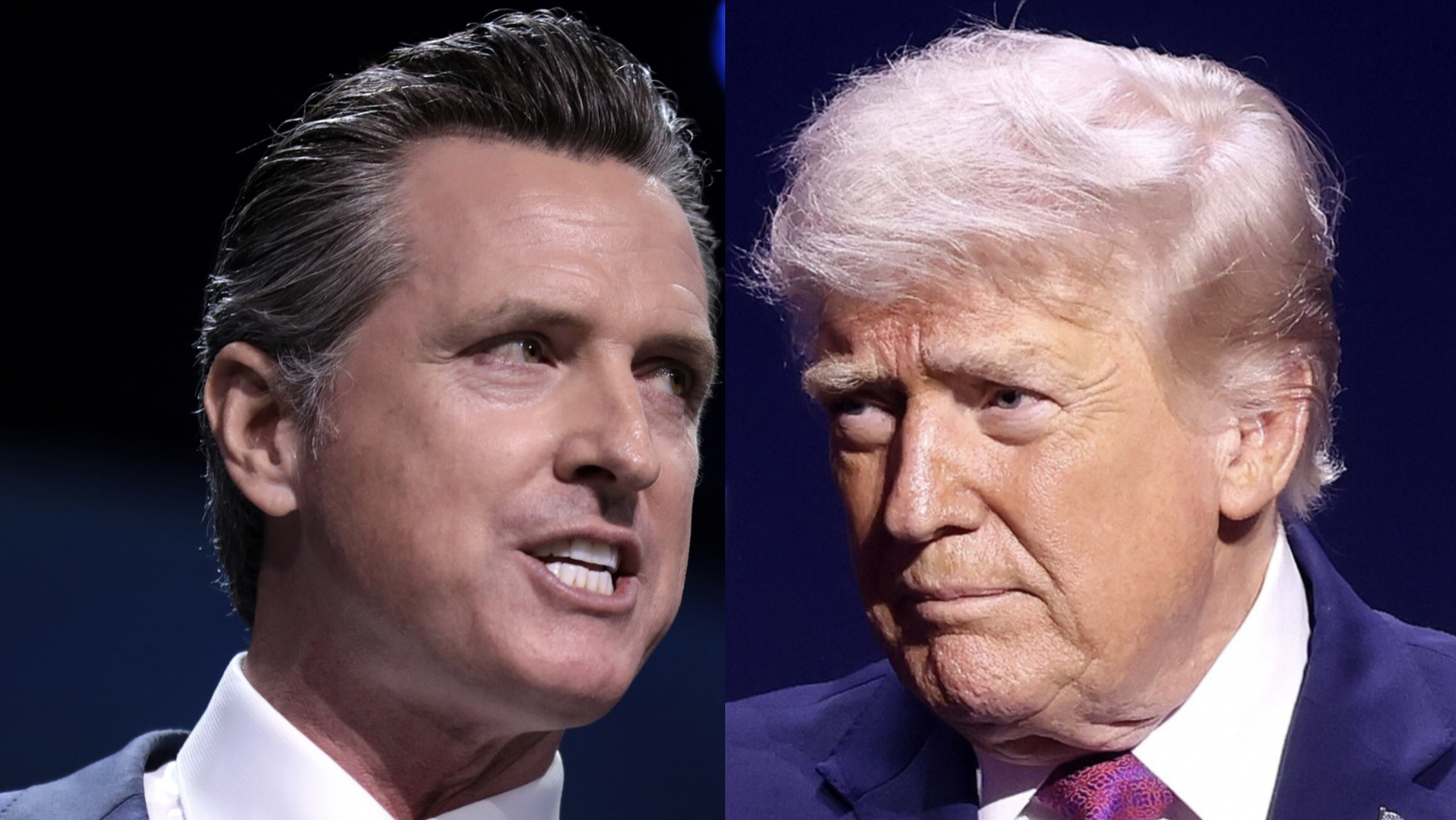
California Governor Gavin Newsom accused President Donald Trump of trying to rig the 2026 midterm elections, calling the Safeguard American Voter Eligibility Act “blatant voter suppression” in a post on X published Monday afternoon, as the stalled legislation once again became the central flashpoint between the White House and the Senate.
Newsom’s post, published at 3:55 p.m. ET on July 27, 2026, laid out a list of Americans he said would be harmed by the bill before directly accusing the president of trying to manipulate the outcome of the November elections. The full post read: “The SAVE Act is blatant voter suppression. It makes voting harder for: Americans without passports, Married women who changed their last names, Military members and Americans overseas, People with disabilities, Seniors. Donald Trump is begging the Senate to pass it so he can suppress YOUR vote. Don’t let him rig our elections. Show up this November.”
The governor’s post landed hours after Trump himself renewed his public pressure campaign on the Senate to pass the bill. Writing on Truth Social earlier Monday, Trump told Senate Majority Leader John Thune not to let the chamber “leave town” for its scheduled August recess until it passes “The Save America Act,” or alternatively eliminates the legislative filibuster so Republicans “can then quickly pass everything they ever dreamed of.”
What the SAVE Act Would Actually Do
The SAVE Act, formally known as the Safeguard American Voter Eligibility Act, would require Americans to present documentary proof of citizenship in person in order to register to vote, effectively ending most existing online and mail-based registration processes. For the majority of voters, that would mean producing a passport or a certified birth certificate at a registration office. The bill has passed the House of Representatives multiple times since 2024, most recently as part of a broader package in February 2026.
The measure’s stated purpose, according to its sponsors, is to prevent noncitizens from voting in federal elections — something that is already illegal under existing federal law and is already enforced. Its lead House sponsor, Representative Chip Roy of Texas, and its Senate sponsor, Senator Mike Lee of Utah, have both described the bill as an election-integrity measure, though Lee has also publicly tied the bill’s passage to Republican prospects in the 2026 midterms.
What the Data Shows
The evidence of large-scale noncitizen voting that the bill is premised on has not materialized in practice. Utah recently completed one of the most extensive state-level citizenship reviews in the country, examining more than two million registered voters, and found a single confirmed instance of noncitizen registration. Separately, research groups tracking the bill’s provisions have estimated that more than 21 million eligible American citizens do not have proof-of-citizenship documents readily accessible, and that the bill as written could block more than 21 million Americans from voting.
A Procedural Fight That Has Dragged Into the Senate
The bill has repeatedly stalled in the upper chamber, where it requires 60 votes to overcome a filibuster. Republicans hold 53 seats, meaning at least seven Democratic votes would be needed, and none have come. On July 23, 2026, House Republican leadership attempted a new approach, attaching the SAVE America Act to the National Defense Authorization Act for fiscal year 2027 and inserting a related Voter ID provision into a separate bill on congressional stock trading, both of which passed the House that day. Critics called the maneuver an attempt to force the measure through by attaching it to unrelated, must-pass legislation.
Trump’s Monday post escalated a standoff that had been building for days. Republican Senators Mike Lee, Rick Scott of Florida, Ashley Moody of Florida, and Jim Banks of Indiana had all separately called for the Senate to cancel its August recess until the bill passes, with Lee stating over the weekend that he would object to any effort to adjourn. Scott wrote on X that “the American people expect us to deliver. They deserve secure elections.” Thune, for his part, has repeatedly said he does not have the votes to pass it.
Newsom’s Broader Record on the Issue
Monday’s post was not an isolated statement. Newsom has repeatedly positioned himself as a leading opponent of the Trump administration’s approach to elections. In May 2026, he signed Senate Bill 73, California legislation barring law enforcement officers, including federal agents, from accessing or seizing voter rolls and voting technology without a court order. At the bill signing, Newsom said California “will not allow our elections to be commandeered by political intimidation, abuse of power, or chaotic interference from extremists chasing conspiracy theories.”
At that same signing, Newsom said he expected “the worst” from Trump “because he’s done the worst,” pointing to instances of federal agents being deployed to Democratic-led states and a sheriff in Riverside County, California, seizing ballots in what state officials called a violation of chain-of-custody law.
Newsom returned to the theme again around the Fourth of July, when his office published a statement describing the Department of Justice’s request for sensitive voter data from at least 30 states, the Riverside County ballot seizure, and the deployment of the California National Guard to Los Angeles as connected episodes. The statement described the guard deployment as “a test run, a rehearsal,” and argued that “the core of our democracy, the thing that separates us from a monarchy or a dictatorship, is the fundamental right to vote.”
Other Officials Have Made Similar Warnings
Newsom is not alone among California officials in opposing the bill. California Secretary of State Shirley Weber issued a statement warning that the SAVE Act would exclude millions of eligible voters, including more than 26.5 million eligible California voters, from registering. Weber said that “if this act is passed, the country will be turning its back on decades of voting advancements that expanded access to the ballot box.”
U.S. Senator Alex Padilla of California, the ranking member of the Senate Rules Committee and a former California secretary of state, issued a statement after the House’s February passage of the bill calling it “a misguided ‘solution’ in search of a problem that does not exist,” and noting that voting by noncitizens is already a federal crime and is already rare. Padilla said he would “fight every step of the way to block” the bill in the Senate.
Is It Voter Suppression? What the Record Shows
Newsom’s central claim — that the bill would disproportionately burden specific groups of otherwise-eligible voters — is broadly supported by the bill’s own text and by nonpartisan analyses of its requirements. Married women who have changed their surname often lack a birth certificate matching their current legal name; researchers estimate this could affect tens of millions of women nationwide. Military members and Americans living overseas frequently rely on absentee and mail registration systems that the bill’s in-person documentation requirement would disrupt. Voting rights organizations, including the NAACP Legal Defense Fund and the League of Women Voters, have separately concluded the bill would disproportionately affect seniors, voters with disabilities, and rural voters who have limited access to passport or vital-records offices.
Whether that constitutes “suppression” as opposed to a legitimate security measure remains a point of political dispute. Republican sponsors maintain the bill closes a vulnerability in the voter-registration system regardless of how rarely it has been exploited to date. Democratic officials and voting rights groups argue that the burden imposed on millions of documented, eligible citizens far outweighs a threat that state-level citizenship audits, such as Utah’s, have found to be negligible in practice.
Where the Fight Stands Now
As of Monday, the bill’s fate in the Senate remained unresolved. Thune has not committed to bringing the measure to the floor for a standalone vote, and it remains unclear whether Republicans will attempt to strip the filibuster to force passage, an option Trump explicitly raised in his Monday post. The dispute has also become entangled with unrelated legislative priorities; Trump previously threatened in June to block renewal of the Foreign Intelligence Surveillance Act unless the SAVE Act passed alongside it.
Newsom’s Monday post is likely to keep the SAVE Act in the national spotlight as the 2026 midterm campaign intensifies, with both parties treating the bill’s fate as a defining test of the fall election cycle. Senate Majority Leader Thune has said that if the bill fails to pass, it will become a central campaign issue in the fall, a prediction that now appears to be playing out in real time as governors, senators, and the president publicly trade accusations over who is actually trying to manipulate the vote.