
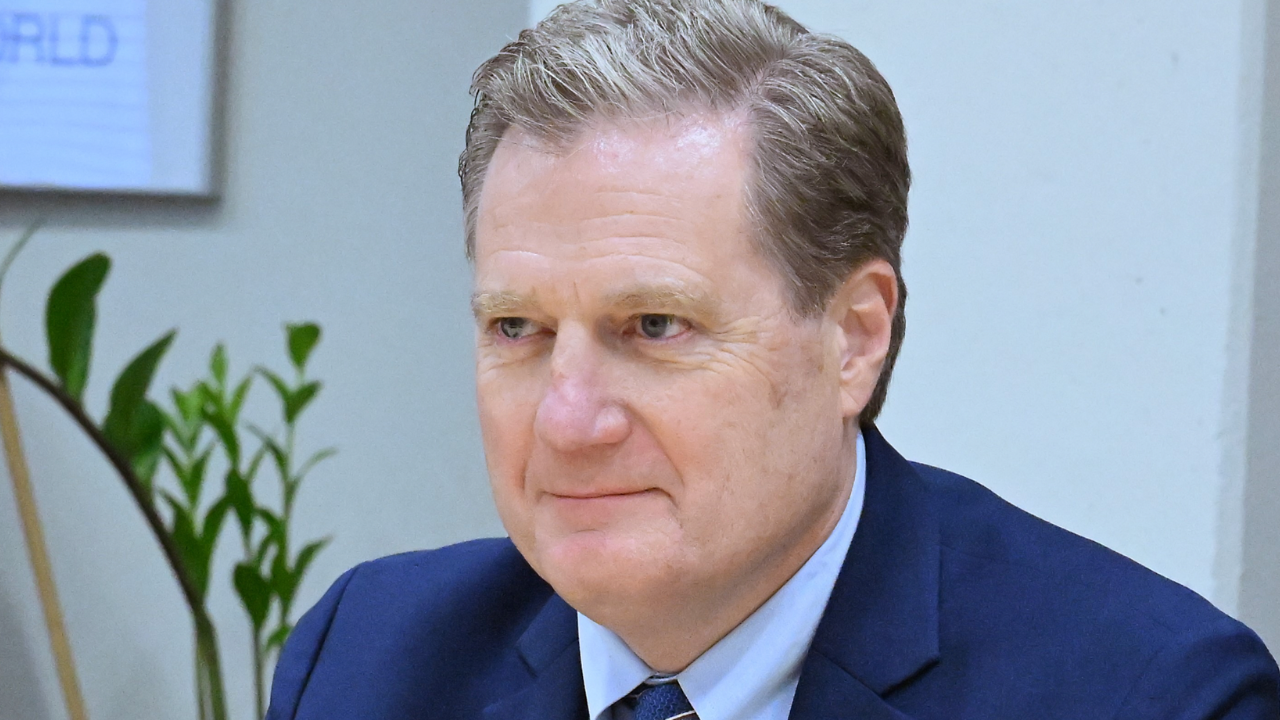
Rep. Mike Turner of Ohio pushed back on the idea that the United States has scaled back its commitment to Ukraine, arguing that a financing arrangement requiring European allies to pay for American-made weapons still keeps Washington actively engaged in the country’s defense.
“There is a belief that the United States has abandoned Ukraine,” Turner wrote on X. “We have not walked away from Ukraine. We must dispel this myth once and for all. The United States is still in the game and actively supporting Ukraine.”
Turner made the comment while sharing a clip of his appearance alongside Hudson Institute Senior Fellow Rebeccah Heinrichs at a July 20 Hudson Institute event debriefing the NATO summit held in Ankara earlier that month. “There’s that misnomer that continues to be said, which is not correct,” Turner said, according to video of the discussion. “The administration, through the PURL program, as you’ve indicated, we’ve required that our European allies fund the program of weapon systems that are going to Ukraine. We’re still in the game and actively supporting Ukraine.”
Turner was referring to the Prioritized Ukraine Requirements List, a mechanism launched in July 2025 under which NATO allies and partner countries finance the purchase of American-made weapons for Ukraine rather than the U.S. government funding and shipping the equipment directly. Under the arrangement, Ukraine identifies critical capability gaps, primarily in air defense, and European governments and Canada commit funding toward packages of U.S. equipment, valued at roughly $500 million each, that the Pentagon then supplies from existing stockpiles or new production.
The program has grown substantially since its launch. Twenty-nine countries, including 26 NATO members and three partner nations, had joined PURL as of its one-year anniversary, with total contributions reaching $6.7 billion and funding more than ten military aid packages, according to a summary from Ukraine’s Ministry of Foreign Affairs. The mechanism has become the dominant channel for certain critical systems, with Ukraine receiving between 90 and 92 percent of its Patriot interceptor missiles through PURL, according to the ministry’s account.
Turner cited the NATO summit’s outcomes as evidence of continued alliance-wide commitment to Ukraine. The official NATO summit overview for the July 7-8 Ankara meeting noted that European allies and Canada now finance the vast majority of security assistance to Ukraine through bilateral and multilateral channels, including a pledge of roughly €70 billion in military equipment, assistance and training for Ukraine in 2026, with allies committing to sustain equivalent support levels in 2027.
Heinrichs, who moderated the discussion, noted that both the U.S. defense industrial base and European contributions to Ukraine’s defense had strengthened. “Our own defense industrial base is improving, and the Europeans really are, no kidding, in a pretty serious way in country in Ukraine, making sure the Ukrainians have what they need,” Heinrichs said.
Turner connected the financing arrangement to the broader diplomatic track, describing Trump’s recent meeting with Ukrainian President Volodymyr Zelensky in positive terms. “It’s great for the president to have said he had a great meeting with Zelensky, and he sees that Ukraine is advancing on the battlefield,” Turner said. “This gives us an opportunity, which was what President Trump’s goal all along has been, for an opportunity for peace negotiations to go forward.”
Turner, a senior member of the House Armed Services Committee who previously chaired the House Permanent Select Committee on Intelligence, was part of a bipartisan congressional delegation that met with Zelensky at the Ankara summit.
Heinrichs directs the Keystone Defense Initiative at the Hudson Institute and served as a commissioner on the congressionally mandated 2023 Strategic Posture Commission, according to her official Hudson Institute biography. She was nominated by President Biden in 2024 to serve as a Republican commissioner on the U.S. Advisory Commission on Public Diplomacy.
The PURL mechanism emerged after the Trump administration wound down direct U.S. military aid shipments to Ukraine following the start of his second term, shifting the funding burden to European governments while keeping American defense contractors as the primary suppliers of the equipment.
Neither the White House nor Ukrainian officials have issued a public response to Turner’s specific remarks.