
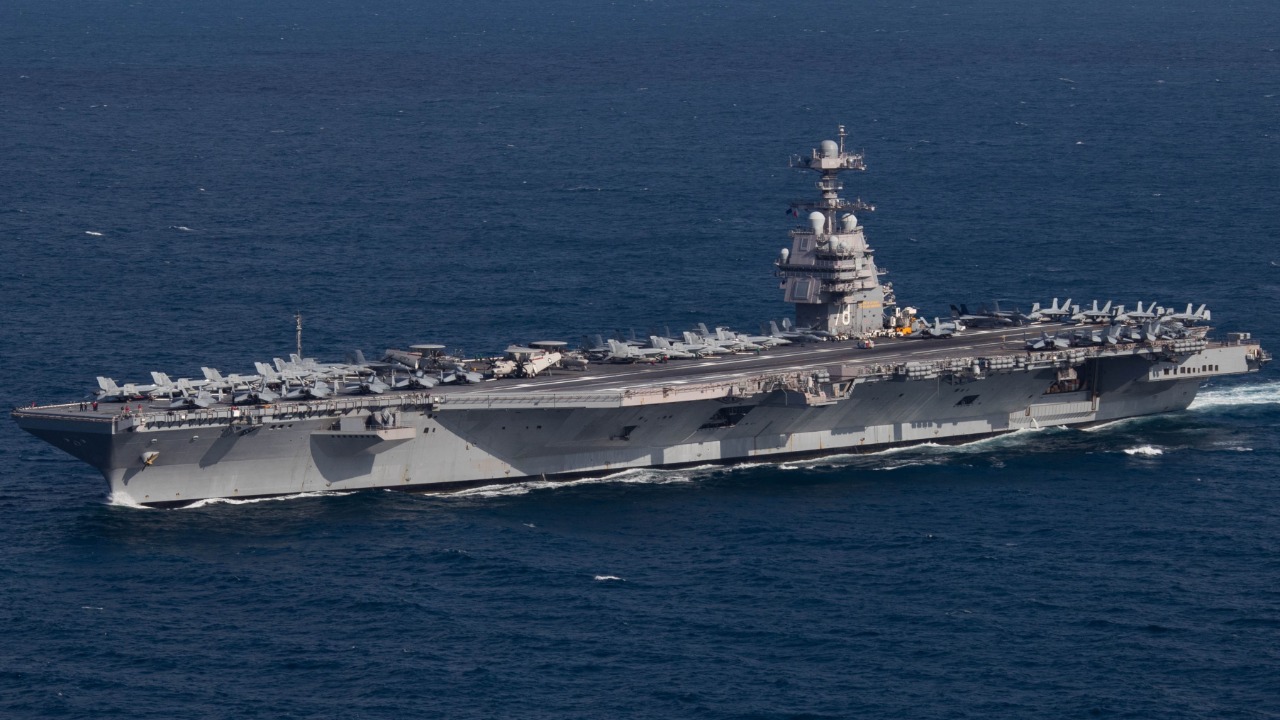
The Navy’s most expensive warship was built to project American power, yet its latest deployment has exposed how fragile that promise can be in practice. The $13 billion USS Gerald R. Ford has been kept on station for months, pushed hard in combat-adjacent operations while struggling with basic systems that sailors rely on every day. The result is a supercarrier tested not only by adversaries and global demand, but by its own unfinished engineering story.
As the ship operates off the coast of Venezuela, the gap between its cutting-edge design and the lived reality for its crew has become impossible to ignore. The Navy is now confronting whether it can sustain this level of strain on a single flagship without eroding readiness, morale, and the credibility of its broader carrier strategy.
From showcase supercarrier to workhorse under strain
The USS Gerald R. Ford was commissioned as the first of a new class of carriers meant to replace the aging Nimitz line, with the Navy promoting it as the largest warship afloat and a symbol of technological advantage. According to the Gerald Ford Foundation’s profile of CVN 78, the Navy Supercarrier USS Gerald R. Ford Is Being Pushed Past the Breaking Point as it shoulders missions once spread across multiple hulls. The ship left Norfolk in June and has now been deployed for seven months, a tempo that would challenge even a mature platform, let alone a first-in-class vessel still working through design kinks.
That extended deployment has unfolded against a backdrop of global demand that has left no aircraft carrier in CENTCOM, increasing pressure on Ford to cover gaps elsewhere. Analysis framed as Global Demands and Navy Posture After the Venezuela Operation argues that the Gerald R. Ford’s 2025 cruise has effectively turned it into a single point of failure for U.S. naval presence. With other carriers like the USS George Washington (CVN-73) tied up in regional duties, as reflected in the USNI News Fleet and Marine Tracker for Jan, Ford has been forced into a role that blurs the line between demonstration platform and operational workhorse.
Venezuela, Operation Southern Spear, and a crowded Caribbean
The current deployment has centered on pressure against the Venezuelan regime, where the USS Ford Aircraft Carrier Is Running Out of Time to attack Venezuela, as one strategic synopsis put it. That analysis, titled The USS Ford Aircraft Carrier Is Running Out of Time, describes how the Navy’s newest carrier, USS Gerald, has been kept in striking distance as Washington weighs options. The ship’s presence has been paired with a broader maritime campaign, including a Maritime Interdiction Operation conducted through Operation Southern Spear, in which the Department of Defense highlighted coordinated efforts to disrupt illicit flows in the region in a Press Release.
Ford is not alone in these waters. Guided-missile cruisers USS Lake Erie (CG-70) and USS Gettysburg (CG-64) are also operating in the Caribbean, according to the Jan entry of the News Fleet and Marine Tracker. Their presence underscores how heavily the Navy has concentrated high-end assets around Venezuela, even as senior leaders caution against stretching the force further toward other flashpoints. A separate policy debate, captured in reporting on the Chief of Naval Operations arguing against sending another carrier toward Iran, reflects a Navy that knows it is already near the edge of what its current posture can sustain, despite SPONSORED material touting Integrating Multi Domain Co concepts.
Toilets, VCHT failures, and the human cost of high-tech design
While strategists focus on deterrence and strike options, sailors aboard Ford have been grappling with a more basic crisis: toilets that do not work. Multiple reports describe a major plumbing headache haunting the $13 billion U.S. carrier off the coast of Venezuela, centered on the ship’s vacuum sewage system, known as VCHT. A detailed account of the problem notes that the sailors who maintain the system, hull maintenance technicians (HTs), fell behind in the months leading up to USS Gerald R. Ford’s current deployment, leaving the crew to endure repeated outages and foul conditions during their months at sea, as described in one report.
The Navy has acknowledged the issue and said Ford will eventually receive VCHT system improvements, but that promise offers little comfort to sailors currently living with the consequences. A document cited in another account shows the ship has been acid flushed at least 10 times since 2023, work that can only be done in port, according to reporting on the maintenance record. One sailor advocate put the stakes bluntly, saying it is important to think about how the Navy is asking sailors to live in these conditions and that leadership should at least ensure basic habitability, a sentiment captured in coverage of crew concerns.
The failures have been so persistent that one viral social media post framed the situation as “NEWS: $13 BILLION U.S. AIRCRAFT CARRIER GROUNDED BY TOILET FAILURES,” describing Broken toilets while operating off the coast of Venezuela and warning that no amount of firepower can intimidate if the crew is worn down by daily indignities, as seen in the widely shared post. The USS Gerald R. Ford’s plumbing woes have become a symbol of how ambitious engineering choices, when not fully matured, can ripple down into the most personal aspects of life at sea, eroding morale even as the ship is asked to perform at the highest operational tempo.
A fleet stretched thin and the limits of a flagship
The strain on Ford is not occurring in isolation, but within a fleet already pulled in multiple directions. With no carrier currently in CENTCOM, the Navy has leaned heavily on the USS Gerald R. Ford, which is being pushed past the Breaking Point, as described in the Gerald Ford Foundation’s overview of recent deployments. Other capital ships, such as the Aircraft carrier USS George Washington (CVN-73) in Yokosuka, Japan, and the guided units in the Caribbean, are tied to their own regional obligations, leaving little slack in the system, as reflected in the fleet tracker entries.