

The biblical Star of Bethlehem has long hovered between faith and astronomy, a luminous mystery that resisted tidy scientific explanation. Now a NASA planetary researcher argues that a specific comet, carefully reconstructed from ancient records, may finally match what the Gospel of Matthew describes more closely than any previous candidate.
By combining historical chronicles, Chinese sky reports, and modern orbital calculations, the scientist contends that a comet in 5 BCE could account for a star that appeared, moved across the sky, and then seemed to “stand still” over Bethlehem. The claim does not settle centuries of debate, but it offers one of the most detailed, testable scenarios yet for what the Magi might actually have seen.
A NASA researcher revives the Star of Bethlehem debate
For generations, astronomers have proposed everything from planetary conjunctions to supernovae to explain the Star of Bethlehem, yet none has fully matched the narrative in Matthew. NASA planetary scientist Mark Matney is now putting forward a different contender, arguing that a specific comet, rather than a fixed star or planetary lineup, best fits both the ancient sky and the biblical description. His work, published in the Journal of the British Astronomical Association, frames the “star” as a real astronomical object that behaved in ways observers of the time could track and interpret as a sign.
According to reporting on his study, Matney identifies a comet recorded around 5 BC as the likely culprit, drawing on historical evidence that points to a bright object visible for several weeks and noted in Chinese records. He suggests that this comet would have been prominent in the pre-dawn sky and could have guided travelers over long distances, aligning with the journey of the Magi toward Bethlehem. Coverage of his research describes how he uses the comet’s apparent path and timing to argue that it could have matched the sequence of events associated with the birth of Jesus in the Gospel of Matthew, including the impression that the star “went before” the wise men and then stopped.
The comet of 5 BCE and the “star that stopped”
The heart of Matney’s case is that a comet in 5 BCE, reconstructed from ancient observations, behaves in a way that can be mapped onto the story of the Magi. A detailed study in the Journal of the British Astronomical Association introduces this comet as a candidate for the Star that the Magi associated with the birth of Jesus, emphasizing how its changing position in the sky could have been interpreted as motion toward a specific region. The analysis notes that the comet brightened and shifted in a way that would have been obvious to skilled skywatchers, who were accustomed to reading celestial events as omens tied to earthly rulers.
The same research explains that as the comet’s apparent motion slowed relative to the background stars, it could have seemed to “stand still” over a particular direction, echoing the language in Matthew that the Star “stopped” over the place where Jesus was. By correlating the comet’s visibility in early June of that year with the likely travel window for the Magi, the study argues that on one particular June day the object would have appeared almost stationary in the sky from the perspective of travelers approaching Bethlehem. Reports summarizing Matney’s work highlight that he treats this “stopping” not as a miracle in the physical sense, but as a natural effect of orbital geometry that would have looked uncanny to observers on the ground.
Ancient records and Chinese skywatchers
To move beyond speculation, Matney and other researchers lean heavily on ancient astronomical records, especially those preserved in East Asia. One report on his findings notes that he points to an object in the sky that was also recorded by the Chinese at the time of 5BC, visible for more than 70 days and described in terms consistent with a comet. These Chinese observations, which carefully logged the position and duration of unusual celestial phenomena, provide independent evidence that a striking object was present in the sky during the period often associated with the birth of Jesus.
Analysis of these records suggests that the comet appeared in a region of the sky that would have been visible from the Near East before dawn, giving the Magi a reliable guide as they traveled westward. A separate examination of ancient astronomical material, cited in coverage of the comet theory, underscores that the object brightened for weeks and then seemed to halt relative to the horizon as its apparent motion changed. This pattern, reconstructed from the Chinese notes and other historical sources, supports the idea that the same comet could have been noticed across cultures, interpreted in China as a portent and in Judea as a sign linked to a royal birth.
Why a comet fits the Gospel of Matthew better than planets
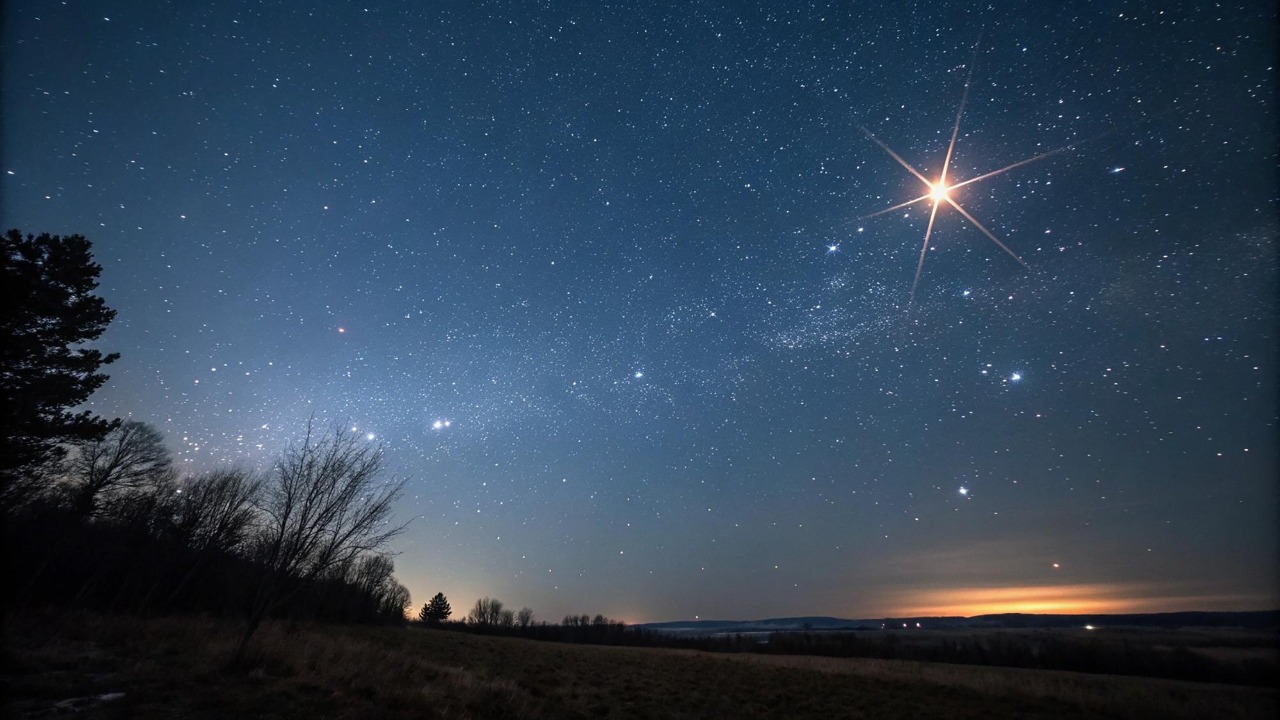
Many earlier explanations for the Star of Bethlehem have focused on planetary conjunctions, such as close pairings of Jupiter and Saturn, or on rare stellar explosions. Matney’s work, and the broader comet hypothesis it builds on, argues that these alternatives struggle to match the narrative details in Matthew. A conjunction, for example, can create a bright point of light, but it does not move across the sky in a way that appears to lead travelers and then come to a stop overhead. A supernova or nova can linger for weeks, yet it remains fixed relative to the background stars, offering no sense of directional guidance beyond its general position.
By contrast, a comet naturally changes position night by night, rising earlier or later and shifting against the constellations, which could be interpreted as motion toward a destination. Reporting on Matney’s argument notes that he explains how a comet could appear to move ahead of the Magi as they journeyed, then seem to pause when its apparent motion slowed near the horizon, creating the impression that it had “stood still” over Bethlehem. Another analysis of the Star of Bethlehem question points out that astronomers have long sought a cosmic explanation that can both shine brightly and then appear to come to a stop overhead, and that a comet with the right orbit and timing satisfies those conditions more convincingly than a planetary lineup.
A 2,000-year mystery meets modern orbital science
The Star of Bethlehem has often been framed as a “2,000-year” mystery, a phrase echoed in coverage of Matney’s proposal that a NASA astronomer may have finally uncovered the true identity of the star over Bethlehem. What distinguishes this latest effort from earlier theories is the combination of textual analysis, historical cross-checking, and modern orbital modeling. By treating the Gospel account as an observer’s report and then testing it against known comet behavior and ancient records, Matney is effectively running a forensic investigation of the night sky around the time of Jesus’s birth.
Reports on his study describe how he reconstructs the likely path of the 5 BCE comet, compares it with the travel route of the Magi, and evaluates whether the timing aligns with the events surrounding Jesus’ birth as described in Matthew. A separate piece on the comet theory emphasizes that the goal of this kind of work is not to prove or disprove matters of faith, but to see whether a natural phenomenon can plausibly underlie a story that has shaped religious imagination for centuries. In that sense, the new research does not close the case on the Star of Bethlehem, but it does narrow the field, giving both believers and skeptics a concrete, historically grounded candidate to consider.
What this means for faith, history, and future research
As a reporter looking at this debate, I see Matney’s comet proposal less as a final verdict and more as a sophisticated bridge between ancient text and modern science. The idea that a real comet in 5 BCE could have inspired the Star of Bethlehem narrative allows historians, theologians, and astronomers to talk in shared terms about what the Magi might have witnessed. It respects the Gospel of Matthew as a record of an extraordinary experience, while also insisting that the sky obeyed the same physical laws then as it does now.
The reaction from the scientific community, as reflected in broader coverage of the Star of Bethlehem question, suggests that the comet theory will spur further work rather than end the conversation. Astronomers continue to refine models of ancient comets, historians keep reassessing the chronology of Jesus’ birth, and analysts of ancient records look for additional corroborating notes in Babylonian, Roman, or Chinese archives. Whether or not the comet of 5 BCE is ultimately accepted as the Star of Bethlehem, the research underscores how much can still be learned when modern tools are applied to questions that have lingered for two millennia, and it shows that even a story as familiar as the Nativity can still yield new insights when the night sky is treated as a primary source.