
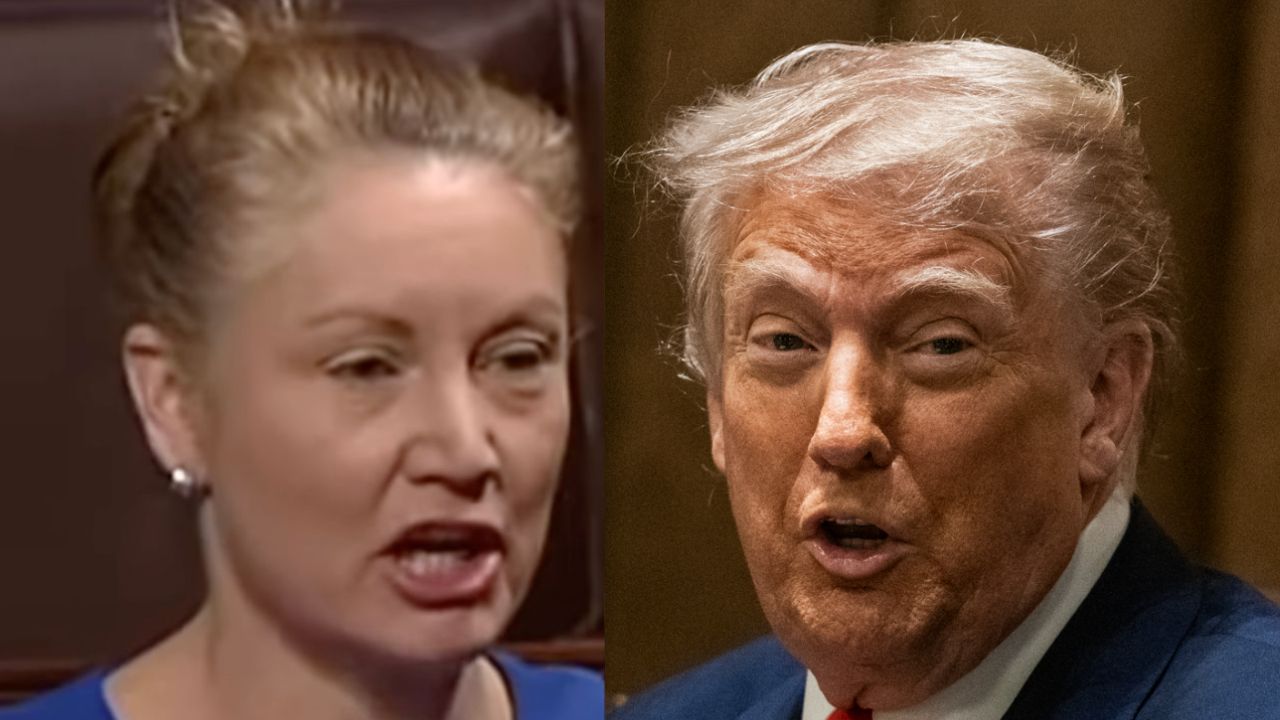
WASHINGTON — Rep. Melanie Stansbury said Friday that “federal law prohibits armed troops at polling places, interference, and using government power to undermine our elections,” after she quoted an account of outside advisers urging President Donald Trump toward martial law for the midterms.
Stansbury, a New Mexico Democrat who represents the 1st District, posted the statement on X on Sept. 25. She quoted a FactPost item that summarized a Sept. 23 Atlantic report. She wrote, “The law is clear,” and added, “We will not be intimidated. Know your rights! Make a plan. We must protect the right to vote.”
The law is clear! Federal law prohibits armed troops at polling places, interference, and using government power to undermine our elections. We will not be intimidated. Know your rights! Make a plan. We must protect the right to vote.
The statute she invoked is 18 U.S.C. § 592. It makes it a crime for an officer “in the civil, military, or naval service of the United States” to order, bring, keep, or control “any troops or armed men at any place where a general or special election is held, unless such force be necessary to repel armed enemies of the United States.” The penalty is a fine, up to five years in prison, or both, and disqualification from federal office. A companion statute, 18 U.S.C. § 593, bars members of the armed forces from fixing voter qualifications, preventing a qualified voter from voting, compelling an election officer to accept an unqualified ballot, imposing different election regulations, or interfering with an election officer’s duties.
A civil provision, 52 U.S.C. § 10102, says no officer of the Army, Navy, or Air Force “shall prescribe or fix, or attempt to prescribe or fix, by proclamation, order, or otherwise, the qualifications of voters in any State, or in any manner interfere with the freedom of any election in any State.” The Justice Department’s election-fraud fact sheet lists the same conduct under § 592: “Ordering, keeping, or having under one’s control any troops or armed men at any polling place in a general or special election, if one is a civil or military officer or employee of the United States government.” The department’s Federal Prosecution of Election Offenses manual says “the federal prosecutor has no authority to send FBI Special Agents or Deputy U.S. Marshals to polling places” and cites § 592.
The Atlantic article described outside advisers, including attorney Peter Ticktin, radio host Wayne Allyn Root, and former Colorado clerk Tina Peters, as urging the president to take control of federal elections. Ticktin told the magazine one option was that Trump “tries to declare martial law on or around November 3.” The same article quoted a White House official as saying Ticktin, Root, and Peters play no role in election policy at the White House, and a Justice Department spokesperson as saying there are no plans “to declare certified voting equipment unreliable or unusable absent credible, verified evidence and the legal process for doing so.” Stansbury’s post did not name those advisers.
Chairman of the Joint Chiefs of Staff Gen. Dan Caine addressed the military question in writing. Sen. Elissa Slotkin, D-Mich., said Caine confirmed the Joint Force has “no plans to send Federal military personnel or Federalized members of the National Guard to polling places during the 2026 elections” and “no plans to use such personnel to seize ballots, voting machines, or other election-related material.” Slotkin’s Aug. 31 release also quotes Caine as writing that election administration and security “remain the fundamental responsibility of state and local officials” and that he had “neither received nor anticipate receiving any unlawful order concerning the role of the Joint Force in the upcoming November 2026 midterm elections.” Slotkin said Defense Secretary Pete Hegseth had not replied. On Sept. 1 she sent a follow-up letter to National Guard Bureau Chief Gen. Steven Nordhaus asking for the same confirmation.
Homeland Security Secretary Markwayne Mullin has drawn a different line for ICE. At his March confirmation hearing he told Slotkin officers would be at a polling place only for a “specific threat,” not for intimidation. At a Sept. 1 news conference carried by C-SPAN he said, “ICE isn’t there to patrol the polling places. We’re there to enforce specific threats,” and that agents would be present “if there is a threat to that polling place or we’re serving a warrant on someone that we have been actively tracking down.” House Homeland Democrats had already cited §§ 592, 593, 594, and 595 in a July 16 letter asking Mullin for documents on any plan to put department personnel at the polls.
FBI Director Kash Patel, at a Senate Judiciary hearing, declined to give an across-the-board pledge that bureau agents would not be at polling places. Rep. Raja Krishnamoorthi, D-Ill., cited § 592 in a Sept. 17 letter to Attorney General Todd Blanche after that testimony. Slotkin in June introduced the Protect Our Polls Act, which would require a joint resolution of approval before the president could use the “repel armed enemies” exception in § 592. New Mexico’s 1st District votes Nov. 3.