
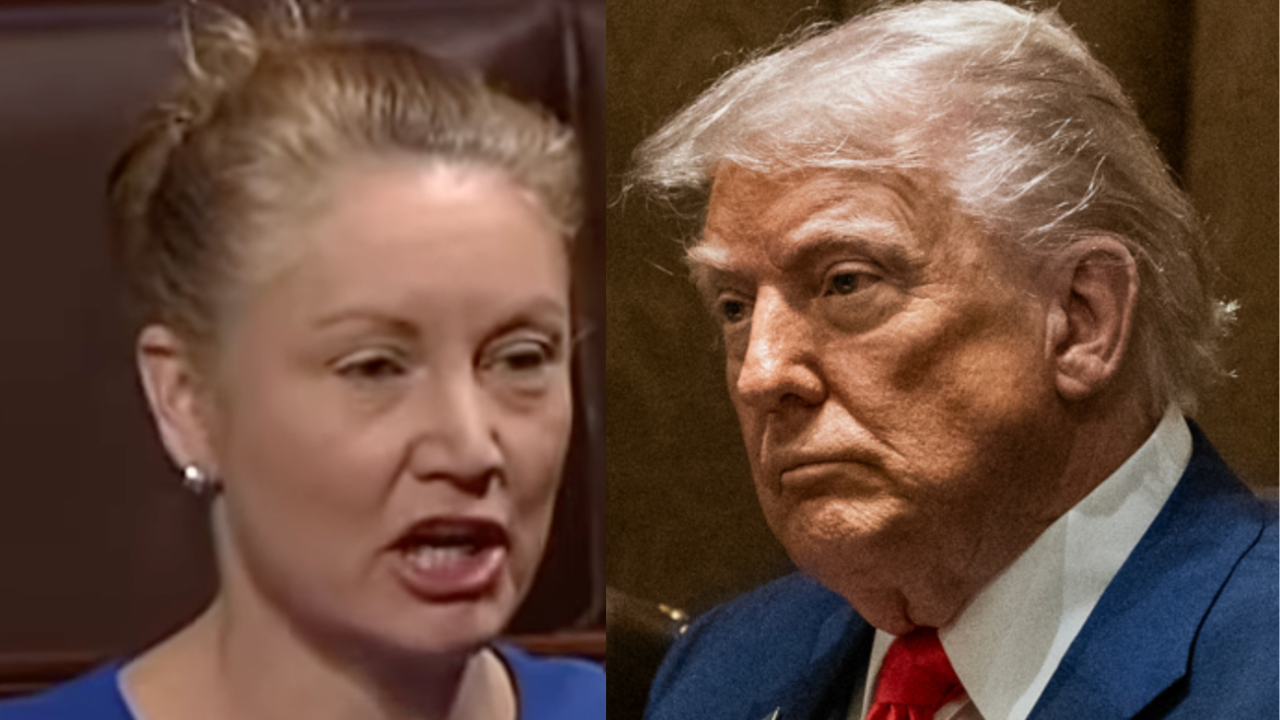
U.S. Representative Melanie Stansbury (D-NM) accused President Donald Trump of enriching himself in office while ordinary Americans fall further behind, tying his personal financial windfall directly to what she called an “illegal war” and taxpayer-funded “vanity projects” in Washington, D.C. The New Mexico Democrat made the accusation in a post on X published Thursday morning, July 30, 2026, framing it as the backdrop for her own legislative fight over housing, healthcare, and food access back home.
Stansbury’s full post, published at 10:22 AM on July 30, read:
“While hard-working Americans are working multiple jobs and struggling to put food on the table and a roof over their heads—this is what the President is busy doing in the White House: GETTING RICH. Meanwhile, he’s spending your taxpayer dollars on an illegal war and vanity projects in DC. This is not ok! That’s why we are fighting here in NM to address housing, healthcare, food, and the needs of our hard-working people!”
The post linked to a New York Times investigation published July 23, 2026, examining how Trump’s business empire has transformed during his second term. The investigation drew on Trump’s federal financial disclosures, which do not state an exact net worth but do detail how much revenue his businesses generate annually.
The Times’ analysis found that in 2017, during Trump’s first term, nearly 90 percent of his business revenue came from his domestic golf and real estate holdings. By the first year of his second term, that picture had shifted dramatically. His businesses expanded most sharply in sectors where he now wields direct governmental power and influence, chief among them cryptocurrency. According to the investigation, Trump earned nearly $800 million from his family’s crypto venture, World Liberty Financial, and another $636 million from his $TRUMP memecoin — categories that generated no revenue at all in 2017.
The Times also found that foreign golf and real estate deals, including several projects in the Middle East, brought in $125 million, more than double what similar foreign business generated in 2017, despite Trump having barred his company from signing new foreign deals during his first term. Legal settlements added as much as $117 million to his 2025 income, largely from media and technology companies including CBS and Meta, with some of those proceeds redirected to his presidential library and a nonprofit supporting the National Mall. Merchandise and publishing, including Trump-branded watches and a special-edition Bible, brought in about $17 million — nearly 18 times what those categories generated in 2017 after adjusting for inflation. By contrast, his core domestic golf and real estate business grew only about 4 percent over the same period, the Times found.
In response to the Times’ findings, Trump told the paper that despite limiting his company’s dealmaking during his first term, “I got absolutely no credit.” White House spokeswoman Anna Kelly defended the president’s business activity in a statement to the Times, saying Trump “was a massively successful businessman prior to becoming president, which was why he was elected to office in the first place,” and that the administration maintains there are no conflicts of interest between his financial holdings and his official actions.
Stansbury’s reference to an “illegal war” points to the ongoing U.S. military conflict with Iran, which began February 28, 2026, when the United States and Israel launched strikes against Iranian targets. Stansbury condemned the strikes the same day, stating that Trump had launched them “without congressional authorization—endangering regional stability, American service members, and U.S. national security,” adding, “Make no mistake—this is illegal.”
On March 5, 2026, Stansbury voted for a War Powers Resolution aimed at forcing Trump to remove U.S. forces from the conflict, a measure that ultimately failed in the House. In her statement on the vote, she said Trump’s “reckless, unlawful, and unauthorized strikes in Iran have already cost the lives of six American Service members and over 200 civilians,” and argued that a classified administration briefing had left her “with more questions than answers,” with no clear justification for the strikes, no identified imminent threat, and no plan for regional stabilization. She called the conflict “a betrayal—as countless Americans are struggling to put a roof over their heads and food on the table.”
The war has continued despite that vote. By July 22, 2026, it had killed 18 U.S. service members and injured hundreds more, with the Pentagon putting its cost at approximately $37.5 billion through the end of the current fiscal year. A separate House vote in July directed Trump to remove forces from the conflict, but a companion measure was blocked in the Senate, leaving the military campaign in place without a formal congressional authorization.
Stansbury’s “vanity projects” reference points to a cluster of large-scale construction efforts Trump has pursued in Washington, D.C. since returning to office, most prominently a new White House East Wing ballroom. First announced in mid-2025 with an estimated $200 million price tag to be covered by private donations, the ballroom’s projected cost has climbed steadily — reported at $400 million by Trump himself in a Truth Social post, and later cited by contractor Clark Construction at roughly $600 million, with $293 million described as coming from private sources and the remainder, more than $300 million, drawn from taxpayer-funded accounts including the Secret Service and the White House Military Office. Other estimates, including one from the Financial Times, put the combined cost of the ballroom and its associated security infrastructure at closer to $800 million.
The ballroom is one of several such projects. Congress has also approved $40 million in taxpayer funds toward a planned statue garden, while a 250-foot triumphal arch proposed for the stretch between the Lincoln Memorial and Arlington National Cemetery has drawn a lawsuit from Vietnam War veterans who argue it would obstruct the cemetery’s view. Renovations to the Lincoln Memorial Reflecting Pool have run at least $12 million over budget. Combined, outside estimates have placed the full cost of Trump’s Washington construction projects — combining private donations and public funds — at more than $1 billion. Polling cited in press coverage found that a majority of Americans oppose both the ballroom and the arch.
House Minority Leader Hakeem Jeffries has separately described the ballroom project as a “vanity project,” and Senate Minority Leader Chuck Schumer criticized a related funding package that included $1 billion for White House security enhancements, saying “Republicans are on a different planet than American families.”
Stansbury’s concerns about Trump’s personal finances are not limited to Thursday’s post. She has joined Senators Elizabeth Warren (D-MA) and Richard Blumenthal (D-CT) in a monthslong investigation into as much as $63 million in corporate legal settlement payments — from ABC, Meta, X, and Paramount — that were pledged to a fund supporting Trump’s future presidential library. The lawmakers found that the fund, the Donald J. Trump Presidential Library Fund, Inc., was administratively dissolved in September 2025 after failing to file a mandatory annual report, and that as much as $21.5 million of the pledged donations remains unaccounted for. In a joint statement, the lawmakers wrote that “the Fund is now gone, and the public has no clarity about the current location or purpose of the funds provided.”
Back in New Mexico, Stansbury has continued to press for federal investment in the district she represents. She has submitted tens of millions of dollars in Community Project Funding requests aimed at expanding access to housing, healthcare, food assistance, and public safety resources, and has said the funding process is one of the few tools available to counter administration-level cuts to programs her constituents rely on. In her own words describing that effort, “As the Administration targets funding and resources our communities depend on, Community Project Funding is one of the most powerful tools we have to deliver investments necessary to support lasting and generational change for communities across our state.”
Thursday’s post places Stansbury among a growing number of congressional Democrats who have sought to draw a direct line between Trump’s personal financial gains, the cost of an unauthorized military conflict, and elective construction spending in the capital — all while arguing that everyday costs for housing, food, and healthcare continue to climb for working Americans. Neither the White House nor Stansbury’s office had issued additional comment specific to the July 30 post at the time of publication.