
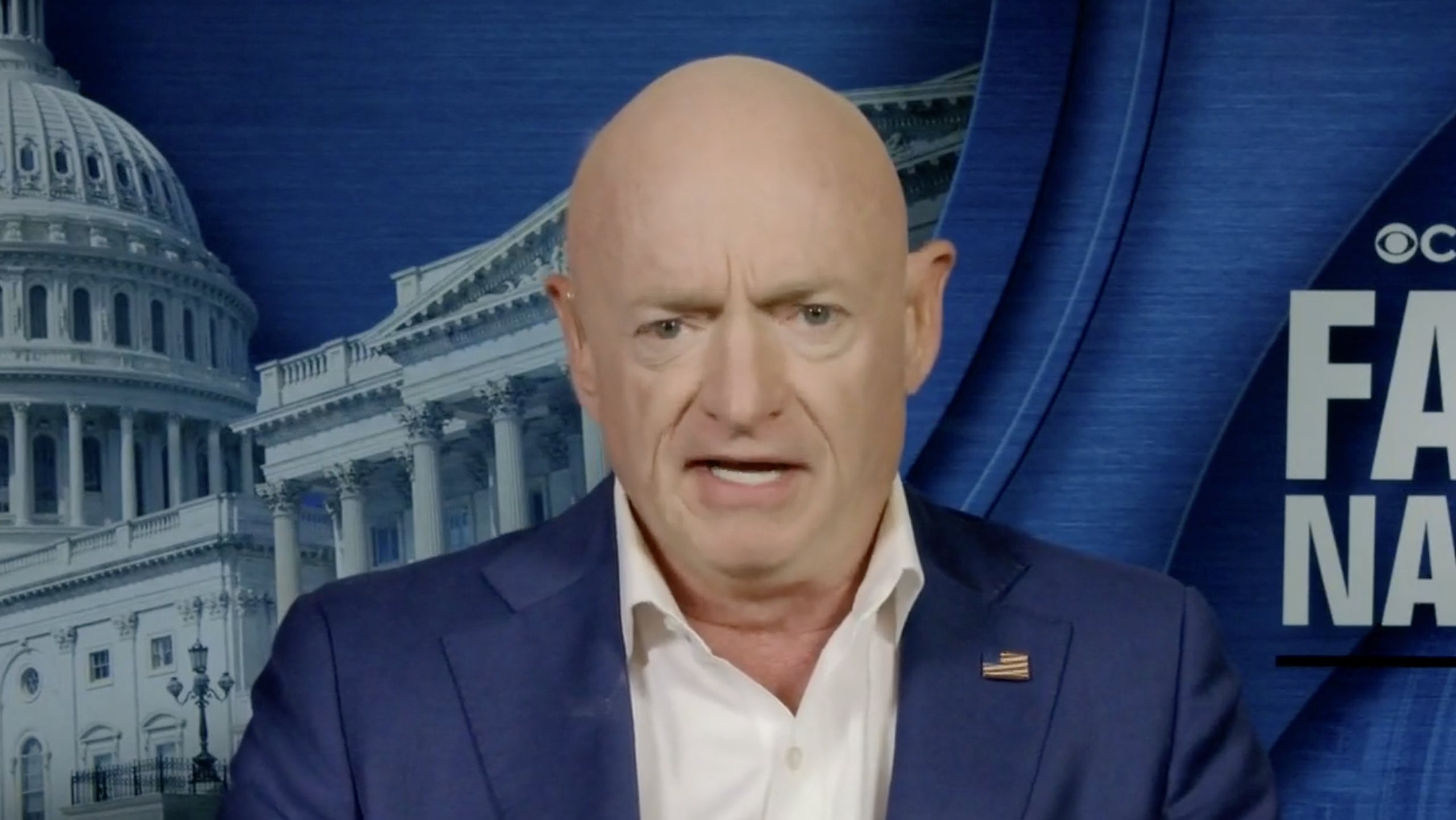
Senator Mark Kelly is arguing that one of the primary barriers to ending the war in Ukraine is President Donald Trump’s own conduct — saying Trump refuses to press Putin, has backed off on sanctions, and has failed to provide Ukraine with the support it needs to reach a durable peace, despite Ukrainian and American desire for the conflict to end.
“Nobody wants this to end more than the Ukrainian people,” Kelly told CBS News’s Face the Nation on May 10. “I think one of the barriers to peace is that Donald Trump has not provided the support to the Ukrainian government, the Ukrainian people, that Ukraine needs. He often… we’ve seen this over and over again, how he’s got this odd relationship with Putin. He refuses to press Putin. He’s backed off on sanctions. He’s not put the pressure on the Russian government with the tools that we actually have to get an outcome and get this conflict to end.”
Kelly’s Planned Ukraine Trip
Kelly’s assessment carries institutional weight. He sits on both the Senate Armed Services Committee and the Senate Intelligence Committee, receiving classified briefings on both the Ukraine and Iran conflicts. He announced on Face the Nation that he will travel back to Ukraine in approximately three weeks to meet with government officials and hear firsthand from the Ukrainian people about the status of the conflict.
This would be at least his second trip to Ukraine since Russia’s full-scale invasion began in February 2022. Kelly has been one of the most consistent Senate advocates for continued U.S. military support for Ukraine, and his planned visit signals that Democratic oversight of the Ukraine conflict has not been displaced by the Iran war — even as the administration’s attention has been largely consumed by the Middle East.
The Sanctions Argument — What Kelly Is Referring To
Kelly’s claim that Trump has “backed off on sanctions” is backed by a documented record. The Trump administration’s proposed 28-point Ukraine peace plan — analyzed provision by provision by the Center for Strategic and International Studies — includes an explicit provision to “reintegrate Russia into the global economy” through lifting sanctions “in stages and on a case-by-case basis” and inviting Russia to rejoin the G8. The plan also proposes a long-term U.S.-Russia economic cooperation agreement covering energy, natural resources, Arctic rare earth extraction, and AI infrastructure.
The pattern Kelly is describing — Trump turning screws on Ukraine while letting Russia off easy — is documented in independent analysis by the Carnegie Endowment for International Peace, which found that only once in the past year had Trump attempted to put meaningful pressure on Moscow — when the Treasury Department sanctioned two Russian oil companies in October 2025. Since then, Carnegie found “there is no sign that Putin feels compelled to moderate his demands.” Russia has continued obliterating Ukraine’s energy infrastructure while Trump has blamed Ukraine for lagging peace talks.
The Iran Sanctions Parallel
Kelly made a related point when Margaret Brennan asked about Trump’s sanctions on Chinese entities supplying satellite imagery to Iran. Kelly noted that the same logic — sanctions as a tool to get outcomes from adversaries — applied directly to Russia and Ukraine. “This administration is not using the sanctions power it has with regards to Russia,” he said. “We’re trying to get them to put more sanctions on Russia, and this administration has been lifting sanctions on the Russians.”
The Council on Foreign Relations has called Trump’s peace plan a potential “Faustian bargain” — noting that it allows the Kremlin to avoid meaningful pressure from the United States and Europe at precisely the moment when a bipartisan sanctions bill in Congress was making progress. “Putin is simply not interested in genuine negotiation,” CFR’s Liana Fix wrote. “Russia is stalling to gain advantage on the ground while Russian forces grind slowly forward in eastern Ukraine.”
Putin’s “Coming to an End” Comment — What Kelly Makes of It
Brennan asked Kelly to interpret Putin’s statement — made during a three-day ceasefire for a prisoner exchange and his Victory Day parade — that the Ukraine conflict “may be coming to an end.” Kelly called it a “positive statement” but declined to read too much into it. “We want this to end. They want it to end,” he said of Ukrainians. His caution reflects a widely-held assessment among Western analysts: that Putin’s rhetorical gestures toward peace have consistently been used to buy time on the battlefield while his forces continue to advance.
The three-day ceasefire itself was granted by Putin to allow his Victory Day parade to proceed — a request he reportedly made to Trump directly. As the Wall Street Journal documented, the parade was dramatically scaled back — no armored vehicles, no military cadets, cellphone service disrupted across Moscow — because of Ukrainian drone threats. The same leader who asked Trump for a ceasefire to protect his parade is, in Kelly’s framing, not being adequately pressured to reach a genuine peace.
McConnell’s Alignment With Kelly’s Position
Kelly’s argument is not a partisan Democratic position — it is one shared by senior Republicans. At Tuesday’s Senate Appropriations hearing, McConnell told Hegseth directly that U.S. military aid approved for Ukraine should “reach their destination without further delay” and that the U.S. has “things to learn from our friends” — specifically citing Ukraine’s success in drone warfare. McConnell, who voted against Hegseth’s confirmation, also said strained relationships with democratic allies “only serves our adversaries’ interests” — language that aligns directly with Kelly’s argument that Trump’s approach to Russia has weakened rather than strengthened the U.S. negotiating position, according to the Senate Appropriations Committee.
The Iran War Distraction
Kelly’s Ukraine remarks arrived in the context of a Face the Nation interview primarily focused on the Iran war — and the two conflicts are now deeply intertwined. The weapons being consumed in the Iran war were largely the same systems Ukraine needs — Tomahawks, Patriot interceptors, ATACMS. The Russian oil revenue windfall from the Hormuz closure has given Moscow a financial cushion that reduces Putin’s economic incentive to reach a deal. And the diplomatic bandwidth of the Trump administration has been consumed by Iran, Islamabad, and Beijing — leaving Ukraine and its partners to manage largely without sustained American diplomatic engagement.
“This administration has done exactly the opposite” of what Trump promised on war and costs, Kelly told Brennan, summarizing both the Iran and Ukraine situations in a single sentence. He promised no new wars and lower prices — he started a new war, drove prices up, and is now, in Kelly’s telling, failing to end either conflict because he is unwilling to use the tools America actually has against the adversaries that are blocking peace. He will carry that argument to Kyiv in person in approximately three weeks.