
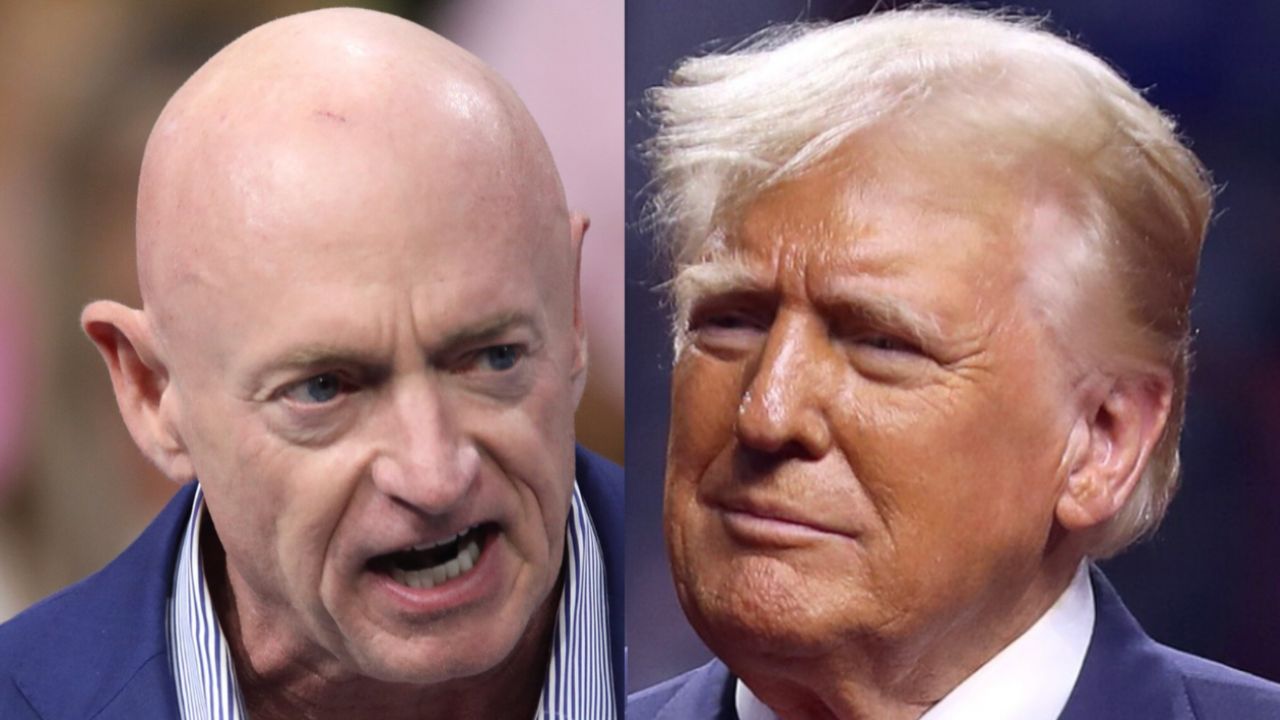
Arizona Democratic Sen. Mark Kelly accused President Donald Trump on Tuesday of improvising his handling of the war with Iran without a coherent strategy, pointing to the president’s shifting and often contradictory public statements about the conflict’s status as evidence that the administration does not have a plan.
Kelly’s remarks, posted to X at 12:16 p.m. on September 8, came in direct response to a Truth Social post from Trump the previous evening in which the president predicted gas prices would fall “precipitously” once the United States “WINS” the war with Iran. Kelly’s full post read:
“Last week, it wasn’t even a ‘war’ according to Trump. Before that, he’s said dozens of times that Iran was totally defeated already. Trump is making it all up as he goes because he has no idea what he’s doing — and it’s raising your costs and making our country less safe.”
Trump’s Original Post Promised Gas Below $2 A Gallon
Trump’s Monday evening Truth Social post, published at 6:16 p.m., tied any relief at the pump to a future military outcome in Iran.
“Oil prices will drop precipitously, like everything else is dropping (but more!), when we WIN the war with Iran. Three Dollars a gallon, but ultimately, below Two Dollars a gallon. It will all happen quickly, and Iran will never have a Nuclear Weapon. MAGA! President DJT,” Trump wrote.
A War Trump Has Called Both Over And Not A War
Kelly’s reference to the war “not even” being described as a war points to comments made by Vice President JD Vance in the days before Trump’s gas price post. Vance argued the ongoing hostilities with Iran should not be characterized as a war, a position Trump defended on September 7, when he called the conflict “small potatoes” while backing Vance’s framing. The dispute over terminology arrived even as fighting has continued into its seventh month, with Iran claiming retaliatory strikes against U.S. forces in Kuwait, Jordan and the United Arab Emirates as recently as September 2 and 3.
The “totally defeated” language Kelly cited traces back to some of Trump’s earliest declarations of victory in the conflict. Speaking in Hebron, Kentucky, on March 11 — less than two weeks after Operation Epic Fury began on February 28 — Trump told supporters, “We won. We won. In the first hour it was over, but we won.” He repeated the claim from the Oval Office on March 24, telling reporters Iran was “totally defeated” while discussing the prospects of a peace deal.
Trump declared victory again on April 8, telling Agence France-Presse the outcome was “100%. No question about it,” a claim Defense Secretary Pete Hegseth echoed the same day, calling the operation “a historic and overwhelming victory on the battlefield, a capital-V military victory.” By June 15, Trump declared the conflict resolved for a third time, writing that a deal with Iran was “now complete” and that the Strait of Hormuz would reopen. Fighting resumed in the weeks that followed, and by early September the war remained active.
Kelly Has Repeatedly Challenged The Administration’s Iran Strategy
Tuesday’s post is the latest in a sustained pattern of criticism Kelly, a retired Navy combat pilot and member of the Senate Armed Services and Intelligence Committees, has directed at the administration since the war began. In a statement released the day Operation Epic Fury launched, Kelly said the United States had “seen this playbook before,” warning of “weeks of inflated claims, selective facts, and talk of imminent threats” reminiscent of prior wars, and said the central question was “whether the mission makes sense and makes us safer — and what it’s going to cost.”
In March, during a Senate Armed Services Committee hearing, Kelly pressed Pentagon policy official Elbridge Colby on what he described as contradictions between the administration’s public threat assessments and its own National Defense Strategy, noting that American service members had already died “based on this notion that Iran posed an imminent threat to the United States.”
In a Senate Intelligence Committee hearing in March, Kelly also questioned Director of National Intelligence Tulsi Gabbard on whether Trump had been fully briefed on the risks of a Strait of Hormuz closure before ordering strikes, and separately raised concerns that loosened sanctions tied to the conflict could be financially benefiting Russia.
Casualty Reporting And War Powers Disputes
In June, Kelly joined Senate Minority Leader Chuck Schumer, Sen. Tim Kaine and more than 30 other Senate Democrats in a letter disputing the administration’s legal claim that hostilities in Iran had “terminated,” arguing the war had already exceeded the statutory deadline set by the War Powers Resolution and demanding release of the Office of Legal Counsel opinion underlying the administration’s position.
In July, Kelly joined a group of Democratic senators in a letter to Hegseth, Joint Chiefs Chairman Gen. Dan Caine and other Pentagon leadership demanding a “full and accurate accounting” of American troops killed, wounded or injured in the war, citing inconsistencies between the Pentagon’s public casualty figures and official statements.
Kelly Has Directly Linked The War To Rising Costs Before
Tuesday’s post was not the first time Kelly connected the war to the price Americans are paying at the pump. In an August appearance on NBC’s “Meet the Press,” Kelly said, “This thing has been a disaster, and it’s been a disaster for the American people in a time when they couldn’t afford their lives. This president gets us into this war and costs then continue to skyrocket,” citing gas prices of $4.50 a gallon in Arizona at the time. A day earlier, on CBS’s “Face the Nation,” Kelly said of the administration’s approach to the war, “They’re flailing, they’re stuck, they’re responsible for this, and the president is the one that has to try to figure out a way out of this.”
Gas Prices Remain Nowhere Near Trump’s Predicted Range
The national average price for regular unleaded gasoline stood at $4.15 a gallon as of September 7, according to AAA, up from $4.14 the previous week and roughly 25% higher than a year earlier. Diesel prices reached $5.90 a gallon the same day, also a significant increase from year-ago levels. California continued to post the highest prices in the country, above $5.80 a gallon, while Indiana remained the cheapest state at roughly $3.45. Gas prices peaked in 2026 at $4.55 a gallon in May before easing slightly, but have not approached the $3 or sub-$2 figures Trump predicted in his Monday post.
Broader Political Context Heading Into Midterms
The exchange between Kelly and Trump comes as energy costs and the unresolved war have become recurring themes in the run-up to the November midterm elections. CBS News polling in August found the war unpopular among Americans overall, with 32% saying they trusted Trump and Republicans to handle Iran better compared with 30% who favored Democrats. Kelly, seen by some political observers as a potential 2028 presidential contender, has used his committee positions on Armed Services and Intelligence to press administration officials on the war’s cost, strategy and legal basis in a series of public hearings throughout the year.
Neither the White House nor Kelly’s office issued additional statements specifically addressing Tuesday’s exchange as of publication.