
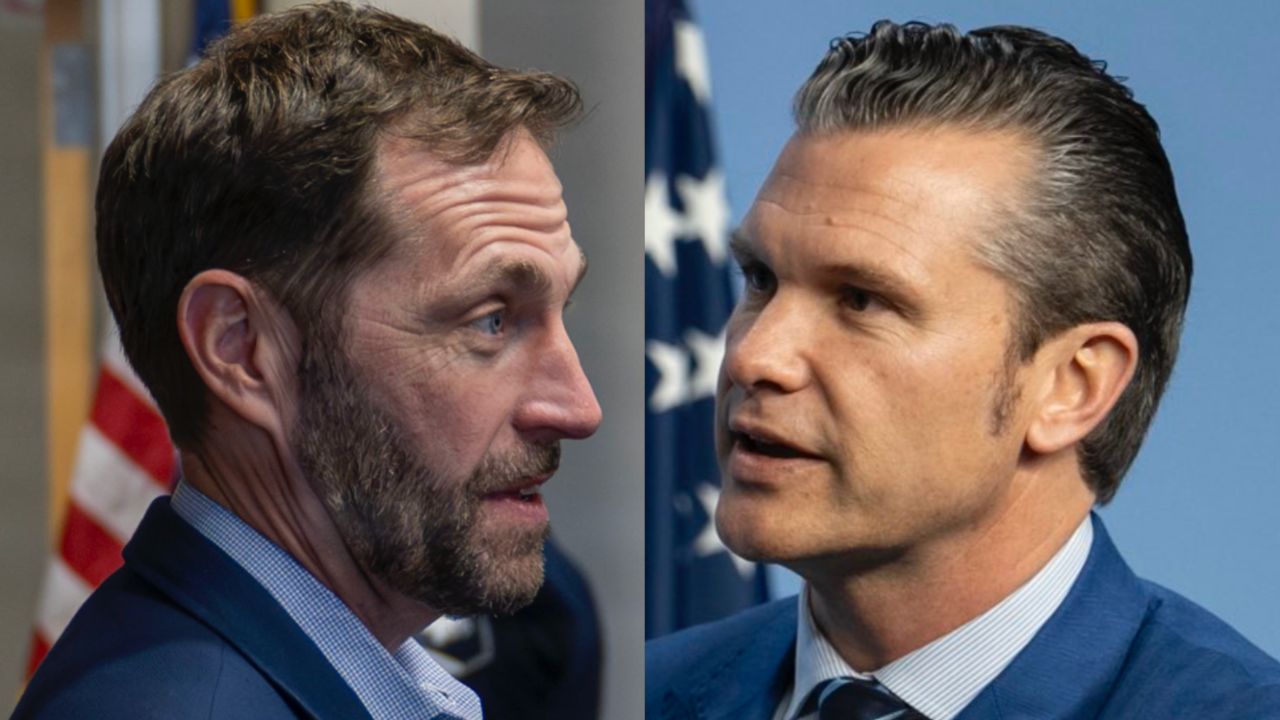
U.S. Representative Jason Crow (D-CO-06), a former Army Ranger and paratrooper who serves on the House Armed Services Committee and House Permanent Select Committee on Intelligence, accused Defense Secretary Pete Hegseth on Tuesday of endangering the country by systematically removing qualified military generals in a purge the congressman says has targeted women, people of color, and officers deemed insufficiently loyal to Hegseth personally.
Crow posted the accusation on X on the morning of September 8, 2026. His full post read:
“Americans aren’t idiots.
Pete Hegseth is making us less safe by purging qualified military generals.
He’s targeting women, people of color, and anyone who isn’t loyal to him.”
The post is Crow’s latest broadside against Hegseth, whom the Colorado Democrat has criticized repeatedly and publicly since early 2025 over his handling of the Pentagon’s senior leadership, his management of classified information, and what Crow characterizes as a pattern of retaliation against officers who fail undefined loyalty tests. Crow’s Tuesday post did not elaborate further on specific names or incidents, but it arrives amid a monthslong pattern of statements from his office making substantially the same core allegation.
A Pattern of Public Accusations
Crow’s Tuesday statement echoes remarks he made just two days earlier during an appearance on CBS’s “Face the Nation with Margaret Brennan” on September 6, 2026. Asked about reports that dozens of senior military officials, including combatant commanders, had been subjected to polygraph tests as part of a Hegseth-ordered leak investigation, Crow said Congress had received no briefing on the probe. He then broadened his criticism to Hegseth’s overall record at the Pentagon, telling Brennan that Hegseth “has purged over 80 generals and admirals,” which Crow said amounted to “the top 10% of the entire military chain of command.” Crow added that the military was “at a 25-year low for the number of women on the promotion list” under Hegseth’s leadership, and said the secretary “has created an environment of fear,” pointing to the ousting of journalists and media access at the Pentagon as part of what he called Hegseth’s “effort to create fear and to clamp down on information.”
The Parlatore Conflict-of-Interest Dispute
Crow’s concerns about Hegseth’s influence over senior promotions predate this week’s statements. In May 2026, Crow directly questioned Hegseth during a House Armed Services Committee hearing about Tim Parlatore, a special adviser to the secretary who also maintained a private legal practice representing outside clients. Crow pressed Hegseth on whether Parlatore represented military officers under consideration for promotion, a line of questioning Hegseth rebuffed at the time, telling the committee “he doesn’t represent anyone” and that “the only person that makes determinations about senior officers is me.”
That exchange resurfaced in August 2026, when Crow’s office cited New York Times reporting indicating that Admiral Daryl Caudle had hired Parlatore to help resolve a Pentagon inspector general investigation that stood in the way of his promotion to Chief of Naval Operations. Crow said the reporting “contradicts Hegseth’s testimony before Congress” and formally demanded a written response from the secretary by September 10, 2026, accusing Hegseth of having “politicized our military, corrupted the highest office at the Pentagon, and now seems to have misled the public and Congress.”
Earlier Calls for Hegseth’s Resignation
Crow’s criticism of Hegseth has escalated at several points since the secretary took office in January 2025. In March 2025, Crow called on Hegseth to resign after reports emerged that he had shared classified war plans in an unsecured Signal chat, saying the disclosure “endangered the lives of American pilots and servicemembers serving overseas” and that Hegseth’s actions were “reckless.”
Crow renewed that call in December 2025 after the Pentagon’s Office of Inspector General concluded that Hegseth’s handling of classified information had likely jeopardized national security and endangered American troops. In a statement at the time, Crow said that “with Pete Hegseth, there is no leadership or accountability” and said the secretary “needs to resign or be fired.”
The Scale of the Purge, According to Reporting
Independent reporting has documented a broad thinning of the Army’s senior leadership under Hegseth that lends context to Crow’s accusations. The New York Times reported on August 25, 2026, that the Army has been left without a confirmed chief of staff since Hegseth fired Gen. Randy George without explanation in April 2026, and that Hegseth has since forced out at least three additional senior officers who had been viewed as potential successors. According to the Times, the Army had 10 four-star generals on active duty when Hegseth took office in January 2025; it currently has five, the fewest in decades.
The Times reported that Hegseth’s distrust of senior Army leadership intensified after he pushed out Gen. James Mingus, the Army’s vice chief of staff, in October 2025, a year ahead of Mingus’s scheduled departure, and nominated his own former senior military aide, Gen. Christopher LaNeve, to replace him. That nomination was held up in the Senate by lawmakers frustrated with Hegseth’s lack of transparency, and Hegseth initially and falsely accused General George of coordinating with senators to block the nomination, according to congressional officials cited by the Times. General George was fired in a 15-second phone call less than two months after LaNeve was eventually confirmed as vice chief in February 2026.
Republican Concerns Alongside Democratic Criticism
The purge has drawn concern beyond Democratic ranks. The Times reported that Senator Joni Ernst, a Republican from Iowa and a 22-year veteran of the Iowa National Guard, had believed Hegseth assured her he would let General George finish his term when she supported LaNeve’s earlier confirmation as vice chief. After George was fired, Ernst called President Trump directly to object, telling him George was one of the Army’s best officers and noting that George’s parents had voted for Trump. According to the Times, Trump told Ernst the firing was Hegseth’s decision and said, “Tell the general I’m sorry.”
Representative Pat Ryan (D-NY), a former Army intelligence officer, told the Times that “hollowing out the most battle-tested and most lethal, proven leaders in a time of war means troops are less safe and we’re less likely to win,” and warned that the firings risk convincing officers “that the military is an apolitical trusted organization that swears an oath to the Constitution, not to a president” is being generationally damaged.
Pentagon and Army Response
Hegseth’s office has referred questions about the firings and the absence of a confirmed Army chief of staff to the Army itself, according to the Times, and the Army has declined to comment on the status of Army Secretary Daniel Driscoll, who officials say is expected to depart the administration in the coming months. In a statement to the Times, Army spokeswoman Cynthia O. Smith said, “Army leaders exemplify the highest standards of duty, selflessness, and professional excellence,” adding that they are “actively driving the Army’s mission forward” and that the service’s “global readiness is never compromised.”
The Congressional Oversight Dimension
Crow’s Tuesday post also lands amid a broader dispute over Hegseth’s transparency with Congress. On his September 6 “Face the Nation” appearance, Crow said lawmakers had learned about the sweeping polygraph-based leak investigation, which reportedly swept up several dozen senior officials including combatant commanders, entirely through public reporting rather than any formal briefing from the Pentagon. Crow, who sits on both the House Intelligence and Armed Services Committees, said the scale of the polygraph campaign was unusual even by post-9/11 standards, telling Brennan “that’s not okay” and “it’s not inevitable.”
Political Context
Crow’s accusations arrive against the backdrop of a military already stretched by an active conflict. The Army’s air defense units have played a central role defending U.S. forces in the Middle East amid Iranian missile attacks tied to the ongoing war, while the Army’s European command has been supporting Ukraine’s defense against Russian forces, according to the Times’ reporting. Critics cited in that reporting have warned that the leadership vacancies could leave the United States at a disadvantage against adversaries such as Russia and China as they accelerate the integration of drones and artificial intelligence into their own force structures.
Neither Hegseth’s office nor the Department of Defense had issued a public response to Crow’s September 8 post at the time of this article’s publication.