
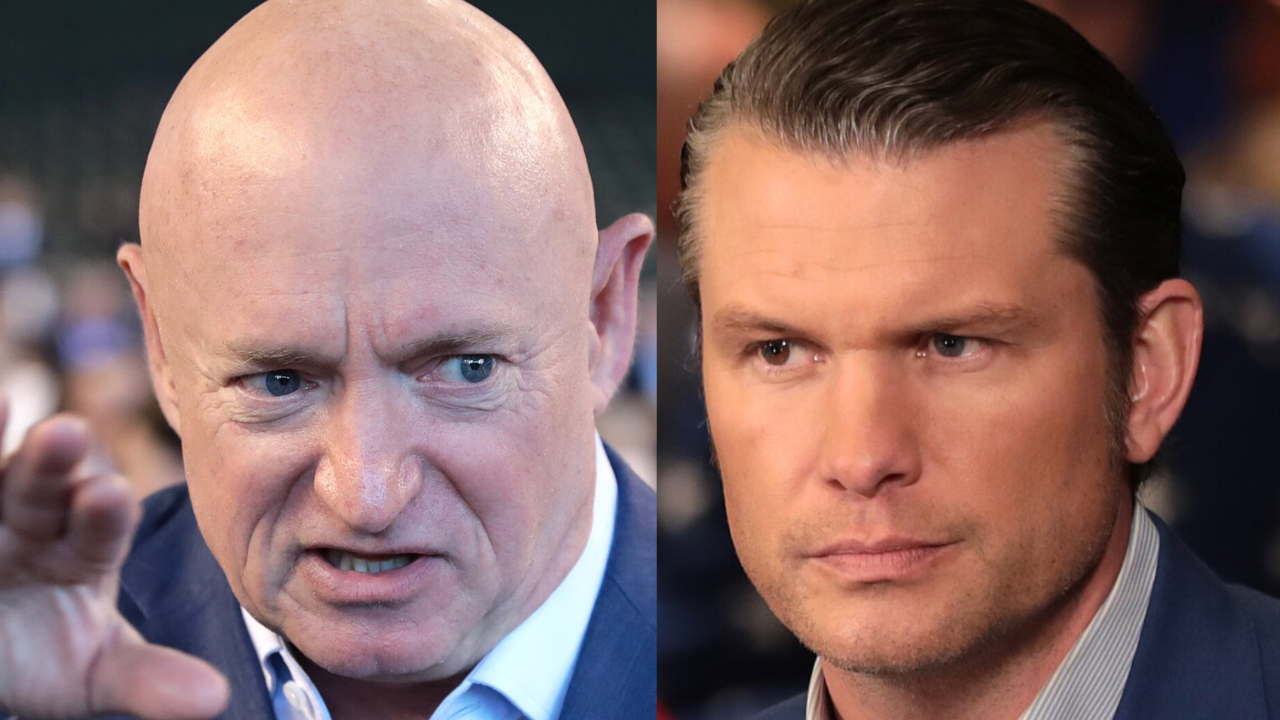
Sen. Mark Kelly of Arizona criticized Defense Secretary Pete Hegseth’s new testosterone screening policy for U.S. troops, arguing it reflects a broader failure of leadership at the Pentagon rather than a genuine readiness measure.
“The U.S. military does not need more testosterone, it needs better leadership, and that starts with the Secretary of Defense,” Kelly said in an appearance on The Briefing with Jen Psaki. “It also starts with the Commander in Chief. Ultimately he is responsible.”
Kelly, a 25-year Navy combat veteran who serves on the Senate Armed Services Committee as Ranking Member of its Airland Subcommittee, had criticized the policy days earlier as well, telling CNN it was “a weird idea” and questioning Hegseth’s judgment in prioritizing it.
Hegseth announced the policy on July 15, saying the Defense Department would begin annually testing testosterone levels in service members 30 and older and would offer voluntary testosterone replacement therapy to those found deficient. “Under the supervision of our world-class medical professionals, war fighters age 30 and older are going to be tested annually as part of their periodic health assessment,” Hegseth said in a video posted to X captioned “The High-T Department of War,” adding that troops under 30 could be screened voluntarily as well.
Hegseth framed the initiative around combat readiness, saying in a separate video that the “individual warfighter” is the military’s primary tactical advantage and that the screening program is “not about artificial enhancement” but about “restoring and optimizing” troops’ natural capabilities.
The policy drew scrutiny from other Senate Democrats. In a letter to Hegseth, Sens. Richard Blumenthal, Mazie Hirono, Gary Peters, Elizabeth Warren and Ruben Gallego wrote that the Pentagon had “provided no evidence that this sweeping new policy will improve” force readiness, pressing for details on its scientific basis, its cost and how it would apply to female service members.
Other Democrats used sharper language. Sen. Tammy Duckworth said the policy sounded “like gender-affirming care to me,” a reference to the administration’s restrictions on transgender troops’ access to hormone therapy, while Rep. Summer Lee asked, “So now y’all support gender-affirming care?” Sen. Cory Booker called Hegseth “not a serious person” and said that having a defense secretary focused on the policy in the midst of the war with Iran “makes us a mockery globally.”
Medical experts have offered a mixed assessment of the screening program. Roughly 5.6 percent of men between 30 and 79 have testosterone deficiency, a condition that can cause muscle loss, fatigue, weight gain and sexual dysfunction, and which has also been linked to diabetes, cardiovascular disease, osteoporosis and depression. Some specialists in military and veteran health have said the issue deserves more research and investment, particularly in high-stress, high-operational-tempo roles, while others have raised concerns that annual screening across the force could lead to overtreatment.
The testosterone policy is the latest in a series of individual-fitness initiatives Hegseth has introduced since taking office, including new grooming standards restricting facial hair, a requirement that all service members pass two physical fitness tests a year against a gender-neutral baseline, and the rescission of the mandatory seasonal influenza vaccine requirement. In a September 2025 speech to hundreds of senior officers in Quantico, Virginia, Hegseth said he did not want to see “fat generals and admirals” in the halls of the Pentagon, calling their presence “a bad look.”
Kelly’s criticism of the testosterone policy came within a broader set of remarks in which he said Hegseth was “firing the wrong people” and called on Trump to remove him from the Cabinet, describing him as “the most unqualified individual we’ve ever had in this position by far.”
Kelly’s relationship with Hegseth has been openly adversarial since January, when Hegseth moved to censure Kelly and downgrade his military retirement rank over a video Kelly and other retired service members released reminding troops they could refuse illegal orders. Kelly filed a lawsuit against Hegseth and the Pentagon over the action, calling it “unlawful and unconstitutional” in a Senate floor speech. “I’ve never backed down from a fight for our country, and I will not back down from this one,” Kelly said at the time.
The Defense Department has not released additional details on the projected cost of the testosterone screening program beyond Hegseth’s initial announcement, and has not responded publicly to the letter from Senate Democrats seeking further information.
Neither the White House nor the Pentagon has issued a direct public response to Kelly’s latest remarks.