
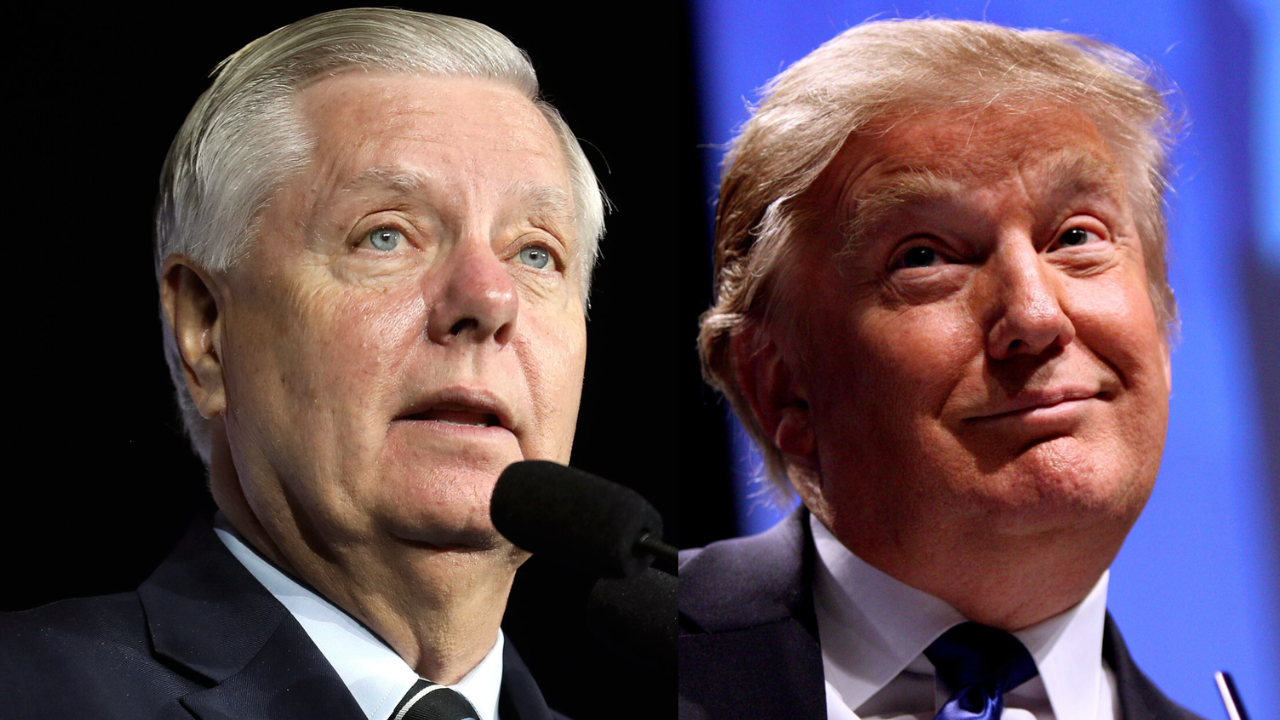
WASHINGTON, May 27, 2026 — Sen. Lindsey Graham, R-S.C., declared Tuesday night on Fox News that President Donald Trump deserves a prize greater than the Nobel if he succeeds in getting Saudi Arabia to recognize Israel — calling it the most consequential diplomatic achievement in the modern history of the Middle East and arguing that Trump is the only leader capable of pulling it off.
“If he can get Saudi Arabia, the center of Islam for the entire world, to recognize the Jewish state Israel, he’ll have ended the Arab-Israeli conflict that’s been going on for thousands of years,” Graham told Fox News host Sean Hannity. “They should change the Nobel Prize to the Trump Prize. If he can do that, and I think he can, it’s the biggest change in the history — in the modern history, and in the ancient history — of the Mideast.”
“Nobody thought that was possible,” Graham continued. “I believe it’s possible, and there’s one guy who can do it: Donald Trump.”
The Vision Graham Is Describing
Graham’s remarks reflect Trump’s most ambitious foreign policy goal — an expanded Abraham Accords that brings Saudi Arabia, the world’s most influential Muslim-majority nation, into formal diplomatic relations with Israel. Such a deal would represent a dramatic transformation of the Middle East, ending a state of hostility that has defined regional politics since Israel’s founding in 1948.
Graham has separately posted on X that “with Saudi Arabia and others like Pakistan making peace with Israel, the region will know a level of stability never dreamed of before President Trump,” and that normalization “will eventually lead to regional integration, making the Middle East a powerhouse for economic opportunity and good instead of a powder keg.”
Trump has explicitly linked the Saudi normalization push to the emerging Iran nuclear framework — telling leaders of Saudi Arabia, the UAE, Qatar, Pakistan, Turkey, Egypt, Jordan, and Bahrain in a recent call that he wants them to “simultaneously sign onto the Abraham Accords” once a wider agreement involving Iran is reached, according to Time. “I hope that Saudi Arabia will be going into the Abraham Accords very shortly,” Trump told reporters aboard Air Force One.
The Abraham Accords — What Already Exists
The Abraham Accords, brokered by Trump in 2020 during his first term, established formal diplomatic and commercial relations between Israel and the United Arab Emirates, Bahrain, Sudan, and Morocco. They were widely celebrated as a historic breakthrough — the first Arab-Israeli normalization agreements in 26 years, following Egypt in 1979 and Jordan in 1994.
Saudi Arabia, however, was conspicuously absent from the original accords. Its participation has been the Holy Grail of Middle East diplomacy ever since — both because of Saudi Arabia’s economic weight as the world’s largest oil exporter and its religious significance as the custodian of Islam’s two holiest sites in Mecca and Medina. Graham’s reference to Saudi Arabia as “the center of Islam for the entire world” reflects that dimension precisely.
The Significant Headwinds
Graham’s optimism is not universally shared — even within the Trump administration. Saudi Arabia’s position has long been that it will normalize relations with Israel only if Israel commits to a “credible, irreversible” path toward establishing a Palestinian state, according to Time. Israel’s current far-right government has said it opposes a two-state solution and Palestinian sovereignty — a direct conflict with Saudi Arabia’s precondition.
When Trump raised the idea of simultaneous Abraham Accords expansion during his recent call with Muslim leaders, an uncomfortable silence lingered on the line — prompting Trump to joke and ask if they were still there, according to a U.S. official cited by Time. Saudi Arabia reaffirmed its Palestinian state position. Pakistan said it would not support any arrangement that contradicts its longstanding recognition-only-after-Palestinian-statehood policy. Qatar, which was on the receiving end of an Israeli airstrike last September, also rejected the proposal.
Senior administration officials have told the Associated Press there is cautious optimism that a Saudi-Israel deal can be sealed by the end of Trump’s second term — but that Saudi Arabia is unlikely to sign on anytime soon. The Middle East of 2026 is significantly different from 2020, when the original accords were signed, with Arab street opinion hardened against Israel following the Gaza war that began in October 2023.
Iran as the Linchpin
Graham’s Tuesday remarks tied Saudi-Israel normalization directly to the Iran nuclear framework Trump announced Saturday as “largely negotiated.” Graham’s argument — and Trump’s — is that neutralizing Iran’s nuclear threat and putting Tehran “in a box” removes the single biggest obstacle to a broader Arab-Israeli peace, by eliminating the regional spoiler that has historically funded and armed anti-Israel forces including Hezbollah, Hamas, and the Houthis.
“Once you put Iran in a box, and he’s gonna do that, we’re gonna have peace between Saudi Arabia and Israel,” Graham said. The logic has a strategic coherence — a weakened, denuclearized Iran with limited regional influence removes the primary reason Saudi Arabia and other Arab states have historically needed to maintain hostile postures toward Israel as a form of street credibility with their own populations.
Whether Trump can simultaneously close an Iran deal, deliver a credible Palestinian statehood pathway acceptable to Saudi Arabia, and overcome Israel’s current government’s opposition to that pathway remains the central question. Graham’s answer, delivered with characteristic confidence on Hannity, was simple: there’s one guy who can do it.