
MELBOURNE, Fla. — Two months from order to first delivery is a short timeline for an Army weapon buy. L3Harris Technologies said on Oct. 13, 2026, that it had started delivering its VAMPIRE counter-drone systems to the U.S. Army and that the first units arrived within two months of the Army’s order. The company also put a number on the system’s field record: more than 350,000 operational hours since 2023.
Both claims come from the manufacturer, and its release cites no Army statement on the deliveries. As the company tells it, a counter-drone kit built to ride in a truck bed reached the Army soon after a June order.
In its Oct. 13 release, L3Harris said it “has started delivering VAMPIRE counter-unmanned systems (C-UxS) to the U.S. Army in support of hostile drone defense,” and that “Initial deliveries arrived within two months of the Army’s $106 million order.” The release did not say how many systems have been delivered or how many the order covers.
A June order worth up to $106 million
The order itself was announced in a June 10, 2026, L3Harris release, which said the company had been selected by the Army “to deliver VAMPIRE™ counter-unmanned systems (c-UxS) to support urgent defense against hostile drones.” That release put the value more carefully than the October one: “The Army’s order is worth up to $106 million,” it said, “as part of the United States’ layered c-UxS defense approach.”
The “up to” matters. A ceiling value is the most the order can reach, not necessarily what the Army will spend; the October release shortened it to a “$106 million order.” Neither release gave a contract number or the length of the order.
At the time, Tom Kirkland, president of Targeting & Sensor Systems in L3Harris’ Communications & Spectrum Dominance segment, said the Army wanted systems “that can be quickly assembled, delivered, set-up and fired.”
What VAMPIRE is
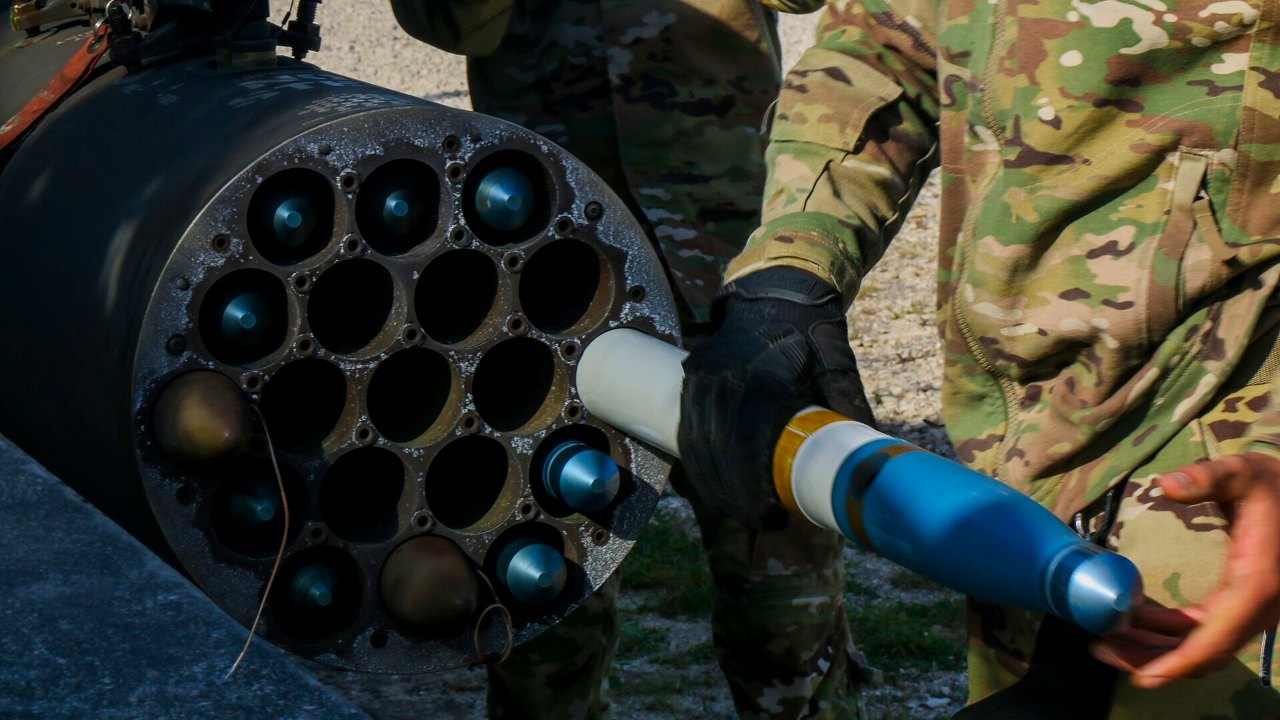
The name is an acronym. L3Harris describes VAMPIRE, short for Vehicle-Agnostic Modular Palletized ISR Rocket Equipment, as “a portable kit that can be installed on most vehicles with a cargo bed for launching of APKWS or other laser-guided munitions.” ISR stands for intelligence, surveillance and reconnaissance, which is the sensing half of the package.
In the October release, the company called it “a self-contained weapons solution that is capable of delivering advanced reconnaissance and precision strike against drones and other remotely piloted aircraft.” The idea, as L3Harris presents it, is that one kit both finds the drone and engages it from a vehicle the unit already has.
The approach targets cost as much as capability. Kirkland said in June that “VAMPIRE is effective at hunting and engaging drone threats affordably, which enables U.S. armed forces to sustain reliable defense of its personnel and infrastructure.” That is a company assessment; neither release cited Army test data.
The 350,000-hour claim
The field figure appears, word for word, in both releases: “Military forces have used the technology extensively in support of European combat operations, logging more than 350,000 operational hours since 2023.” L3Harris did not break the number down by unit, country or number of systems, so it is best read as a cumulative company tally rather than an audited Army statistic.
The June release said L3Harris developed and invested in VAMPIRE to provide a low-cost solution to drone threats. It also said that in 2026 the company ramped up production, “initiating high-volume production in Huntsville, Alabama.”
First kits in Army hands
Chris Aebli, president of L3Harris’ Communications & Spectrum Dominance segment, framed the October deliveries as a joint effort with the service:
“From day one, our team has worked side-by-side with the Army to rapidly field VAMPIRE systems. U.S. armed forces are now equipped to reliably defend personnel and vital assets against drone threats.”
The record on the deliveries is the company’s: initial units in Army hands within two months of the June order, against an order valued at up to $106 million. L3Harris has not announced a completion date for the remaining deliveries or the total number of kits.