
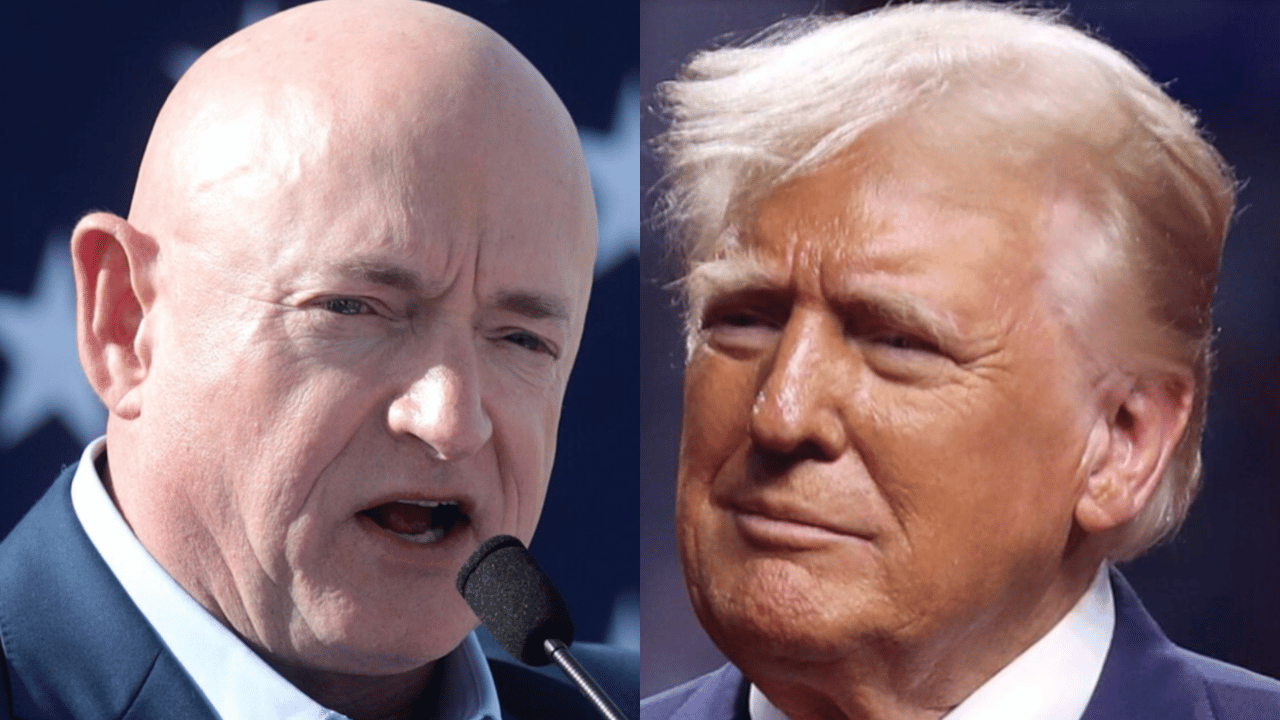
Sen. Mark Kelly, an Arizona Democrat and Navy combat veteran, said President Donald Trump “went through life as a guy who avoided Vietnam” and “He’s got draft deferments,” and that Secretary of War Pete Hegseth “runs around on a stage and talks about killing people and maximum lethality,” framing both as forms of “insecurity,” during an interview on On Sunday with Jack Cocchiarella.
Cocchiarella asked whether Trump and Hegseth’s tough-guy posture reflected insecurity after a stretch of talk about Iran strikes and military posture. “I think it’s the insecurity,” Kelly answered. “I think Donald Trump, you know, went through life as a guy who avoided Vietnam. He’s got draft deferments. He didn’t want to serve. He doesn’t understand service. He doesn’t understand members of the military.”
Kelly said he believes Trump is “intimidated, you know, by people who served” yet now serves as commander in chief. “So he wants to project this tough guy image and just go around and, you know, dropping bombs on things at every opportunity,” Kelly said.
On Hegseth, Kelly drew a different line from Trump’s draft-era record. “He’s a guy who served, he served overseas,” Kelly said. “I don’t know specifics about, you know, his combat experience, what that is, but he didn’t get very far.” Kelly said that, as he understood it, Hegseth at one point was barred from deploying to Washington, D.C., for an inauguration because of concerns about tattoos and beliefs.
“He seems to operate as a secretary of defense as you would expect a junior officer might,” Kelly said. “He cares about those kinds of things. You know, how people look, beards, you know, uniforms, gym shorts. And then to project his tough guy image, he runs around on a stage and talks about killing people and maximum lethality.”
“So I think you have insecurity in both of them for different reasons,” Kelly told Cocchiarella.
Hegseth has used that lethality language in a formal War Department address. In his Sept. 30, 2025, speech to general and flag officers at Marine Corps Base Quantico, preserved by American Rhetoric from the War Department text, Hegseth said the force should fight with “common sense, maximum lethality and authority for warfighters.” He told the room, “We unleash overwhelming and punishing violence on the enemy,” and closed by saying, “Lethality is our calling card and victory our only acceptable end state.”
In the same Quantico address, Hegseth framed appearance and fitness standards as part of restoring a warfighting culture, including directives on grooming, physical training, and what he called an end to “unprofessional appearance.” Those passages are the department’s own words on the appearance focus Kelly linked to a “junior officer” style of leadership. Hegseth told the officers the culture change was about preparing the force to fight and win, presenting standards on beards, uniforms, and physical readiness as tools of lethality.
The White House has likewise cast military rebuild and lethality as kept promises. In a Nov. 2, 2026, White House promises-kept release, the administration said Trump “directed the Department of War to end ‘diversity, equity, and inclusion’ measures that inhibited service members from meeting their objectives and returned the military to its core mission of warfighting and lethality,” and highlighted recruitment goals met across services. That release is the administration’s primary framing of the same “lethality” agenda Kelly tied to insecurity on On Sunday.
Kelly’s “draft deferments” and “avoided Vietnam” lines in the On Sunday interview are his own account of that history as he connected it to wartime decision-making and to Hegseth’s stage rhetoric. Kelly, a former astronaut who said in the same interview that he flew 39 combat missions into Iraq and Kuwait as a Navy pilot, presented the insecurity thesis as an explanation for what he called a tough-guy projection by both the president and the secretary.
Cocchiarella had framed the exchange as a question about whether Hegseth’s tenure was about looking tough after arguing the force had been “too woke” or “too soft.” Kelly answered that the deeper driver, in his view, was insecurity in both men for different reasons: Trump from never serving, Hegseth from what Kelly cast as a junior-officer preoccupation with appearance paired with stage talk about killing.
Hegseth’s Quantico speech also told senior leaders that the department would restore a warrior ethos and that standards would be enforced evenly. Those lines sit alongside the “maximum lethality” passages American Rhetoric preserves from the War Department text and are the department’s primary statement of the culture Hegseth said he was building. Kelly’s On Sunday critique treats that same language as a sign of insecurity; Hegseth’s text treats it as the mission.
Kelly’s “avoided Vietnam,” “draft deferments,” “maximum lethality,” “junior officer,” and “insecurity” language is his own from the On Sunday interview. Hegseth’s Sept. 30, 2025, Quantico address uses “maximum lethality” and “lethality” as War Department priorities and pairs them with standards on appearance and training. The White House Nov. 2 release frames a return to “warfighting and lethality” as a kept promise. Whether that stage language, those department standards, and Trump’s draft-era record prove the insecurity thesis Kelly advanced is a judgment the interview states and the cited Quantico and White House texts leave open.