
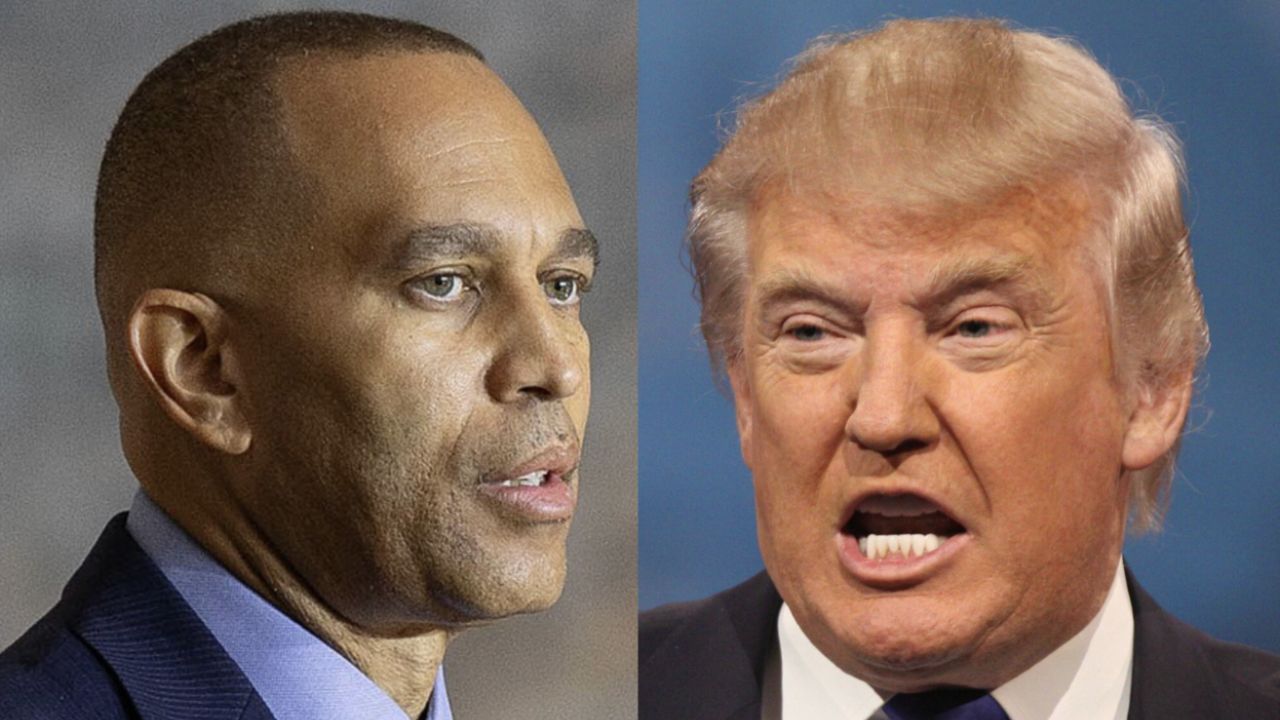
House Minority Leader Hakeem Jeffries used Labor Day’s record gas prices to launch a fresh broadside against President Donald Trump and congressional Republicans on Tuesday, tying the ongoing war with Iran and the administration’s tariff policy directly to the rising cost of living heading into the November midterms.
In a post on X published at 12:02 p.m. on September 8, 2026, Jeffries wrote in full:
“Americans paid record-high gas prices on Labor Day. Republicans promised to lower costs. Their reckless war of choice in Iran and the Trump Tariffs have instead made life way more expensive. They are all unfit to govern.”
Record Prices at the Pump
The post came two days after national gas prices reached $4.15 a gallon on Labor Day, according to AAA, surpassing the previous holiday record of $3.82 set in September 2012 and marking the first Labor Day in history that pump prices climbed above $4 nationally. Diesel prices also hit a record of $5.90 a gallon, up from $3.71 a year earlier.
AAA spokesperson Brittany Moye said the seasonal decline typically seen after the summer driving season had not materialized this year because elevated crude oil costs offset the usual trend. The average price is up roughly 30 percent from the $3.20 a gallon drivers paid at the same point last year.
Industry analysts have pointed to the war between the United States and Iran, which began February 28 under the banner Operation Epic Fury, as the primary driver of the increase. The U.S. Energy Information Administration reported that daily crude oil throughput in the Strait of Hormuz fell to roughly 4.9 million barrels in the second quarter of 2026, a fraction of the 21.6 million barrels per day that transited the waterway in the final quarter of 2025.
A Consistent Line of Attack
Tuesday’s post extends a message Jeffries has repeated throughout the summer. In a July 27 interview on Bloomberg, he said Americans were “drowning in this failed Trump economy,” arguing that Trump “promised to lower the high cost of living on day one” but that “costs have gone up” instead, citing both the tariffs and the Iran war’s effect on gas prices.
During an April 15 appearance on CNBC’s Squawk Box, Jeffries told host Joe Kernen that “gas prices have skyrocketed as a direct result of Donald Trump’s reckless war of choice,” adding that “Donald Trump and Republicans have made affirmative policy decisions that actually have made life more expensive for the American people.”
At an August 31 press conference in the Capitol, Jeffries said Trump “promised that he wasn’t going to start endless wars in the Middle East, he was going to stop them,” before turning the country toward “a reckless and costly war of choice in Iran that has been an absolute disaster for the American people.” He argued that Iran was “stronger now than it was before Donald Trump started this reckless Republican war of choice.”
Broken Promises on the Cost of Living
Jeffries’s Tuesday post directly references a Republican pledge to lower costs, a theme Democrats have pressed since Trump’s first months in office. During his August 29 appearance on MS NOW, Jeffries noted that the six-month anniversary of the Iran war had just passed, remarking that the administration had told Americans “the war would be over in a matter of days,” and that it was “still going half a year later.”
Democratic Congressional Campaign Committee Chair Rep. Suzan DelBene made a similar argument earlier this year, telling Fox News Digital that “Trump went into this war without thinking through the implications, and we’ve seen gas prices skyrocket across the country, on top of prices going up for families, housing, food, healthcare, all going up because of actions taken by this President and Republicans in Congress.”
White House and GOP Response
The White House has maintained that the price increases are temporary. Press Secretary Karoline Leavitt said earlier this year that “when Operation Epic Fury is complete, gas prices will plummet back to the multi-year lows American drivers enjoyed before these short-term disruptions,” adding that Trump “remains committed to fully unleashing American energy dominance, lowering costs, and putting more money back in the pockets of hardworking American families.”
Vice President JD Vance faced questions on the issue at a White House briefing last week, acknowledging he did not know when Iranian attacks on shipping in the Strait of Hormuz would stop. He said the administration was working to lower prices by escorting oil tankers through the strait and pursuing new sources of crude, including a deal with Venezuela, though experts cited in reporting on the briefing said benefits from that agreement could take years to materialize.
Treasury Secretary Scott Bessent had predicted in July that consumers could see relief “maybe by Labor Day.” Gasoline prices instead reached their highest level ever heading into the holiday weekend.
Political Stakes Ahead of the Midterms
The gas price surge has emerged as a significant liability for Republicans defending narrow majorities in both chambers ahead of November. A Politico analysis found that the president’s party has historically lost an average of 32 House seats in midterm elections when gas prices are elevated, compared with six seats when prices are lower.
One swing-district House Republican, speaking anonymously to MS NOW, said they were “just as frustrated” as voters about the elevated prices, adding, “I wish the administration had a plan.” National Republican Congressional Committee Chair Richard Hudson has defended the administration’s actions in Iran while placing responsibility on individual candidates to explain the war’s economic effects to constituents.
Political scientist J. Michael Bitzer of Catawba College said the current environment is “intrinsically built against the president and the war,” noting that the economic fallout “is certainly not helping his cause” as Trump’s approval rating has fallen to roughly 35 percent.
Background on the Conflict’s Economic Toll
The war has now stretched well beyond its initial timeline, with crude oil prices climbing from roughly $67 a barrel before the February 28 start of the conflict to about $92 a barrel by early September, according to CNBC. Refinery damage tied to both the Iran war and the ongoing Russia-Ukraine war has further constrained gasoline supply, with domestic gasoline stocks running 6 percent below the seasonal average as of late August.
Jeffries’s Tuesday statement did not include additional remarks beyond the X post itself, though it aligns with a message his office and House Democrats have sustained for months as they seek to make affordability, the Iran war, and the tariffs central issues in the run-up to the midterm elections.