
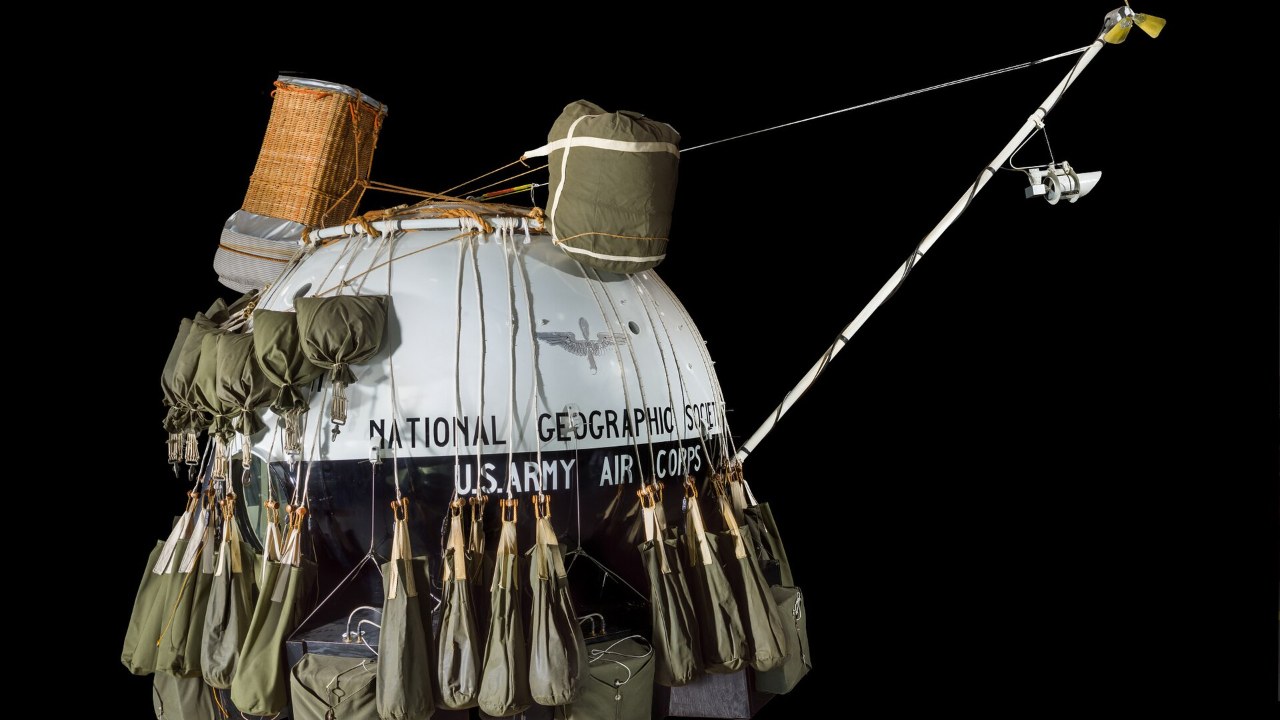
The gondola is a sphere nine feet across, made of welded magnesium and aluminum alloy and painted black and white. On Nov. 11, 1935, it carried Capt. Albert Stevens and Capt. Orvil Anderson up from the floor of a South Dakota canyon to 72,395 feet, or 22,066 meters, beneath the helium balloon Explorer II. That was a world altitude record.
The launch site was the Stratobowl, near Rapid City. The cabin is held by the Smithsonian’s National Air and Space Museum, which displays it in the Barron Hilton Pioneers of Flight gallery. Its credit line reads “Gift of the National Geographic Society.”
The museum’s object record for the Explorer II gondola sets out the essentials. It gives the launch date of Nov. 11, 1935, names the two captains, and states the record altitude of 22,066 meters (72,395 feet). It also records that the sphere measures 2.8 meters (9 feet) in diameter.
A canyon chosen for calm air
Inflating a stratosphere balloon on the ground left it exposed to wind. In a 2015 Air & Space history of the Stratobowl flights, researcher Roger Mola explains why the Army Air Corps picked a box canyon in the Black Hills. Limestone walls about 400 feet high enclosed it on three sides and shielded the balloon during inflation.
Per Mola’s account, the National Geographic Society and the U.S. Army Air Corps jointly sponsored the program. The museum’s record says the project was conceived by Stevens, who was chief of the Army Air Corps’ photography laboratory at Wright Field, Ohio, and funded by the National Geographic Society. The words “National Geographic Society and U.S. Army Air Corps” are still painted on the side of the cabin.
What Explorer I taught the crew
Explorer II was the program’s second try. The museum’s record says the first balloon, Explorer I, ripped in 1934, and its hydrogen exploded. Stevens, Anderson and Maj. William Kepner all parachuted to safety. Mola’s article dates that flight to July 28, 1934, and reports that the envelope tore at about 63,000 feet.
For the second flight the team made several changes, according to the museum. It widened the portholes so the crew could get out more easily and filled the balloon with helium in place of hydrogen. To improve the chances of a record, it also enlarged the balloon, cut the crew from three to two, and halved the scientific payload.
Per the museum, the cabin weighed 290 kilograms (640 pounds) and carried a 700-kilogram (1,500-pound) payload. Outside it hung canvas ballast bags, instrument parachute bags, a main parachute, battery boxes and a wicker basket for a spectrograph.
Eight hours over South Dakota
The museum’s record gives the timeline. Explorer II lifted off at 7:01 a.m. and reached about 22 kilometers at 10:50 a.m. It stayed at that height until 12:20 p.m. and touched down at 3:14 p.m. near White Lake, South Dakota.
The flight was also a scientific mission. The museum says the photographs taken from the gondola were the first to show the division between the troposphere and the stratosphere, and the curvature of the Earth from record altitude. Instruments aboard gathered data on cosmic rays, the ozone layer, aeronomy, meteorology, biology and radio propagation.
Explorer II’s altitude beat an earlier American mark. Mola’s article says the first Americans to reach the stratosphere climbed to 61,237 feet from Akron, Ohio, on Nov. 20, 1933.
The sphere’s record, as the Smithsonian states it, is 72,395 feet, flown on Nov. 11, 1935, by two captains.
Top image: The Explorer II gondola in the Smithsonian National Air and Space Museum collection. Image Credit: Smithsonian National Air and Space Museum — CC0 / Wikimedia Commons
This article was produced with the assistance of AI and reviewed by Combat Rated editors prior to publication.