
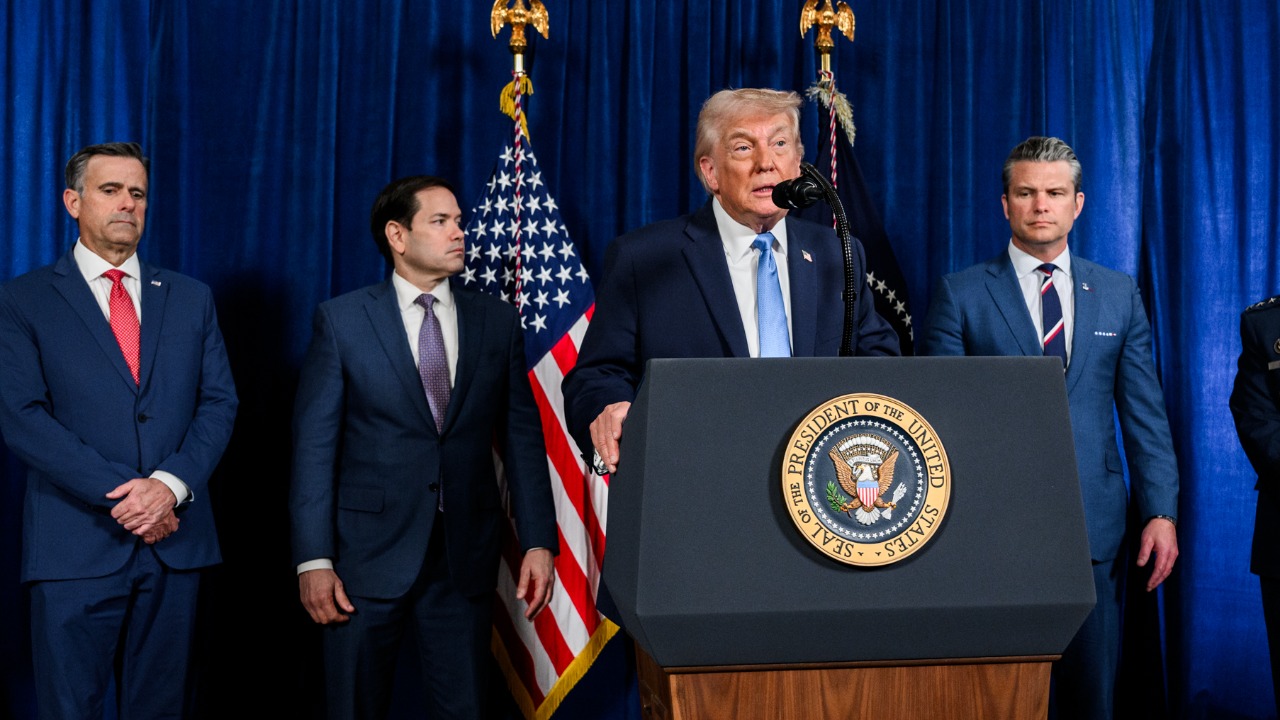
President Donald Trump is openly discarding the traditional guardrails on American power just as the Senate is scrambling to rebuild them. As lawmakers move to restrict further military action in Venezuela, Trump is insisting that his only real constraint is his personal sense of right and wrong, not international law or multilateral norms. The collision between a president who says he does not need global rules and a Congress trying to reassert its war powers is rapidly becoming the defining test of how far the United States is willing to stretch its authority in Venezuela.
Trump’s rejection of international law as a constraint
Trump has been unusually explicit about how he views legal limits on his power abroad, and the picture that emerges is stark. He has said that his “only” real check as he seeks greater global leverage is “my own morality,” a formulation that places personal judgment above any external framework of rules or institutions. In the same vein, when pressed on whether the United States must still follow international law, Trump brushed the question aside and suggested that it “depends what your definition is,” signaling that he sees global legal standards as flexible tools rather than binding obligations.
That attitude crystallized in his recent remark that he does not “need international law,” a line he delivered while discussing his approach to using force and dictating outcomes beyond U.S. borders. In a separate exchange, he described his own moral compass as “the only thing that can stop me,” underscoring that he views formal constraints as secondary to his personal sense of purpose. United Nations experts have already warned that this posture risks a slide back toward an “age of imperialism,” in which powerful states act first and worry about legal justification later, and their concern is sharpened by the fact that Trump is speaking in the context of aggressive policies toward Venezuela and its leadership.
From Venezuela strikes to a Senate revolt
The immediate backdrop to the Senate’s revolt is the rapid escalation of U.S. action in Venezuela, including a strike that targeted the country’s leadership and the reported “capture” of Nicolás Maduro. Lawmakers in the United States reacted sharply to that operation, with some warning that the removal of Maduro could destabilize the region and leave neighbors such as Colombia facing serious turmoil. The operation also raised questions about how far Trump was prepared to go in dictating Venezuela’s political future and controlling its vital oil revenues, especially as he signaled that Washington intended to steer decisions on Venezuelan oil sales for the foreseeable future.
Trump’s willingness to contemplate additional military steps only deepened those concerns. He initially prepared a second strike on Venezuela, then abruptly called it off as political pressure mounted in Washington. By that point, however, the damage to trust between the White House and Capitol Hill was done. Senators in both parties had watched the president order force against a South American country without prior congressional authorization, then speak as if he could continue or expand those operations at will, and they began to look for ways to reassert their own constitutional role before another round of attacks could be launched.
A rare bipartisan push to curb presidential war powers
In response, the Senate has taken the unusual step of advancing a bipartisan resolution designed specifically to limit Trump’s ability to wage war in Venezuela without explicit approval from Congress. The measure, backed in a key procedural vote, would bar the president from initiating or sustaining military operations against Venezuela unless lawmakers give their consent. That vote represented a rare public rebuke of a sitting commander in chief by a chamber that has often deferred to the executive branch on questions of war and peace, and it came even though the Senate is led by Republicans who generally support Trump on domestic issues.
Supporters of the resolution argue that the Constitution gives Congress, not the president alone, the power to decide when the United States goes to war, and they say that authority has been eroded by decades of open-ended authorizations and unilateral action. A small group of Republicans joined Democrats to push the measure forward, reflecting unease with Trump’s willingness to strike Venezuela and his rhetoric about not needing international law. The Republican-led Senate framed the move as an effort to restore balance, making clear that any further attacks on Venezuela must be debated and authorized on Capitol Hill rather than ordered from the Oval Office without prior consultation.
Trump’s backlash and the stakes for U.S. self-defense
Trump has not taken the Senate’s challenge quietly, and his response reveals how he interprets both his office and the risks he believes the country faces. He has blasted the war powers measure as a vote that “greatly hampers American Self Defense and National Security,” arguing that it impedes the President’s Authority as Commander in Chief at a time when he says the United States must be ready to act quickly. In his telling, constraints imposed by Congress or by international law do not simply limit his discretion, they actively endanger the country by slowing or blocking decisive action against threats he associates with Venezuela, including drug trafficking and weapons flows.
That framing dovetails with his broader insistence that legal guardrails are less important than his own intentions. Trump has repeatedly said he is “not looking to hurt people” and that his personal morality is the key safeguard against abuse of power, a claim that asks both domestic lawmakers and foreign governments to trust his judgment rather than rely on codified rules. Critics in the Senate counter that the entire point of constitutional checks is to prevent any single individual, however confident, from unilaterally deciding when and how the United States uses force. The clash over Venezuela therefore goes beyond a single theater of operations and cuts to the core question of whether American self-defense is best protected by concentrating authority in the presidency or by insisting on shared responsibility between branches of government.
Global implications and the return of great-power impunity
The confrontation between Trump and the Senate is being watched closely outside the United States, particularly in Latin America, where memories of past U.S. interventions remain vivid. The attack that led to Maduro’s removal and the talk of indefinite U.S. control over Venezuelan oil decisions have already alarmed Colombia, which is bracing for potential spillover instability and internal turmoil. When the president of the United States then declares that he does not need international law, regional leaders hear an echo of earlier eras in which Washington treated sovereign borders as negotiable and regime change as a matter of policy preference rather than last resort.
International legal experts and human rights officials warn that this combination of rhetoric and action risks normalizing a world in which powerful states feel free to abduct foreign leaders, dictate economic outcomes, and use force without multilateral backing. A United Nations rapporteur has voiced concern that the global system may be sliding back toward a pattern of imperial behavior, with the Government of the United States setting a precedent that others could follow. If Trump’s view prevails, and if Congress proves unable or unwilling to enforce limits through tools like the Venezuela war powers resolution, the message to other capitals will be clear: international law is optional, and what matters most is who has the power to act, not the rules that are supposed to govern that power.