
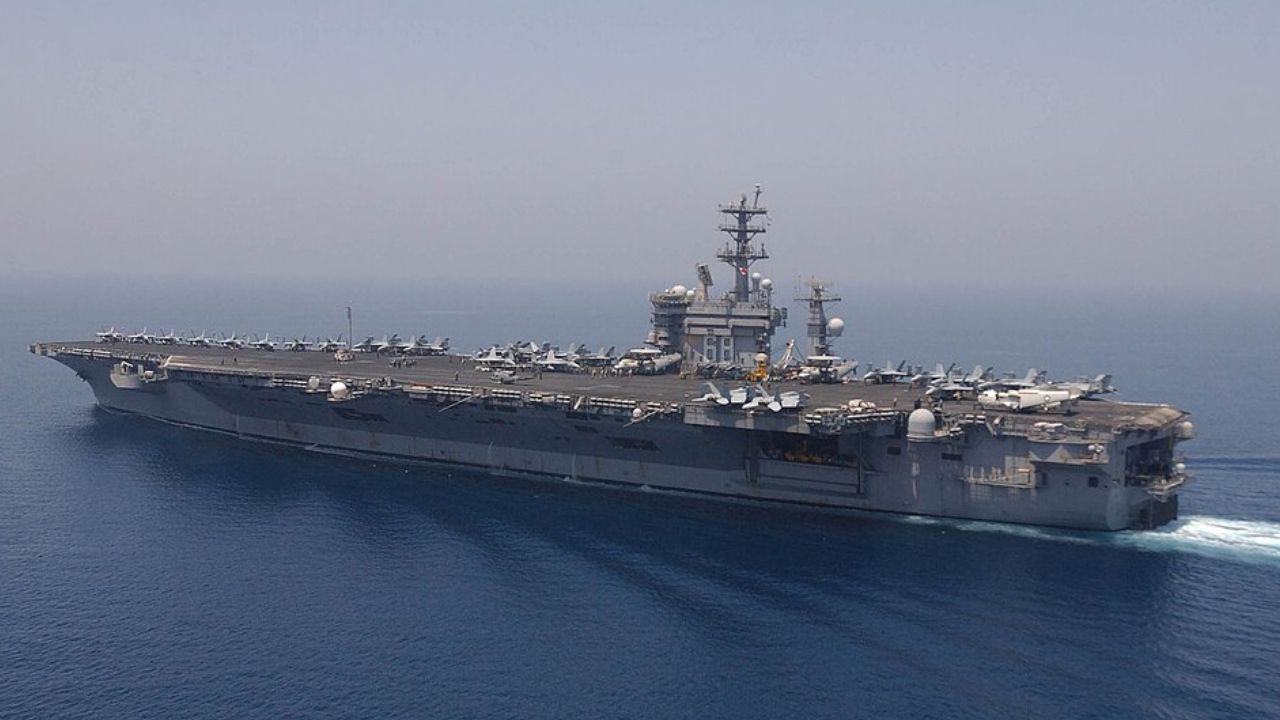
The Nimitz-class nuclear-powered aircraft carriers (CVN-68 class) did more than expand the U.S. Navy’s fleet of capital ships. They reinforced a strategic habit: treating sustained, sea-based airpower as a readily available tool for deterrence, crisis response, and limited war. From the late Cold War through post‑9/11 operations, these carriers helped make the carrier strike group a standing option for U.S. leaders—an option that can arrive without waiting on host-nation basing agreements and can remain on station for extended periods. That model still matters, in part because potential adversaries now focus on disrupting it with modern surveillance and long-range weapons.
In broad terms, the Nimitz class became the template for modern U.S. naval power projection by combining nuclear endurance with a large air wing and the ability to sustain flight operations over time. The strategic effect was not that carriers replaced land-based air or joint forces, but that they made it easier for the United States to act early in a contingency, or to maintain pressure when access ashore was limited, delayed, or politically constrained.
A floating airbase—with endurance built in
The defining feature of the Nimitz class is nuclear propulsion. By reducing the ship’s dependence on conventional refueling, nuclear power supports long deployments and flexible movement within a theater. That translates into a practical kind of strategic freedom: a carrier can reposition, loiter, or surge based more on operational need than on the ship’s fuel state.
That endurance does not eliminate logistics. Nuclear propulsion powers the ship, but aviation operations still rely on a steady flow of jet fuel, spare parts, ordnance, food, and maintenance capacity. In practice, Nimitz-class employment reinforced the broader structure needed to keep a carrier effective—escorts, replenishment, and planning—helping the carrier strike group evolve into a full operating model rather than a simple formation.
Sortie generation as strategy, not just tactics
Aircraft effects are the reason carriers matter. The Nimitz class strengthened an approach in which sea-based aviation can be sustained and adjusted to political objectives—ranging from day-to-day presence and deterrence to limited strikes and enforcement missions. The key is not a single dramatic event, but the ability to generate repeated flight operations: launching, recovering, rearming, refueling, and returning aircraft to the air on a predictable rhythm.
At the deck level, that rhythm is a tightly managed cycle of people, equipment, and timing. The strategic payoff is easier to see than to count: a carrier that can keep producing patrols, early warning, and strike sorties from international waters creates persistent pressure and expands commanders’ options. Often, the most influential effect is not any one strike, but the continuous presence behind diplomacy and coalition planning.
Why basing access became less decisive
One of the most durable impacts of the Nimitz model is political. Sea-based airpower can reduce the need to secure host-nation basing at the start of a crisis, when negotiations, domestic politics, and regional sensitivities can slow decision-making or narrow what land-based aircraft are permitted to do. A carrier operating offshore can provide an immediate and visible signal of intent while access and allied arrangements are worked out.
This does not make carriers a universal substitute for bases. When access is available, carriers add depth and flexibility to joint airpower. When access is uncertain or constrained, they can be among the most immediately employable sources of sustained aviation in a theater.
The carrier strike group: an architecture built around the Nimitz model
Nimitz-class carriers also shaped how the fleet organizes to project power. The carrier strike group concept pairs the carrier and its air wing with escorts for air and missile defense, anti-submarine warfare, and maritime security, supported by replenishment ships and tied into joint and coalition command-and-control networks. The carrier becomes a mobile node that can contribute to broader theater objectives while protecting itself through layered defense and coordinated operations.
The consequence is a scalable package that can be adapted to different missions and rules of engagement—presence and deterrence, limited strike options, no-fly zone support, maritime security, and humanitarian assistance. The carrier does not operate in isolation, and it does not “win wars” on its own. But the Nimitz-era model influenced how maritime forces are assembled so they can contribute early and remain relevant as operations evolve.
The human and industrial footprint that makes it work
Carrier power projection depends on people and process as much as hardware. A Nimitz-class carrier fields a large ship’s company and an extensive aviation workforce, and the concept of operations assumes continuous maintenance, training, and qualification cycles. That human and organizational capacity is what allows flight operations to persist over months rather than only in short bursts.
The class also reflects an industrial commitment that stretches across decades. The ships were built primarily by Newport News Shipbuilding (Huntington Ingalls Industries), and their long service lives depend on a sustainment ecosystem with specialized nuclear expertise and predictable shipyard throughput. Refueling and overhaul work—varying by hull and timeframe—underscores a central reality: carrier availability is tied as tightly to maintenance capacity and skilled labor as it is to strategy or fleet size.
Influence beyond the U.S.: the benchmark effect
The Nimitz class also shaped global expectations about what large-deck carrier aviation can provide. Even where other navies pursue different designs and doctrines, the U.S. approach—integrating a large-deck carrier into a protective strike group and using it as an independent instrument of policy—became a reference point in debates about fleet design and maritime power.
That influence is less about copying a specific ship and more about adopting a concept: persistent aviation at sea, protected by layered defenses and connected to wider surveillance and strike networks. Countries adapt that logic to their own budgets, geographies, and threat environments, but the Nimitz-era model helped set the terms of the modern carrier discussion.
Contested seas: adapting the Nimitz-era model
The central question today is how well the Nimitz-class approach holds up in more contested environments, particularly as China and Russia field anti-access/area-denial (A2/AD) capabilities. Long-range anti-ship weapons, submarines, and pervasive ISR—along with cyber and targeting networks—are designed to hold high-value ships at risk and complicate carrier operations. The debate is not best framed as “invulnerable” versus “obsolete,” but as how to preserve political and military utility when an adversary can detect and threaten forces at greater range.
Much of the adaptation focuses on employment and integration: operating in ways that complicate targeting, relying more on standoff weapons, and incorporating unmanned aviation as capabilities mature. None of these is a guaranteed answer. Their value depends on factors that have always shaped carrier effectiveness—escort quality, ISR, munitions, and the availability of regional access—while the threat environment continues to evolve.
Nimitz vs. Ford—and what changes next
Comparisons with the newer Ford class often emphasize technology, but the strategic continuity is the larger point. Both classes are built around the same basic purpose: generating sustained airpower from the sea as a central tool of U.S. strategy. The transition matters because it intersects with readiness and capacity. How many carriers are available at any moment depends on maintenance cycles, modernization schedules, and shipyard capacity as much as on the number of hulls in the fleet.
The next chapter is therefore less about a single pivot than about managing tradeoffs. The Navy must keep Nimitz-class ships credible while adapting tactics, air wing capabilities, and operating patterns to higher-threat conditions. The Nimitz class reshaped U.S. power projection by making sustained, sea-based aviation routine; the coming era will test how well that routine can adjust to faster targeting cycles, longer-range threats, and the persistent requirement to reassure allies without unnecessarily escalating crises.