
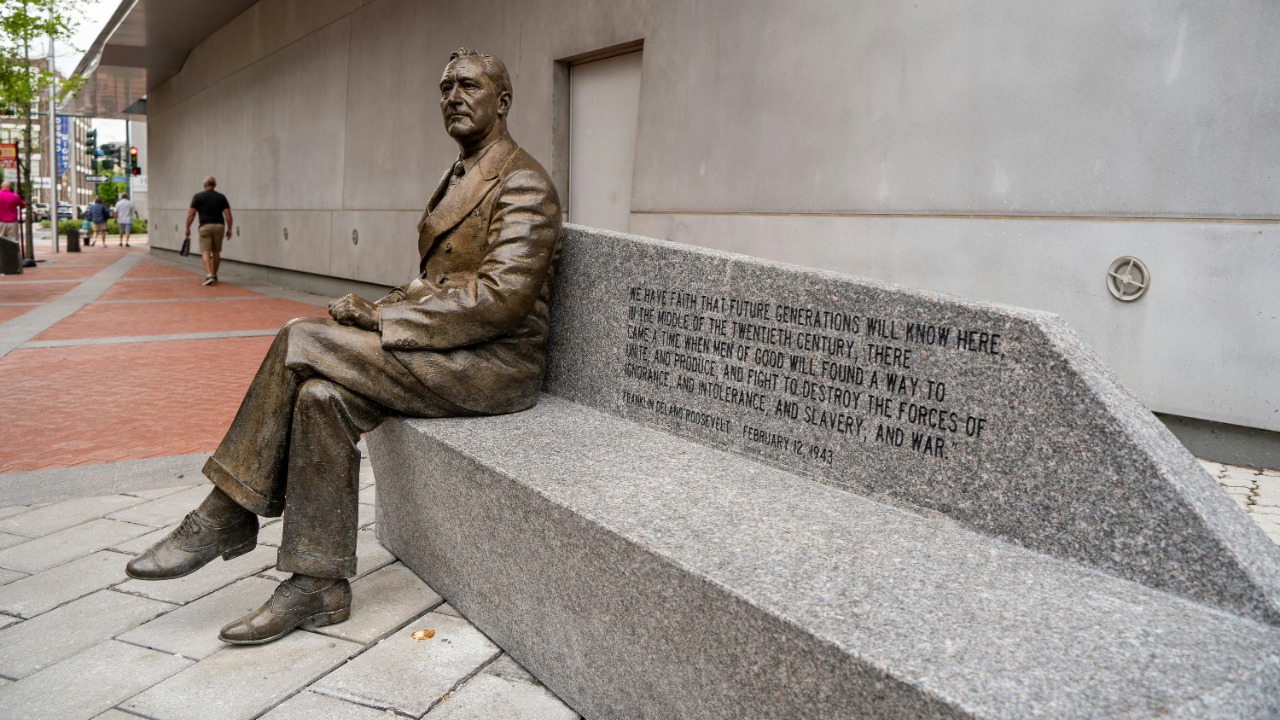
By the time Franklin D. Roosevelt took the oath of office in March 1933, the country was running on nerves and rumors. Banks were failing, paychecks were disappearing, and fear had turned into a kind of daily weather. People weren’t just worried about money—they were worried about whether the whole system worked at all. It was the kind of moment when leadership doesn’t get graded on vibes; it gets graded on whether the lights stay on.
Roosevelt’s response wasn’t to pretend everything was fine or to bury Americans in policy jargon. He treated the emergency like an emergency, spoke to people like adults, and moved with a speed that startled even his allies. And while historians still debate plenty about the details, one thing is hard to argue with: when America needed a steady hand, he made sure it felt one.
A country in free fall—and a president who named the fear
The Great Depression had been grinding on for more than three years when Roosevelt arrived in Washington. Unemployment was staggering, farms were collapsing under debt, and factories sat quiet. Even people who still had work were cutting back, because nobody knew what tomorrow would bring.
Roosevelt’s first big leadership move was emotional as much as political: he named what people were feeling. In his inaugural address, he delivered the line that would follow him forever—“the only thing we have to fear is fear itself.” It wasn’t a magic spell, but it was a clear signal that the White House understood the problem wasn’t just financial. Confidence had crashed, too.
The bank holiday: stopping the panic before it spread
One of Roosevelt’s earliest calls was also one of the boldest: he shut the banks. The move, known as the “bank holiday,” temporarily closed banks nationwide so the government could assess which ones were solvent and which ones weren’t. That sounds terrifying—closing every bank in America is not exactly a soothing headline.
But that was the point: panic was already doing the damage, and Roosevelt wanted to hit pause. Then he paired the dramatic action with something just as important—explanation. Americans didn’t simply get an order; they got a reason, in plain language, with a promise that the goal was stability, not punishment.
Fireside chats: a masterclass in calm, direct communication
If Roosevelt were around today, he’d probably be the person who can explain a complicated crisis in one clear thread that everyone actually reads. His “fireside chats,” radio addresses delivered in a relaxed, conversational tone, made millions of people feel like the president was speaking directly to their living room. And in a time when misinformation traveled by gossip and headlines, that closeness mattered.
In the first fireside chat, he explained how banking works and why reopening sound banks was safe. He didn’t talk down to listeners, but he also didn’t hide behind technicalities. The effect was immediate: when banks reopened, many Americans deposited money instead of pulling it out. It was leadership through clarity—and it worked.
The “First Hundred Days”: action, action, action
Roosevelt’s early presidency is famous for the “First Hundred Days,” a rapid burst of legislation and emergency programs. Congress passed bill after bill, and the administration built new agencies at a pace that made Washington feel like a startup with a very serious dress code. Not every program was perfect, but the energy itself sent a message: the government was no longer frozen.
Some efforts focused on relief—helping people survive right now. Others aimed at recovery—getting the economy moving again. And others were about reform—trying to prevent the same kind of collapse from happening again, or at least making it harder to repeat.
Putting people to work: relief that looked like dignity
One of Roosevelt’s clearest instincts was that aid shouldn’t only be a handout; it should also restore momentum and self-respect. Programs like the Civilian Conservation Corps (CCC) hired young men to work in forests, parks, and conservation projects. The Works Progress Administration (WPA) and other initiatives employed millions in construction, public buildings, roads, and even arts projects.
These weren’t just job programs—they were visible proof that the country could still build things. You could point to a bridge, a school, a trail, and say, “We made that in the middle of the worst economy in generations.” It’s hard to overstate how powerful that is when people feel stuck.
Rules for the financial game: rebuilding trust after the crash
Roosevelt also pushed reforms meant to make finance less of a casino. New rules targeted risky banking practices and sought to restore trust in the system. Over time, federal deposit insurance (through the FDIC) helped ordinary savers feel safer keeping money in banks—because “my life savings could vanish overnight” is not a recipe for economic recovery.
To be clear, these reforms didn’t make capitalism polite forever. But they did create guardrails, and guardrails are what you install when you’ve just watched a bus go off the road.
Social Security: a long bet on basic security
In 1935, Roosevelt signed the Social Security Act, creating a system of old-age benefits and unemployment insurance. It wasn’t a flashy crisis response like closing the banks, and it didn’t solve the Depression overnight. But it addressed something the Depression exposed brutally: millions of Americans had no safety net if age, disability, or job loss hit.
Social Security became one of the most durable pieces of the New Deal. And regardless of where people land politically, its basic idea—modern life needs modern insurance—was a major shift in how the federal government saw its responsibilities.
Leadership under pressure: optimism, experimentation, and persistence
Roosevelt’s style wasn’t “I have one perfect plan.” It was more like, “We’re going to try things, keep what works, and adjust fast.” He openly embraced experimentation, which sounds obvious now, but at the time it was a big departure from cautious, wait-and-see governance. When people are hungry and the system is wobbling, “maybe later” doesn’t land well.
He also understood the psychology of a crisis. He projected confidence even when the situation was grim, and he made the public feel included—like they were part of the recovery, not just spectators to it. Sometimes that confidence annoyed critics, and some programs sparked fierce opposition. But in an emergency, steadiness isn’t just a personality trait; it’s a tool.
The debates and the legacy: why his response still gets argued about
Roosevelt’s actions didn’t end the Great Depression by themselves, and historians still argue about which policies mattered most and which created unintended consequences. Business leaders and political opponents accused him of expanding federal power too far. Others argued he didn’t go far enough, especially for groups left out of early relief efforts.
Yet even with those debates, the shape of his leadership is unmistakable. He met panic with presence, confusion with communication, and paralysis with action. In a moment when the country could’ve lost faith in itself, Roosevelt made it feel—day by day—that America still had a driver at the wheel.