
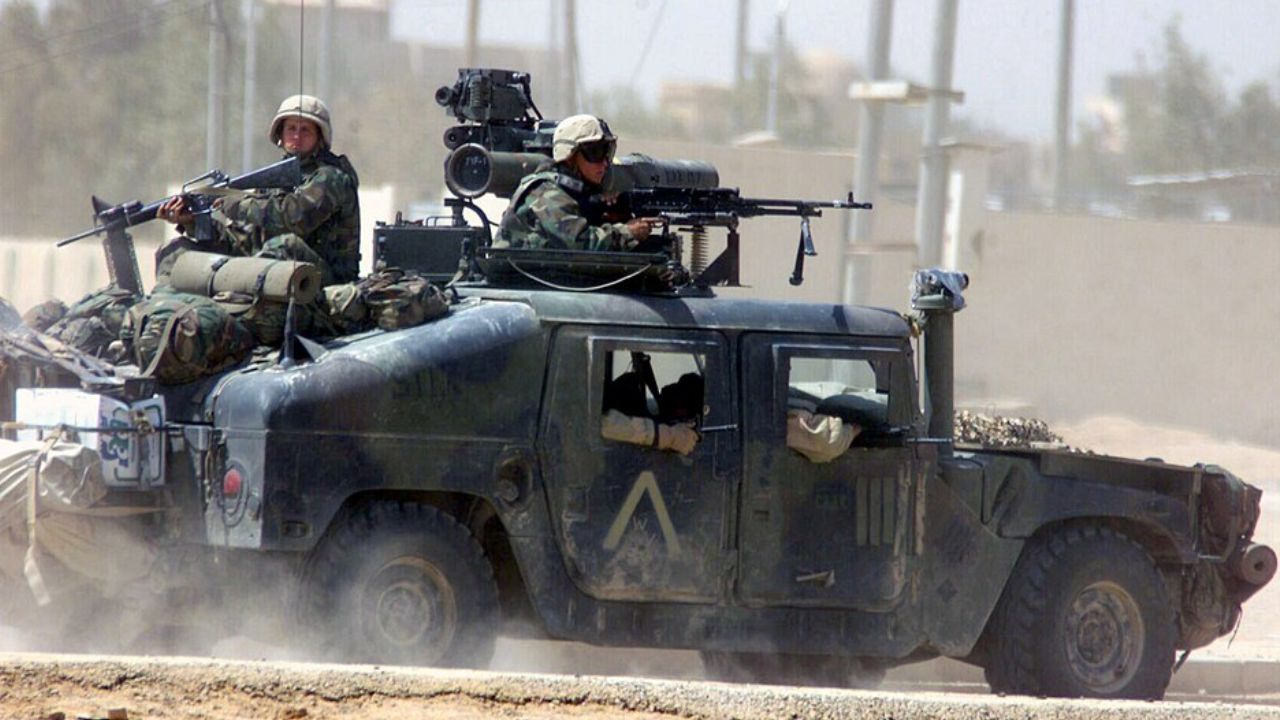
The Humvee was not a sudden leap in U.S. military vehicle design. It grew out of decades of Army thinking about tactical mobility: how to move people, weapons, and supplies across broken terrain while staying reliable, maintainable, and supportable at scale. Fielded in huge numbers and used across the joint force, the High Mobility Multipurpose Wheeled Vehicle (HMMWV)—better known as the Humvee—carried forward lessons from the jeep era and post‑WWII light trucks, then absorbed new lessons once it was pushed into modern combat environments.
That lineage helps explain both what the Humvee did well and what it was never meant to do. It was built as a light tactical vehicle intended to be broadly usable across roles and easy to sustain through standardized parts and maintenance practices. It was not originally designed as an armored combat vehicle, and that design intent shaped the platform’s limits when battlefield threats changed.
From the jeep mindset to postwar demands
U.S. light tactical vehicles have long been asked to balance competing needs: carry more, go farther, remain mobile off-road, and still be simple enough to keep running across units with uneven levels of mechanical support. The jeep-era concept of a small, versatile vehicle set expectations for utility and mobility, but post‑WWII missions pressed “light” vehicles into carrying more equipment and supporting more specialized tasks.
Across those decades, the core trade space remained consistent: mobility versus payload versus reliability versus maintainability. Earlier fleets also exposed a recurring readiness problem—too many unique parts, too many one-off configurations, or designs that are hard to service outside a depot can turn a vehicle inventory into a sustainment burden. Over time, doctrine and logistics pushed the U.S. military toward vehicles that could flex across missions without fragmenting the supply chain.
A vehicle designed for fleet utility
The HMMWV embodied a “widely usable” approach rather than a niche, single-purpose design. It was intended to support multiple roles—such as cargo movement, weapons carriage, and medical evacuation—primarily through configurations and mission equipment rather than entirely separate vehicles for each task. Public reporting widely identifies AM General as the prime producer, and the vehicle’s widespread adoption by the U.S. Army and extensive U.S. Marine Corps use reflected the demand for a common light tactical platform across formations.
That role flexibility also served a practical purpose: a standardized base vehicle reduces the burden of training, parts variety, and maintenance complexity. In operational terms, the more a fleet shares common components and practices, the easier it is to keep vehicles running and to move mechanics and parts across units without creating new bottlenecks.
Doctrine and sustainment shaped the Humvee’s priorities
The Humvee’s logic fits how the U.S. military often operates: rapid deployment, dispersed movement, and continuous sustainment. A vehicle that can be maintained close to the fight and fielded broadly can be strategically valuable even if it is not exceptional in any single performance metric. That emphasis contributed to the Humvee’s reputation as an all-purpose workhorse—useful for transporting troops and supplies and for carrying communications gear and other mission kits.
It also made mixed formations easier to manage. When many units rely on the same basic vehicle family, the force reduces the friction that comes from supporting multiple small fleets with different training requirements and different repair pipelines.
How “light tactical” drifted into a combat role
Combat rarely respects acquisition intent. Over time, the Humvee became a case study in how militaries adapt a mass-fielded platform—adding armor, weapons, communications upgrades, and other equipment as requirements evolve. That feedback loop between operational use and procurement is a recurring reality for any vehicle that becomes widely available and immediately useful.
But adaptation has limits. A platform designed around light tactical mobility will eventually face hard tradeoffs when threats demand substantially more protection. The Humvee’s later service illustrates a difficult lesson: survivability against mines and IEDs became a defining challenge, and that was not the central design driver of the original vehicle. As the Humvee moved from general utility toward armed patrol and other higher-risk roles, it encountered stresses that no amount of add-ons could fully eliminate.
Why standardization matters as much as performance
Large fleets live or die by sustainment. Even without precise cost figures, the readiness logic is straightforward: mass-use vehicles must be maintainable with predictable parts flow, consistent training, and repair practices that can be carried out widely, not only at specialized facilities. The Humvee’s strategic value was amplified by scale—many vehicles supported by common logistics can generate operational mass, keeping more trucks available and reducing the number of unique problems the supply system has to solve.
That same ecosystem also explains why “good enough” platforms can last longer than outsiders expect. Once a vehicle family is embedded in training pipelines, maintenance routines, and unit equipment structures, replacing it is not just a purchase decision. It requires reshaping a logistics and sustainment system, which can be slow, costly, and disruptive if executed poorly.
Industrial and fleet-management consequences
A widely used vehicle family also anchors an industrial support ecosystem of parts, upgrades, and refurbishment. AM General’s role as prime producer is the most visible piece, but the broader dynamic is about sustainment capacity and the long tail of fleet support. Over time, incremental modernization and service-life extensions often compete with clean-sheet replacements because they can preserve readiness while avoiding a sudden, large-scale transition.
Successor decisions, in turn, have to account for more than capability. They must consider whether a new vehicle can be fielded at meaningful scale and whether the force can absorb the sustainment burden of introducing it alongside an existing fleet.
Adaptation under pressure—and the limits of retrofits
The Humvee’s evolution under combat pressure highlights the consequences of layered upgrades. As protection and mission equipment grow, the balance shifts: payload margins tighten, mobility can change, and maintenance demand can rise. The vehicle can be adapted far beyond its starting point, but each retrofit forces compromises among protection, performance, and availability.
This is where broader discussions of MRAPs and the JLTV belong in context: as responses to threat environments and mission demands that went beyond what a light tactical vehicle was originally intended to endure. The Humvee’s story is not simply that it was inadequate, but that the mission space expanded dramatically, forcing the U.S. military to rethink how it matches protection and mobility to specific tasks.
What the Humvee’s design lineage reveals
The central takeaway is that vehicle design follows doctrine and sustainment. The Humvee reflects decades of U.S. experience balancing mobility, payload, reliability, and maintainability, and it was reshaped again by combat-driven adaptation. Those same forces will shape future vehicles—requirements will aim to anticipate threats, while real-world use will continue to push platforms beyond the neat boundaries set in acquisition documents.
In practice, that often produces a mixed-fleet reality rather than a clean swap. As newer systems take on the highest-risk missions, legacy platforms can remain valuable where their original strengths—utility, volume, and sustainment familiarity—still matter. The Humvee’s long arc shows how past design tradeoffs created a mass-usable workhorse, why it was pressed into roles beyond its intent, and why replacing a standardized fleet is never only a matter of buying a “better” truck.