
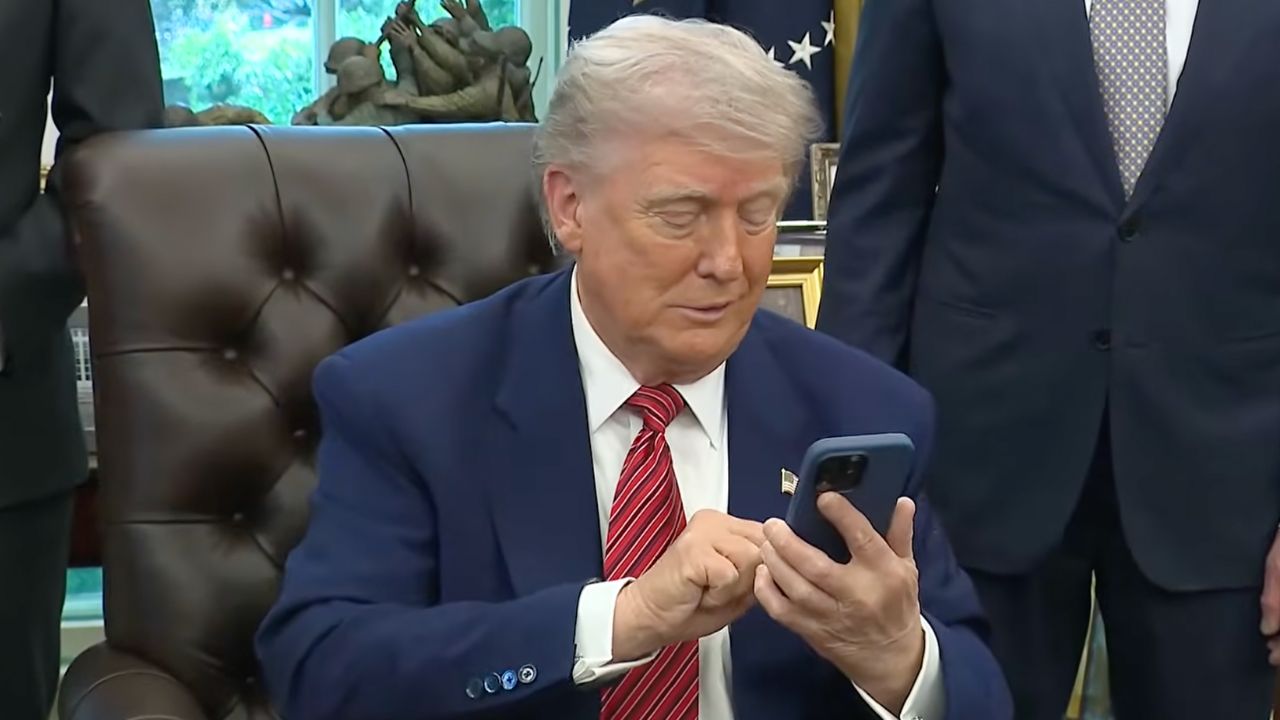
The top Democrats on the House Judiciary and Oversight Committees are demanding that President Donald Trump preserve his conversations with artificial intelligence chatbots, including Elon Musk’s Grok, as they investigate whether the technology influenced the decision to seize Venezuelan President Nicolás Maduro. Reps. Jamie Raskin of Maryland and Robert Garcia of California accuse the president of consulting a chatbot rather than Congress on a military operation.
In a letter unveiled Oct. 30, the lawmakers say “any prompts” submitted to AI chatbots, including Grok, ChatGPT, Claude, Gemini and Perplexity, while Trump carried out his official duties, along with the chatbots’ responses, are the property of the United States and must be preserved. They also request a closed-door briefing by 5 p.m. on Nov. 11.
The request follows a TIME report earlier this month describing a previously undisclosed December 2025 Oval Office meeting between Trump and Musk. According to an official who was present, Trump spent hours asking Grok questions about his presidency and legacy.
At the time, Trump was ordering missile strikes on Venezuelan boats he alleged were smuggling drugs into the United States. The official said he asked Grok how Venezuelans would react if the U.S. captured Maduro. The chatbot responded that Maduro was a repressive and deeply unpopular dictator whose downfall many Venezuelans would likely celebrate. The following month, Trump ordered a military operation to seize Maduro, and celebrations erupted in the streets of Venezuela. Trump came away convinced that Grok was ingenious, according to officials familiar with his thinking.
What the Letter Says
Raskin and Garcia call the episode “deeply troubling.” They write that Trump “consulted Grok—but not Congress—on your military deployment to Venezuela, circumventing Congress’s constitutional power to declare war and introducing instead into American foreign policy decision making a technology that is highly manipulable and demonstrably error-prone.”
The lawmakers also argue that the White House’s use of AI chatbots “exposes the United States to acute national security risks.” They add that the use of privately operated systems leaves the country open to “malign influence from unknown and unaccountable third parties.” The letter notes that Musk has significant business interests in China, one of Maduro’s closest backers.
To show the risks of relying on AI in military matters, the letter points to two reports. The first describes a U.S. intelligence report alleging that a Chinese vessel was carrying components for a nuclear weapons program, which officials later found relied on an AI chatbot that had misidentified the cargo. The second attributes a U.S. strike on an Iranian elementary school, which killed at least 123 children, in part to “overreliance on artificial-intelligence technology.”
The letter closes its argument with a direct demand for transparency. “If an unelected oligarch is influencing U.S. policy through his AI-generated alter ego, Americans have a right to know how governmental decisions are being reached,” Raskin and Garcia write.
The Legal Basis: The Presidential Records Act
The preservation demand rests on the Presidential Records Act, enacted in the wake of the Watergate scandal. The law makes presidential records the property of the public and requires that they be kept separate from personal materials. Amendments passed in 2014 extended it to electronic records, applying the preservation principle to the content of information rather than the medium that holds it. Raskin and Garcia state that Trump’s AI prompts and the outputs he received “plainly fall within the definition of presidential records.”
The statute does not mention AI, however. The most direct federal guidance, from the National Archives, covers agencies under the separate Federal Records Act. It treats prompts and outputs as likely records only if they are captured and saved in an agency system, a caveat critics say limits its reach for commercial chatbots. In April, the Justice Department’s Office of Legal Counsel declared the Act unconstitutional, though the White House has told a court its staff are still preserving materials related to their work. A federal judge ordered the administration in May to preserve presidential records for now.
The letter also lists ten topics for the briefing. They include White House retention policies for AI-generated materials, contracts with chatbot vendors, restrictions on submitting classified information to chatbots, and a description of any use of AI chatbots by Trump in the presence of non-government individuals such as Musk. The lawmakers also ask which email addresses Trump used to access chatbot services and whether outside vendors can access the prompts and outputs.
White House Response
A Trump administration official said the White House “preserves all required records in accordance with the law” but declined to answer specific questions stemming from the letter. A spokesperson for Musk did not respond to requests for comment.
Background: The Maduro Operation and Grok in Government
U.S. forces captured Maduro and his wife, Cilia Flores, in Caracas on Jan. 3, 2026, flying them to New York to face federal narco-terrorism charges. Legal experts immediately questioned whether the operation was lawful, and the administration framed the mission as a law enforcement action. The Maduro operation was the most significant U.S. intervention in Latin America since the 1990 capture of Panama’s Manuel Noriega.
Grok’s role inside government has drawn Democratic scrutiny before. The General Services Administration struck a deal allowing federal agencies to buy Grok models for 42 cents until March 2027, and advocacy groups have pressed the Office of Management and Budget to block the chatbot. House Oversight Democrats, including Garcia, earlier wrote to the GSA, warning that “it appears that federal agencies may be permitted to adopt Grok without following legally mandated procedures that protect privacy and cybersecurity.”
What Comes Next
Raskin and Garcia would be in line to chair the Judiciary and Oversight Committees if Democrats win the House in the Nov. 3 midterm elections. Both letters were copied to the current chairmen, Reps. Jim Jordan and James Comer. A Democratic-controlled House could use hearings, document requests and subpoenas to examine how Trump and his advisers have conducted official business, including how much emerging technologies have shaped decisions.
The Nov. 11 briefing deadline falls just days after the election. Whether the White House complies, ignores the request or fights it could offer an early glimpse of the confrontations that await Trump in the final years of his presidency.