
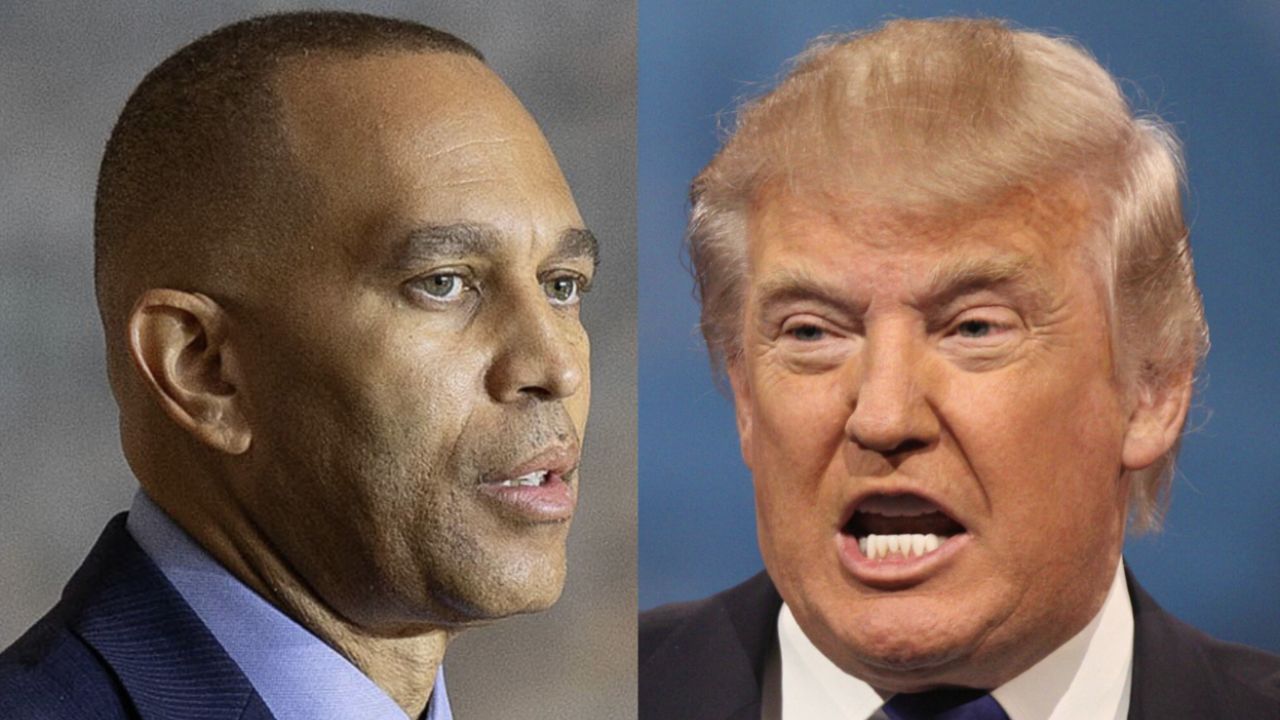
House Minority Leader Hakeem Jeffries used a Saturday morning post on X to renew his attack on President Donald Trump’s handling of the war in Iran, tying the conflict’s mounting American casualties directly to Trump’s own description of the fighting a day earlier as “small potatoes.” The exchange marks the latest flashpoint in a monthslong political battle over a war that has now stretched more than six months, killed at least 18 U.S. service members, and left more than 800 troops wounded, according to figures Jeffries cited in his post.
Jeffries’ Full Statement
Jeffries posted the statement to X at 9:09 a.m. on September 5, 2026, writing in full:
“There have been at least 18 deaths and more than 800 injuries in Donald Trump’s reckless war of choice in Iran.
He calls the conflict ‘small potatoes.’
In reality it’s Operation Epic Failure.”
The post included a video clip of Trump’s Friday remarks in the Oval Office in which the president described the six-month-old conflict as “small potatoes.”
Trump’s “Small Potatoes” Remark
Jeffries’ post was a direct response to comments Trump made Friday, September 4, when he was asked by reporters in the Oval Office about Vice President JD Vance’s assertion a day earlier that the fighting in Iran no longer amounts to a “war.” Trump told reporters the U.S. is now conducting “intermittent” strikes on Iran and said “a lot of people don’t call it a war.” He went on to say, “I can understand what he’s saying,” adding, “I call it a military conflict because it’s small potatoes for us. It’s not a big thing.”
Pressed by a reporter on how he could describe the conflict as “small potatoes” given that 18 U.S. service members have died, Trump pointed to the toll of past American wars by comparison, telling reporters, “We did Venezuela and we did this. In Venezuela, we lost nobody. And this, we lost 18 people. And, in Vietnam we lost 100,000 people. And in other conflicts, we lost tens of thousands of people.” He also defended the broader campaign, saying, “Iran will not have a nuclear weapon because if they did you probably wouldn’t be standing here.”
Vance’s “Not a War” Comments and the Kuwait Strikes
Trump’s remarks came a day after Vance, speaking at a White House press briefing on September 3, rejected the word “war” to describe the ongoing fighting between the United States and Iran. Asked whether the conflict could be resolved before the November 3 midterm elections, Vance told reporters, “I wouldn’t call it a war,” adding, “Right now, there is no active shooting.”
Vance’s comments came even as Iran launched missile and drone strikes against U.S. Gulf ally Kuwait on September 3 in retaliation for earlier rounds of American strikes, according to the Associated Press. Al Jazeera separately reported that Trump told reporters “we’re not fighting right now,” while acknowledging the U.S. continues to enforce a naval blockade in the Strait of Hormuz.
A Six-Month Pattern of Downplaying the War
Al Jazeera noted that Trump has repeatedly avoided calling the conflict a war since it began on February 28, at various points describing it as a “little skirmish,” a “little detour,” and a “little excursion.” The war, waged jointly by the U.S. and Israel under the Pentagon designation “Operation Epic Fury,” was launched with strikes on Iranian military, nuclear and leadership targets and has since expanded into a prolonged campaign involving naval blockades in the Strait of Hormuz and repeated exchanges of fire across the region.
Jeffries’ Long-Running “Operation Epic Failure” Branding
Saturday’s post continued a line of attack Jeffries has pressed since at least June. On June 24, Jeffries released a statement through his House office accusing Trump and Defense Secretary Pete Hegseth of having “plunged America into Operation Epic Failure with no objective, strategy or support,” arguing the war had “cost taxpayers billions, led to the deaths of 13 servicemembers, engulfed the entire region in conflict and skyrocketed the already high cost of living at home.”
In that same statement, Jeffries noted that House and Senate Democrats had pushed through a War Powers Resolution aimed at ending the conflict, and warned that “the Trump administration cannot be trusted with another dime connected to the war” after the White House sought more than $70 billion in additional war funding from Congress.
The following day, at a Capitol Hill press conference, Jeffries said House Democrats “have opposed this war from the very beginning” and argued the conflict had left the United States “weaker relative to Iran than the position that we were in before Donald Trump started this war.” He added that Americans were “forced to pay the price” through higher gas and food prices tied to the war.
By mid-July, Jeffries escalated his criticism further, telling reporters that the war had cost more than $100 billion in taxpayer money and calling the administration’s spending “out of control”. Later that month, Jeffries again went after Trump and Hegseth by name in a televised interview as the U.S. death toll continued to climb, directly holding both officials “accountable for the mounting human cost of the conflict.”
Disputes Over the Casualty Count
The 18-death figure cited by Jeffries has itself been the subject of political friction inside the administration. Commerce Secretary Howard Lutnick said on CNBC on September 2 that “there haven’t been American deaths” in the conflict, prompting Trump to publicly correct him the next day, posting that Lutnick “had Venezuela on his mind when he said nobody was killed” and stating plainly, “18 people were killed in Iran!” Lutnick later said he had “misspoken.”
Independent tracking of the war’s toll has shown wider discrepancies. Wounded totals compiled from Pentagon casualty data have climbed over the summer, rising from roughly 687 to 757 after the Defense Department updated its database in August, while independent tallies not captured by official Pentagon reporting have placed the true number of wounded above 900 — a range that aligns with the more-than-800 figure Jeffries cited in Saturday’s post.
Civilian Casualties and the Kuhestak Strike
The war’s human cost has extended well beyond U.S. military personnel. Iranian officials reported that a September 1 strike on a wedding ceremony in Kuhestak, a coastal town in Hormozgan Province along the Strait of Hormuz, killed at least four people, including a child, and wounded dozens more. Vance told reporters he was “extremely skeptical” of the Kuhestak reports, even as a Reuters analysis cited by outside monitors found the strike was likely caused directly by a U.S. munition. Iran’s Health Ministry separately said 18 people were killed and 142 injured in U.S. strikes between August 30 and September 2, according to a statement posted on X by ministry spokesman Hossein Kermanpour.
The Political Stakes Ahead of November
The dispute over how to characterize the war comes as both parties look toward the November 3 midterm elections, in which Republicans are seeking to preserve narrow majorities in both chambers of Congress. Vance’s refusal to predict an end to the conflict before Election Day, paired with Trump’s effort to minimize its scale, has given Democrats an opening to frame the war as an open-ended and costly failure of leadership. Jeffries’ Saturday post, invoking both the human toll and Trump’s own words, signals that Democrats intend to keep the war — and its casualty count — at the center of that argument through the fall campaign.
Neither the White House nor the Pentagon had issued a public response to Jeffries’ September 5 post as of this writing.