
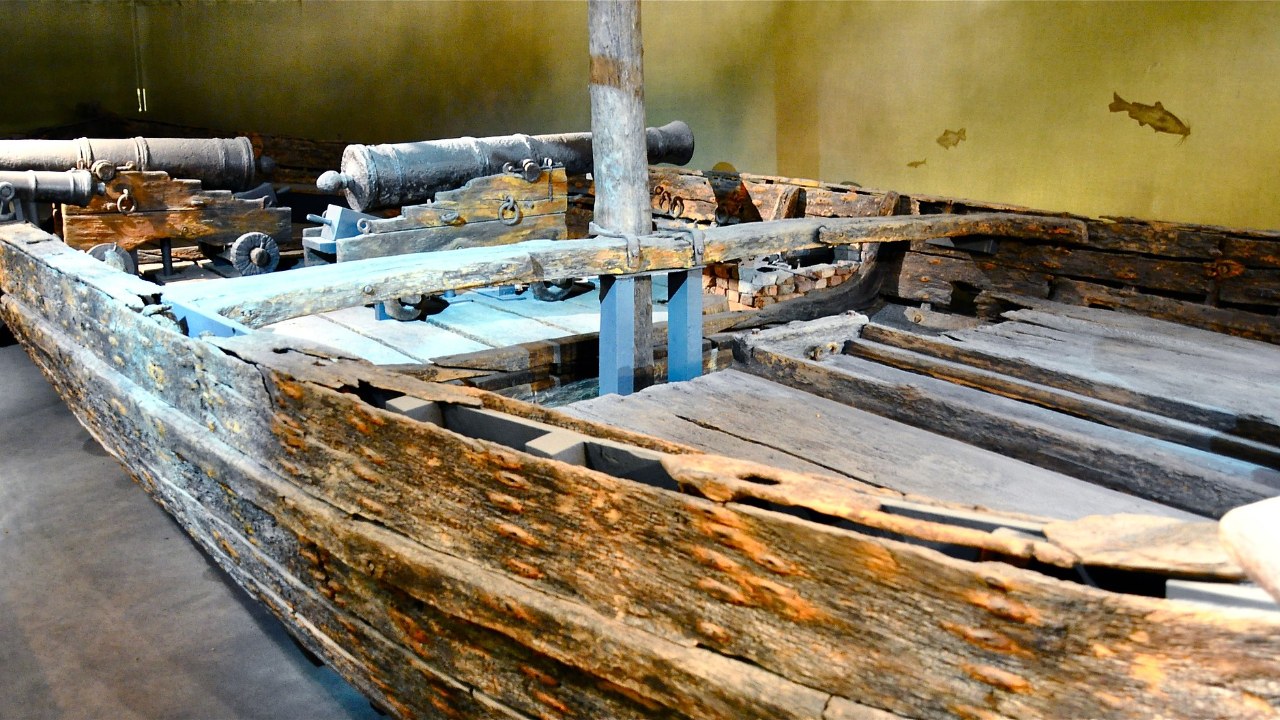
Two hundred fifty years separate the gunboat Philadelphia’s last fight from Oct. 11, 2026. She went down in Lake Champlain on Oct. 11, 1776, during the battle off Valcour Island, one of the American gunboats built in a single summer to meet a British fleet on the lake. Raised from the lake bottom in 1935, the oak-hulled boat now sits inside the Smithsonian’s National Museum of American History in Washington.
The Smithsonian makes a strong claim for her. In the institution’s own words, the 1776 gunboat is “the oldest American fighting vessel in existence.” She lost the battle she was built for, and the cannonball that sank her is in the collection alongside her.
The Smithsonian Institution Archives’ catalog record for the gunboat “Philadelphia” sets out the core facts: built in 1776, sunk on Oct. 11, 1776, in Lake Champlain “during the battle off Valcour Island,” where a British fleet defeated an American flotilla commanded by Gen. Benedict Arnold. The record says she was raised in 1935 and came to the Smithsonian in 1964, and it notes a 12-pounder gun mounted at her bow.
A gunboat built in one summer
Philadelphia was a working boat, not a frigate. A Smithsonian Preservation Periodical article on the gunboat’s conservation (Volume 3, Issue 2, Summer 2024) says she was “originally constructed in the summer of 1776 in upstate New York” and was one of eight gunboats Arnold used at Valcour Island. Her oak hull measures 54 feet long, 15 feet in beam and 5 feet deep, with a 36-foot mast, per the same issue.
She was armed to fight above her weight. The periodical lists “three guns (one twelve-pounder and two nine-pounders)” and refers to “the 44 men that operated the gunboat.” Three guns and 44 men on a 54-foot hull made for a crowded boat.
The fight off Valcour Island
The British brought more ships and heavier guns. The National Park Service’s article on the gunboat Spitfire, another of Arnold’s boats lost in the same action, describes the American fleet under Brig. Gen. Benedict Arnold facing “a superior number of British ships” whose “larger caliber guns” tore holes in the American vessels. Realizing the battle was lost, Arnold withdrew under cover of darkness toward Crown Point, according to the NPS account.
The NPS gives the battle its strategic weight in one line: “the American fleet had forestalled a British attack on Fort Ticonderoga for months, but at great cost.” Philadelphia was part of that cost. Smithsonian Magazine’s Aug. 22, 2025 report on her conservation says she was struck near the bow by a 24-pound cannonball and sank about an hour after the battle ended.
From the lake bottom to the Mall
She stayed on the bottom of Lake Champlain for more than 150 years. Smithsonian Magazine reports that Lorenzo Hagglund, a salvage engineer and World War I veteran, found her, and that his team raised her in 1935. The museum’s collection record for the gunboat says she “was raised by Colonel Lorenzo Hagglund in 1935,” was shown at points around Lake Champlain in the years that followed, and was left to the Smithsonian in Hagglund’s will. The periodical adds that she was recovered from 57 feet below the lake’s surface with her hull mostly intact.
She was installed in the new Museum of History and Technology, now the National Museum of American History, in 1964, the collection record states. The cannonball traveled with her, Smithsonian Magazine reports.
A conservation project timed to the 250th
Age has caught up with the hull. Smithsonian Magazine reported in August 2025 that her timbers were shrinking and her iron fittings disintegrating, and quoted museum director Anthea M. Hartig: “Because of its age and condition, the gunboat is in critical need of conservation treatment.” The project is funded in part by a $750,000 Save America’s Treasures grant from the National Park Service awarded in late 2023 and $1 million from Americana Corner, according to the same report.
The work is being done where she stands, on the museum’s third floor, with viewing windows for visitors. Texas A&M University’s Nautical Archaeology Program said in a Feb. 2, 2026 project update that its team, led by conservator Peter Fix, is working on the ship with the National Museum of American History. The Smithsonian periodical had projected conservation work between March 2025 and June 2026.
Oct. 11, 2026 marks 250 years since Philadelphia went down off Valcour Island. The boat that lost that fight remains on display at the National Museum of American History.
Top image: The gunboat Philadelphia on display at the Smithsonian’s National Museum of American History in Washington, in 2012. Image Credit: Kevin Burkett — CC BY-SA 2.0 / Wikimedia Commons
This article was produced with the assistance of AI and reviewed by Combat Rated editors prior to publication.