
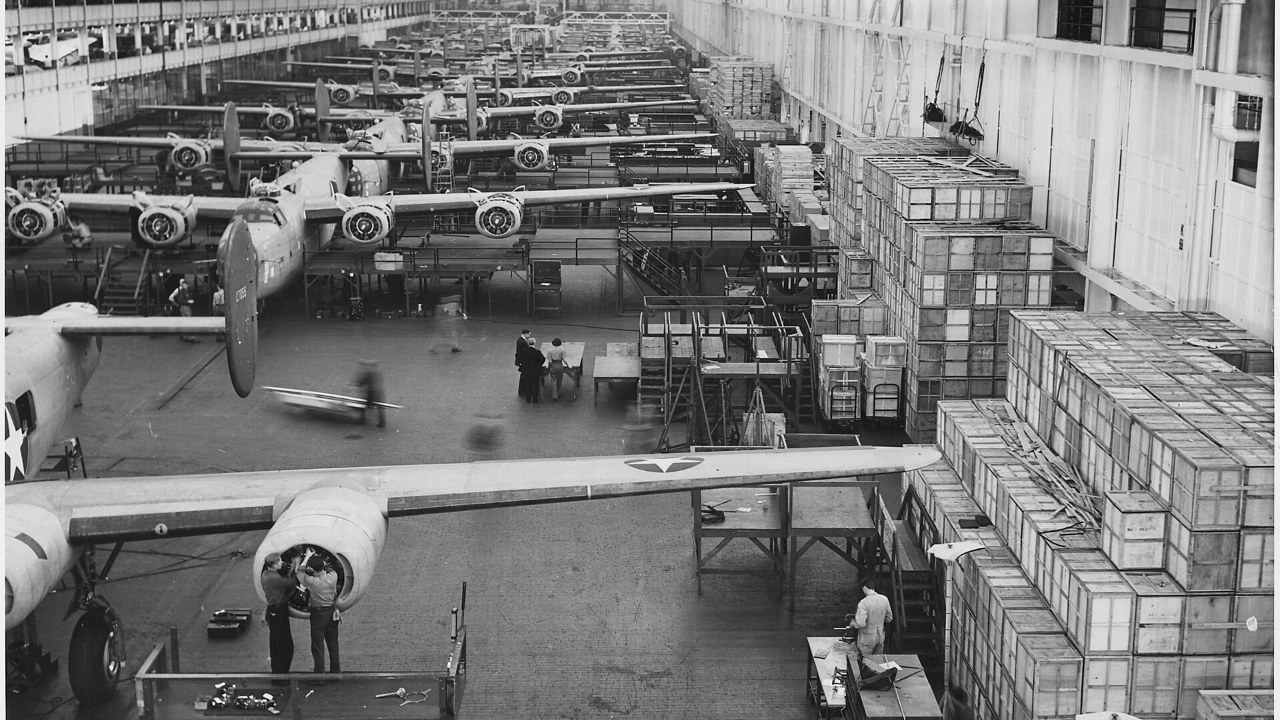
One B-24 Liberator every hour was the promise Charles Sorensen made for Ford’s Willow Run bomber plant in Michigan. Established aircraft makers called it preposterous. At its best, the plant came within a few minutes of the boast: in April 1944, its workers produced 453 bombers in 468 hours, a pace of one finished B-24 every 63 minutes.
It took more than two years to get there, and the first stretch went badly. By June 1945, the mile-long factory had built 8,685 Liberators.
Those figures come from The Henry Ford. The museum’s Willow Run Bomber Plant collection set states that “Charles Sorensen boasted that Ford would produce B-24s at the rate of one each hour. Established aircraft manufacturers, used to a much slower rate, considered the claim preposterous.” On the peak, it says: “At last Willow Run hit its stride in 1944. That April, employees in two nine-hour shifts, working six days a week, produced 453 airplanes in 468 hours — a production rate equal to one finished B-24 Liberator every 63 minutes.”
Sorensen’s boast and the B-24
The B-24 was Consolidated’s bomber. According to The Henry Ford, Sorensen traveled to Consolidated’s San Diego plant with Ford president Edsel Ford, and “Sorensen and his team methodically broke the complex bomber plane into 11 major assemblies, and then further divided these into 69 subassemblies.” The Henry Ford’s catalog describes the result as B-24s built “using automobile mass production techniques.”
The museum’s set describes the scale. The main building “would be more than a mile long with dual, parallel assembly lines,” and its “L” shape kept it from crossing into neighboring Wayne County. The plant was formally dedicated on Oct. 22, 1941, in a ceremony attended by Maj. Jimmy Doolittle of the U.S. Army Air Forces.
A September 1945 aerial photograph in the museum’s collection shows the finished complex. Its catalog description lists several factory buildings, classrooms, a hospital and worker housing, plus an adjacent airport “with six runways and three hangars,” which “allowed finished airplanes to leave the plant under their own power.”
Willow Run’s slow start in 1942
The early record did not resemble the promise. The Henry Ford’s account says Ford struggled to get Willow Run running at full potential, and that the government’s constant design changes to the B-24 were particularly troubling. “Only 56 airplanes were built in all of 1942,” the museum states. “But, as 1943 arrived, problems got solved and Willow Run turned a corner.”
The milestones that followed show the line speeding up. Employees celebrated the 1,000th finished B-24 on Nov. 3, 1943, and the 6,000th airplane in September 1944, per the same collection set.
A production flow chart dated Sept. 1, 1944, also in the museum’s collection, explains how the line was organized. Fuselages were joined to center wing sections and landing gear, then moved along four parallel lines where noses and tails were added. Those lines merged into two for wingtips and engines, and a single final line handled finishing and fueling.
453 bombers in 468 hours
The April 1944 figure is the peak the museum cites, and it is still not quite one an hour. A wartime print of B-24 wing assembly at Willow Run, dated Oct. 13, 1944, in The Henry Ford’s collection, carries the same benchmark in its catalog notes: “at the plant’s peak, Willow Run crews produced an average of one bomber every 63 minutes.”
The workforce behind that number was large. At its peak, according to the museum, Willow Run employed more than 42,000 people. “Approximately one-third of the plant’s assembly line workers were female,” the set states, and at its peak the plant “employed more than 15,000 women — some 35 percent of its total staff.” The museum adds that the skilled women who did this work, at Willow Run and elsewhere, inspired the symbolic “Rosie the Riveter” character. A March 1943 photograph of employees assembling a bomber, also in the collection, notes that women did “everything from clerical work in the offices to riveting and welding on the assembly line.”
8,685 Liberators by June 1945
Willow Run’s final tally is on the museum’s record as well. “Workers at Willow Run built a staggering 8,685 B-24 bombers — 6,792 complete planes and 1,893 knock-down kits,” it says, “by the time the last one was finished on June 28, 1945.”
Not every one of those bombers was finished in Michigan. The catalog entry for a circa-1943 photograph of B-24 assemblies being loaded into a trailer says some 1,800 bombers were sent as partially assembled kits to Consolidated Aircraft Corporation in Fort Worth, Texas, or Douglas Aircraft in Tulsa, Oklahoma, with each plane’s components packed into two specially designed semi-trailers.
By the museum’s figures, Willow Run’s peak fell three minutes short of Sorensen’s hour, from a plant that had built 56 airplanes in all of 1942. After the war, The Henry Ford notes, the plant went to Kaiser-Frazer and later General Motors, which ran it until 2010.
Top image: An assembly line at Ford’s Willow Run bomber plant during World War II. Image Credit: Howard R. Hollem — Public domain / Wikimedia Commons
This article was produced with the assistance of AI and reviewed by Combat Rated editors prior to publication.