
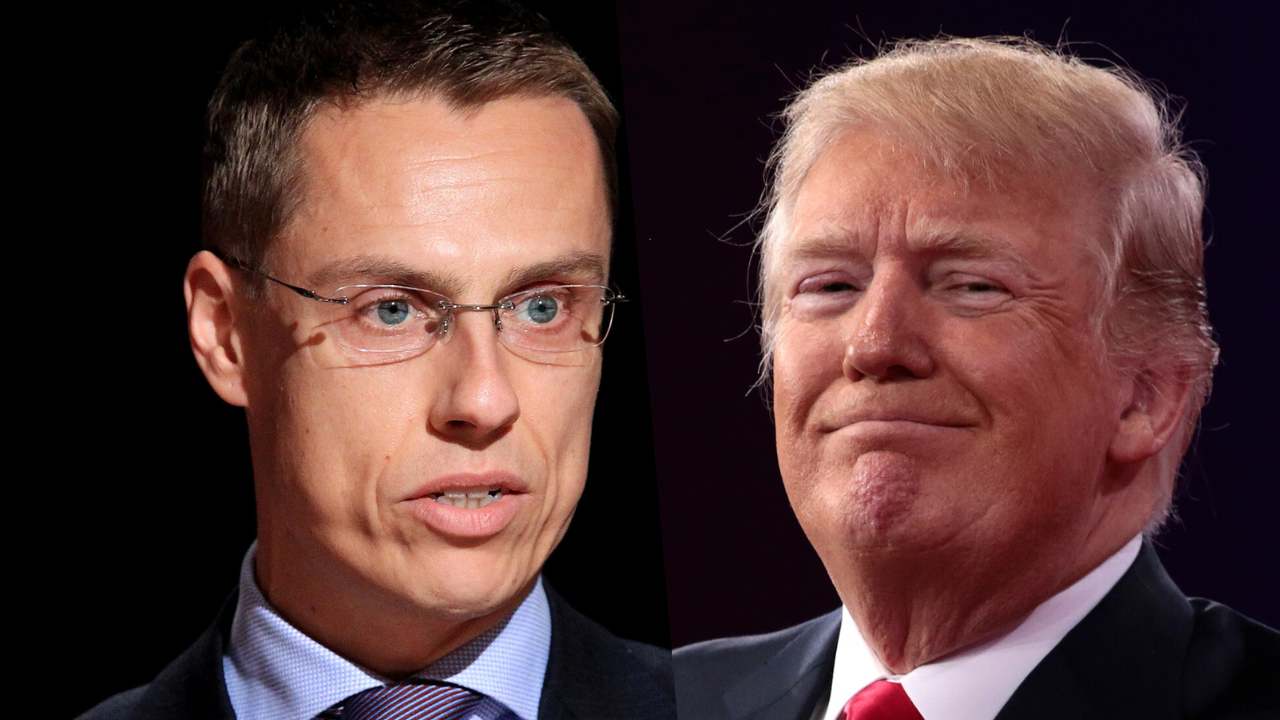
VILNIUS, May 14, 2026 — Finnish President Alexander Stubb offered one of the sharpest European assessments yet of the Trump administration’s foreign policy doctrine during a discussion hosted by the Geopolitics and Security Studies Center in Vilnius, Lithuania, drawing a pointed contrast between America’s post-9/11 coalition-building approach and what he described as a new era of unilateral action that has left NATO allies without consultation on decisions that directly affect their security.
“We didn’t get a mandate on Iraq, but could you join us in a coalition of willing to help?” Stubb said, describing the approach of previous U.S. administrations. “But now, of course, the Americans don’t ask. You go into Venezuela, you don’t ask. You make claims on Greenland, you don’t ask. You go into Iran, you don’t ask. And then the question is, what do we do from a foreign policy perspective?”
The remarks came during a conversation titled “Rebalancing the New World Order: Cooperation in the Age of Fragmentation,” moderated by GSSC Director Linas Kojala — an event focused on the changing world order, the future of transatlantic security, NATO’s role, and Europe’s responsibility for its own defense. Kojala was awarded the Knight First Class of the Order of the Lion of Finland, one of the country’s highest state honors, days after the event.
The President Even Wrote A Book About It
Stubb’s remarks at the GSSC were consistent with the framework he laid out in his January 2026 book The Triangle of Power: Rebalancing the New World Order, published by Biteback. In it, Stubb argues that the liberal world order that emerged after World War II is unraveling and that three global coalitions — the “Global West” led by the U.S. and Europe, the “Global East” led by China and Russia, and the “Global South” led by countries such as India, Saudi Arabia, and South Africa — will determine what comes next.
Stubb argues that the West, “despite the momentary disruption of U.S. President Donald Trump’s unilateralism, remains committed to some sort of reformed and updated multilateral system,” according to a Foreign Affairs review. The book has become required reading in European foreign policy circles and frames much of Stubb’s public diplomacy in 2026.
At the Raisina Dialogue in New Delhi in March, Stubb expanded on the theme, telling the audience that “the era of a Western-dominated world is over” and that the Global South — particularly India — would cast the decisive vote in determining whether the future tilts toward cooperation or fragmentation.
The NATO Troop Drama Stubb’s Remarks Reflect
Stubb’s observation that “the Americans don’t ask” landed against a backdrop of acute NATO turbulence. In early May, Defense Secretary Pete Hegseth ordered 5,000 U.S. troops withdrawn from Germany — a decision that followed Trump’s public anger at German Chancellor Friedrich Merz — and then canceled a planned 4,000-troop rotation to Poland, leaving equipment already in European ports and allies blindsided. The dispatch to Germany of U.S. personnel trained to fire long-range missiles was also halted without prior consultation.
On May 22, Trump reversed himself — announcing he would send 5,000 troops back to Poland after the election of Trump-endorsed Polish President Karol Nawrocki — leaving NATO allies bewildered by Washington’s flip-flopping. Sweden’s foreign minister described the situation as “confusing.” Secretary of State Marco Rubio, appearing at a NATO foreign ministers meeting in Helsingborg, Sweden, insisted the troop decisions were “not a punitive thing” and acknowledged there would eventually be fewer U.S. troops in Europe.
NATO Secretary General Mark Rutte said the U.S. troop withdrawal “will not have an impact on NATO’s defense plans” and would unfold “in a structured way,” noting Washington needed to “pivot more towards Asia.” Finland’s Defense Minister Antti Häkkänen warned separately that Europe must develop a coordinated roadmap with Washington to gradually take over more security responsibilities — precisely the “what do we do” question Stubb posed at the GSSC.
Finland’s Position — Exposed and Prepared
Finland’s perspective on U.S. reliability carries particular weight given its geography. As a NATO member sharing a 1,340-kilometer land border with Russia, Finland is among the alliance’s most exposed frontline states. It joined NATO in April 2023 — ending decades of military non-alignment — and signed a bilateral Defense Cooperation Agreement with the United States that entered into force in September 2024, granting U.S. forces access to 15 Finnish military bases.
Finland is meeting its obligations by every measure. Its defense and security-related spending is projected to reach 2.4 percent of GDP in 2026 — exceeding NATO’s 1.5 percent target and well above the 2 percent baseline, according to Finland’s Ministry of Defence. Finland also purchased 64 Lockheed Martin F-35A fighters in an $8.8 billion deal, and its defense budget has risen from $3.5 billion in 2020 to $6.1 billion in 2023.
The Washington Times noted in a May 2026 report that the Trump administration’s complaints about European defense spending “are meeting a different reality in Finland,” with Finnish Defense Minister Häkkänen stressing that cooperation between the U.S. and Finland is “beneficial for both.”
Venezuela, Greenland, Iran — The Three Cases
The three examples Stubb cited each represent a different dimension of Trump’s unilateral posture. On Venezuela, the Trump administration imposed sweeping Treasury sanctions and invoked the Alien Enemies Act to deport Venezuelan nationals without consulting Latin American neighbors or European allies.
On Greenland, Trump made repeated claims that the U.S. should acquire the autonomous Danish territory — threatening tariffs and refusing to rule out military force — drawing a joint statement of concern from eight European nations including Finland. Stubb told Politico in March that the transatlantic alliance was experiencing “not a rupture, but a rift” — with the “Global North” defending the liberal world order while “the Global West becomes the US that is more transactional.”
On Iran, Trump authorized Operation Midnight Hammer airstrikes on Iranian nuclear facilities in June 2025 without seeking congressional authorization or consulting NATO allies in advance. European capitals were informed rather than consulted — a pattern Stubb described at the GSSC as the defining characteristic of the new American foreign policy posture.
Europe’s Strategic Response
“Our aim is for Europe to be a more equal and capable partner for the United States in the future,” Stubb said in his opening of Parliament address in February 2026. “Capability also enables confidence. Unless backed up by power, strong statements ring hollow.”
Stubb attended the Bucharest Nine Summit on May 13 — a gathering of NATO’s eastern flank nations focused on transatlantic security ahead of the forthcoming NATO summit in Ankara — and engaged in a parallel discussion at the Brookings Institution in April on the same themes of fragmentation and European autonomy.
His answer to the “what do we do” question he posed at the GSSC has been consistent across every forum: build capability, spend more, and develop the strategic autonomy to act whether Washington asks or not.