
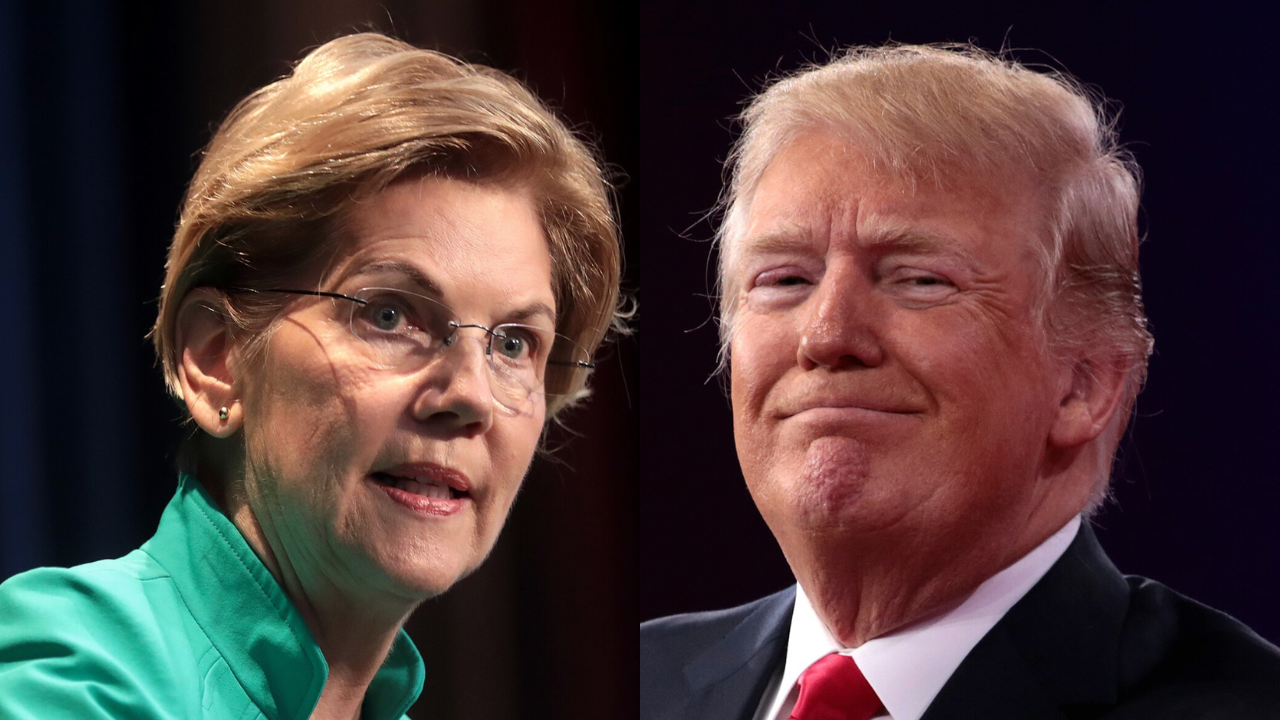
Senator Elizabeth Warren is sounding the alarm over what she calls an unchecked corruption risk at the Pentagon — saying the Defense Department has no effective process to stop President Trump’s sons from profiting off taxpayer-funded defense contracts, and that the department’s own responses to her questions have confirmed its inability or unwillingness to address the problem.
“The Pentagon has NO plan to stop Trump’s family from profiting off lucrative defense contracts,” Warren posted Monday. “I asked. They couldn’t or wouldn’t answer.”
The Specific Company at the Center of the Controversy
The focal point of Warren’s concern is Powerus — a West Palm Beach-based drone manufacturer founded in early 2025 by U.S. Army Special Operations veterans. The company makes drones for commercial and military use and has been aggressively expanding, buying three rival companies in the past six months and raising $60 million from investors, according to Military.com.
In March 2026, Powerus merged with Aureus Greenway Holdings — a Florida-based golf club company listed on the Nasdaq that is partly owned by Donald Trump Jr. and Eric Trump — in a reverse merger that took Powerus public. The Trump brothers joined Powerus’s board following the merger. Their investment firm, American Venture Partners, backed the combined entity. Their boutique investment bank, Dominari Securities — which operates out of Trump Tower — was also involved in the transaction.
Within weeks of the merger, the U.S. Air Force agreed to buy an undisclosed number of Powerus’s Guardian-2 interceptor drones — a semi-autonomous counter-drone system designed to defeat cheap one-way attack drones of the Shahed variety that Iran has been deploying against U.S. and Gulf partner forces, according to Bloomberg. The Pentagon is spending approximately $1 billion to boost domestic drone production, and Powerus is positioned to capture a significant share of that spending.
Warren’s Letters — and What the Pentagon Failed to Answer
Warren’s concern did not begin Monday. On January 22, 2026 — weeks before the Iran war began — she sent the Pentagon a detailed inquiry asking about the department’s contracting decisions involving companies associated with the Trump children, according to CNBC, which reviewed both letters exclusively.
The Pentagon’s response — written by Assistant Secretary of Defense Dane Hughes — said the Office of Strategic Capital “is committed to upholding the highest ethical standards” and that the department “goes beyond minimum regulatory review requirements” by mandating additional supervisor reviews of financial disclosure forms. It did not mention the Trump children by name. It did not explain how the department handles specific contracts involving their interests.
Warren sent a follow-up letter co-signed by Sen. Richard Blumenthal on March 25, calling the Pentagon’s response a failure. “It failed to provide answers to the vast majority of questions that we asked regarding DoD’s decision making process for the contracts and loan guarantees referenced in our January 22 letter,” Warren wrote. “It also suggests that DoD appears to have no effective processes in place to ensure that DoD contracts are being fairly awarded to companies based on our national security and defense requirements — rather than the financial interests of the President’s family.”
Warren’s Core Argument — Why the Pentagon’s Answer Missed the Point
Warren’s sharpest critique is not that Pentagon employees might personally invest in Trump-linked companies. It is something more fundamental. “The mechanism of potential corruption is not at all related to DoD contracting employees’ financial investments,” she wrote. “That mechanism involves the President or his family having inside information or influence over DoD policies and plans, and potential political favoritism by DoD officials who want to be in the good graces of the President or his family.”
In other words, the Pentagon’s ethics framework — designed to prevent government employees from personally benefiting from their own contracting decisions — is structurally incapable of addressing a situation where the president’s sons are invested in a company competing for contracts from a department whose leadership wants to please the president.
The Iran War Connection
The conflict of interest concern is sharpened by the Iran war’s role in driving demand for exactly the products Powerus makes. Powerus was simultaneously pitching its drone interceptors to Gulf countries under Iranian drone attack and negotiating a Pentagon contract — all while the president who launched the war sat in the Oval Office and his sons sat on Powerus’s board, according to PBS NewsHour.
Richard Painter, former chief White House ethics lawyer under President George W. Bush, told the Associated Press: “These countries are under enormous pressure to buy from the sons of the president so he will do what they want. This is going to be the first family of a president to make a lot of money off war — a war he didn’t get the consent of Congress for.”
What the Trump Sons Have Said
Eric Trump sent the Associated Press a statement saying: “I am incredibly proud to invest in companies I believe in. Drones are clearly the wave of the future.” Powerus co-founder Brett Velicovich has insisted the Air Force procurement decision was based purely on merit. “They’re not going to pick a system because of who’s on an investor list,” Velicovich told Bloomberg. “They’re picking because they need it now.”
When CNBC asked the Pentagon about Warren’s March letter, a spokesperson replied only: “As with all congressional correspondence, we’ll respond in writing to the Senator.” Monday’s Warren post — more than six weeks after the March letter — suggests that response has not yet arrived, or has not answered her questions. The Pentagon has not publicly confirmed whether any conflict of interest review was conducted before the Air Force placed its Powerus order, or whether the ethics lawyers were consulted about the purchase. Those are the answers Warren says she is still waiting for.