
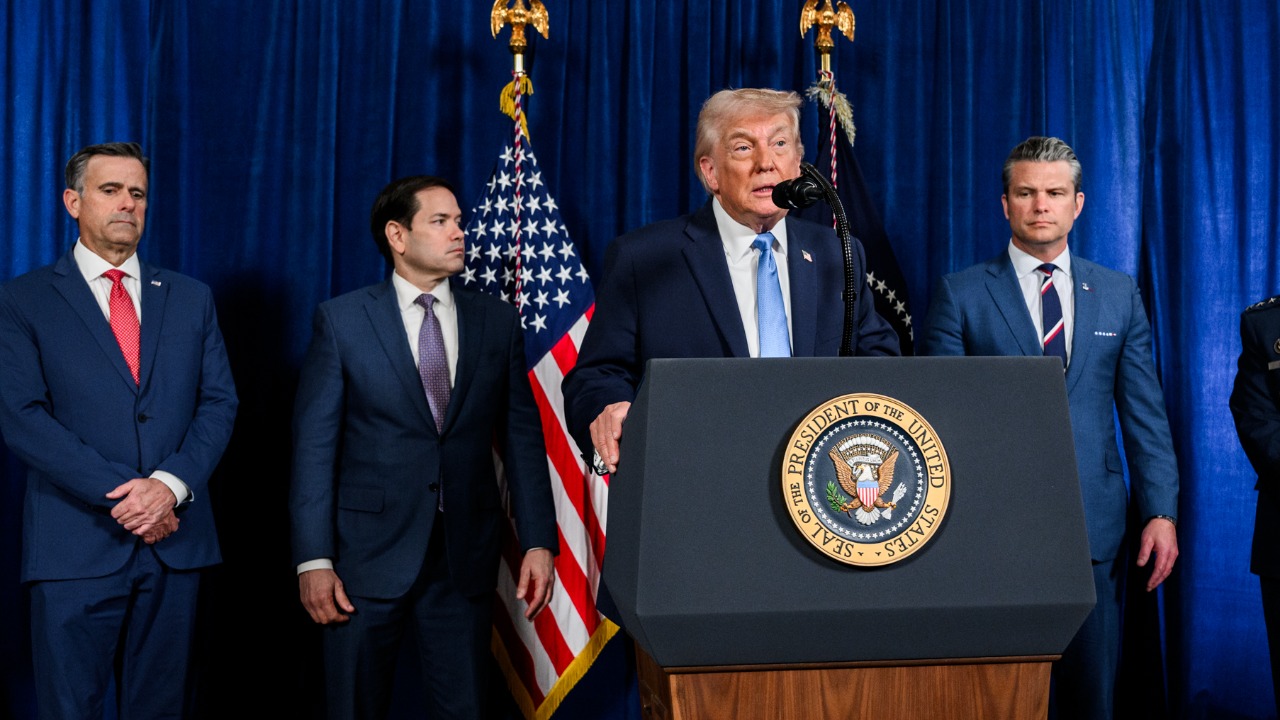
President Donald Trump has turned a long-simmering fascination with Greenland into a blunt strategic ultimatum, telling Denmark that the United States will secure control of the Arctic island on terms Washington chooses. His “easy way or hard way” framing is not just rhetorical bravado, it signals a willingness to test alliances, stretch legal norms, and risk confrontation to reshape the map in America’s favor. I see his latest remarks as a revealing window into how this White House now thinks about territory, power, and the limits of diplomacy.
At the center of the dispute is Greenland itself, a vast Arctic territory with a population of about 57,000 and a location that has suddenly become central to global competition. Trump has tied his push directly to national security, arguing that whoever controls Greenland will shape the future of the Arctic and the balance of power with rivals. By insisting that the United States will move ahead “whether they like it or not,” he has turned a complex question of self-determination and alliance management into a stark test of will.
The “easy way or hard way” doctrine
When I listen to Trump describe his Greenland ambitions, what stands out is how he has converted a speculative idea into a binary ultimatum. He has said the United States will take Greenland the “easy way or hard way,” explicitly raising the prospect of risking war with Denmark to prevent any rival from gaining a foothold on the island. In his telling, the choice for Copenhagen is not whether Washington pursues this goal, but whether Denmark cooperates with a negotiated transfer or faces escalating pressure that could shake the foundations of the relationship.
Trump has framed this as a matter of strategic necessity rather than optional expansionism, insisting that the United States will acquire Greenland “whether they like it or not” in order to block China or Russia from doing so. He has linked this posture to a broader pattern that includes the recent operation in Venezuela, presenting both Greenland and Venezuela as red lines where Washington will not tolerate rival influence.
Greenland, Denmark, and the NATO fault line
From my vantage point, the most destabilizing element of Trump’s Greenland push is how directly it collides with the interests of a NATO ally. Denmark retains formal sovereignty over Greenland, even as the island exercises extensive self-rule, and Trump’s threat to take the territory “the hard way” effectively places Copenhagen on notice that its wishes may be overridden. Analysts have warned that this approach could mark “NATO’s darkest hour,” because it pits the United States against Denmark inside an alliance that is supposed to guarantee mutual defense, not territorial coercion.
Trump has not softened his language even as concerns about an intra-alliance crisis have grown. He has told reporters that “we are going to do something on Greenland whether they like it or not,” and has signaled that he might raise the issue directly with Danish leaders while insisting that the United States cannot allow another power to take over the Arctic island. In parallel, he has warned that Russia and China will not be permitted to control Greenland, tying the island’s fate to missile detection, Arctic sea lanes, and the credibility of the North Atlantic Treaty itself.
Greenlandic resistance and Danish alarm
While Trump speaks in terms of great-power chess, I see a very different story unfolding on the ground in Nuuk and Copenhagen. Greenland’s party leaders have firmly rejected his push for United States control of the territory, stressing that they do not want to be treated as a bargaining chip and that they do not want either Russia or China as neighbors any more than they want to be absorbed by Washington. Their message has been echoed by ordinary Greenlanders who have said “we do not want to be Americans,” a sentiment that cuts directly against Trump’s assumption that the island’s population can be folded into the United States as a strategic asset.
Danish officials and European leaders have reacted with alarm, warning that Trump’s rhetoric risks normalizing the idea that powerful states can simply acquire territory over local objections. Some have pointed out that Greenland, with its roughly 57,000 residents, has its own political institutions and identity that cannot be erased by a unilateral declaration from Washington. In televised remarks, President Donald Trump has nonetheless remained determined to take over Greenland and has prepared to meet with Danish and Greenlandic representatives, even as Greenland’s party leaders reiterate that the island’s future must be decided in Nuuk, not in Washington.
For many residents, the stakes are not abstract. Greenland’s communities are already grappling with climate change, resource extraction, and cultural preservation, and the prospect of being drawn into a geopolitical tug-of-war adds another layer of uncertainty. When I look at their responses, I see a clear assertion of self-determination that complicates Trump’s narrative of strategic inevitability and forces Washington and Copenhagen alike to confront the democratic legitimacy of any proposed change in status.
U.S. politics, Arctic strategy, and what comes next
Inside the United States, Trump’s Greenland gambit has exposed a sharp divide between those who share his hard-edged view of national security and those who see his approach as reckless. He has argued that “we need Greenland from the standpoint of national security, and Denmark is not going to be able to do it,” casting doubt on Copenhagen’s capacity to defend the island and suggesting that only American ownership can keep it out of rival hands. Senator Lisa Murkowski has pushed back, warning that taking Greenland would be “a colossal mistake” that could drive allies away and push the alliance closer to the end of NATO.
Trump, for his part, has doubled down on the military logic. He has said that “we are going to do something on Greenland whether they like it or not,” and has linked that pledge to plans for expanded United States military infrastructure in the Arctic. In one exchange, he argued that if a country wants to protect a place like Greenland, “you have to own it,” a line that encapsulates his transactional view of security and territory. That stance has been reinforced by his comments that the United States is making moves to acquire Greenland in the wake of the operation in Venezuela, and by his insistence that the administration will not allow rivals to take over the Arctic island.
As I weigh these developments, I keep returning to the basic geography that has made Greenland so coveted. The island sits astride key Arctic sea routes and hosts critical facilities such as missile detection sites, making it a focal point for any contest over the High North. Trump has repeatedly highlighted military considerations, while analysts note that control over Greenland would shape access to emerging Arctic shipping lanes and natural resources. His comments that the United States will act on Greenland whether Denmark likes it or not, and that he is prepared to take the island the easy way or, have already galvanized opposition among Greenlanders who say “we do not want to be Americans” and among Europeans who fear a precedent for territorial bargaining inside the alliance. As Greenlanders and Danes push back, the question is no longer whether Trump is serious, but how far he is prepared to go to turn his “easy way or hard way” warning into policy.