
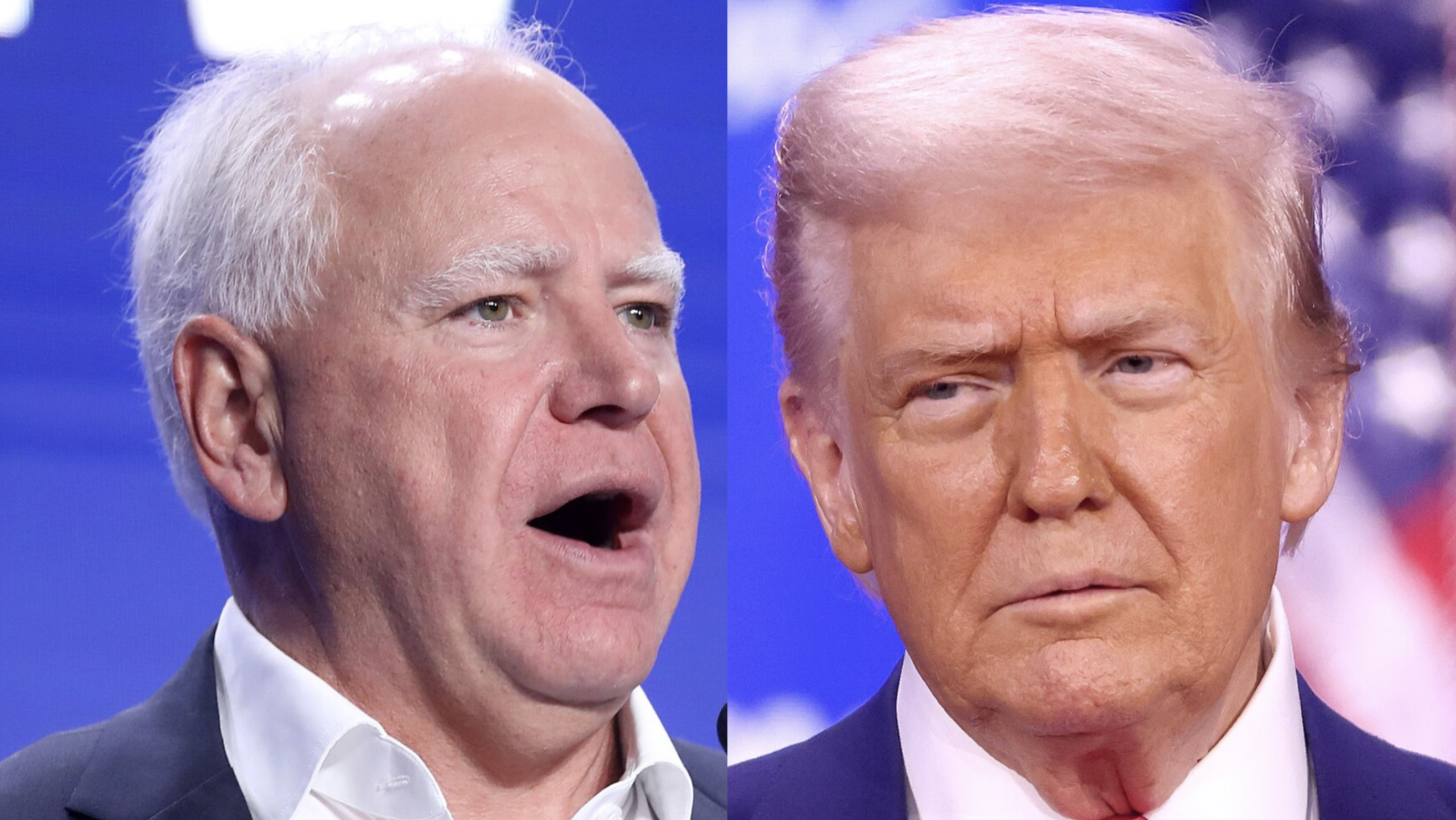
WASHINGTON — The Supreme Court of the United States handed President Donald Trump a decisive defeat on Tuesday, ruling 6-3 in Trump v. Barbara that his executive order seeking to end birthright citizenship violates the Fourteenth Amendment — and no governor in the country reacted more forcefully than Minnesota’s Tim Walz, who declared in no uncertain terms that the president has no authority to define the boundaries of American identity.
Posting to X at 2:26 p.m. on June 30, 2026, Walz wrote:
“Donald Trump does not decide who is American.
The Supreme Court affirmed a defining principle of this great nation:
If you are born on American soil, you are an American.”
The Ruling That Stopped Trump’s Signature Immigration Order
The case originated with Executive Order 14160, signed by Trump on January 20, 2025 — his first day back in the White House — which directed federal agencies to refuse citizenship documentation to children born in the United States if neither parent held U.S. citizenship or lawful permanent residency. The order had never taken effect, blocked by a cascade of federal courts who found it flatly unconstitutional under the Fourteenth Amendment’s Citizenship Clause, which has guaranteed citizenship to virtually all persons born on American soil since its ratification in 1868.
Chief Justice John Roberts, writing for the majority and joined by Justices Brett Kavanaugh, Amy Coney Barrett, Sonia Sotomayor, Elena Kagan, and Ketanji Brown Jackson, affirmed those rulings. Roberts anchored his opinion in the text and history of the Fourteenth Amendment, tracing the American tradition of birthright citizenship to English common law. “Citizenship, then and now, was the right to have rights — to freely participate in our political community,” Roberts wrote. “We keep that promise today.”
A Governor Who Has Consistently Stood Against Trump’s Immigration Agenda
Walz’s reaction on Tuesday reflected a posture he has maintained consistently since Trump’s re-election. As Minnesota’s 41st governor and a 24-year veteran of the Army National Guard, Walz has repeatedly positioned himself as a bulwark against what he views as the Trump administration’s unconstitutional overreach on immigration. During his April 2025 State of the State address, Walz delivered a pointed rebuke of the administration, declaring: “Here in Minnesota, that freedom — freedom from hunger and poverty, freedom to worship or not, freedom to be who you are — is everybody’s birthright, no matter how much money you make or where your family came from.”
As governor, Walz signed legislation extending state health insurance coverage regardless of immigration status, provided undocumented Minnesotans access to state driver’s licenses, and allowed undocumented immigrants to receive free tuition at state universities — policies that placed Minnesota directly at odds with the Trump administration’s immigration enforcement priorities. In 2021, Walz also urged Democratic leaders in Congress to prioritize creating pathways to citizenship for undocumented immigrants, including “Dreamers,” essential workers, and Temporary Protected Status holders.
Walz: “A Defining Principle of This Great Nation”
By calling birthright citizenship “a defining principle of this great nation,” Walz on Tuesday framed the ruling not merely as a legal victory but as a reaffirmation of foundational American values — a characterization aligned with the Supreme Court majority’s own historical analysis. Roberts traced the principle of jus soli — citizenship by birthplace — through centuries of Anglo-American legal tradition, noting it had applied to children of foreigners, including those present temporarily, since long before the Fourteenth Amendment was ratified.
Conservatives dissenting from the majority — Justices Clarence Thomas, Samuel Alito, and Neil Gorsuch — argued the Citizenship Clause was primarily designed for the formerly enslaved and that the majority’s reading devalues American citizenship. In the immediate aftermath of the ruling, President Trump posted on Truth Social calling the outcome “too bad for our Country” and urged Congress to pass legislation restricting birthright citizenship, offering his “Complete and Total Support” for such efforts.
For Walz, who served as the 2024 Democratic vice-presidential nominee alongside former Vice President Kamala Harris, the ruling arrived as one of the highest-profile legal victories against the administration’s second-term immigration agenda. Having spent years pushing back against policies he views as hostile to immigrant communities in Minnesota, his reaction Tuesday — that the president simply does not get to determine who qualifies as an American — encapsulated the central Democratic argument that has been vindicated in the nation’s highest court.