

On a blasted ridge above Okinawa, a slight United States Army medic who refused to carry a rifle did what entire units could not. Desmond Thomas Doss stayed on the Maeda Escarpment after his company pulled back, hauling wounded men to the cliff edge and lowering them to safety one by one. His refusal to quit, even after he was badly wounded himself, turned a quiet conscientious objector into one of World War II’s most unlikely heroes.
Doss’s stand at what soldiers called Hacksaw Ridge has since become a touchstone for courage rooted in conviction rather than firepower. His story, from a strict religious upbringing in Lynchburg, Virginia to the Medal of Honor ceremony with President Harry S. Truman, shows how moral resolve can shape battlefield decisions in ways that defy military logic yet save lives.
From Lynchburg to the front lines
Desmond Thomas Doss grew up in Lynchburg, Virginia, in a home shaped by both hardship and deep religious faith. Raised as a devout Seventh-day Adventist, he absorbed a literal reading of the commandment “Thou shalt not kill,” a belief that would later collide with the demands of a global war. When World War II engulfed Europe and the Pacific, he believed the conflict was just and felt a strong duty to serve as an American, but he was equally certain he could not take a life or even touch a weapon, a tension that would define his military path.
Rather than seek exemption, Doss volunteered for the United States Army as a medical corpsman, requesting the designation of conscientious objector so he could save lives instead of taking them. During training, that stance put him at odds with both the system and his peers. When his company began weapons qualification, Doss refused to pick up a rifle, explaining that he could not handle a gun because of his religion. The decision drew ridicule and disciplinary pressure, yet he held his ground, insisting that his role would be to treat the wounded, not to kill.
Forged in earlier battles
By the time his unit reached Okinawa, Doss was no stranger to combat or to the cost of his convictions. Serving with the 307th Infantry Regiment of the 77th Infantry Division, he had already moved through brutal campaigns where artillery, machine guns, and close-quarters fighting tested every soldier’s nerve. In those earlier battles he built a reputation as a medic who would go forward under fire to reach the injured, a pattern that foreshadowed what he would do on the Maeda Escarpment. Each engagement reinforced his belief that his purpose in uniform was to preserve life, even as those around him carried rifles and grenades.
That record of quiet, persistent service gradually shifted how fellow soldiers saw him. Men who had mocked the unarmed medic began to rely on him when the shooting started, knowing he would come for them if they fell. Accounts of his service describe him repeatedly entering exposed ground to pull comrades back, a habit that earned him respect long before the world heard of Hacksaw Ridge. Those experiences also hardened his practical skills, from improvising bandages under fire to navigating shell-torn terrain, all of which would prove essential on Okinawa’s cliffs.
The night on Hacksaw Ridge
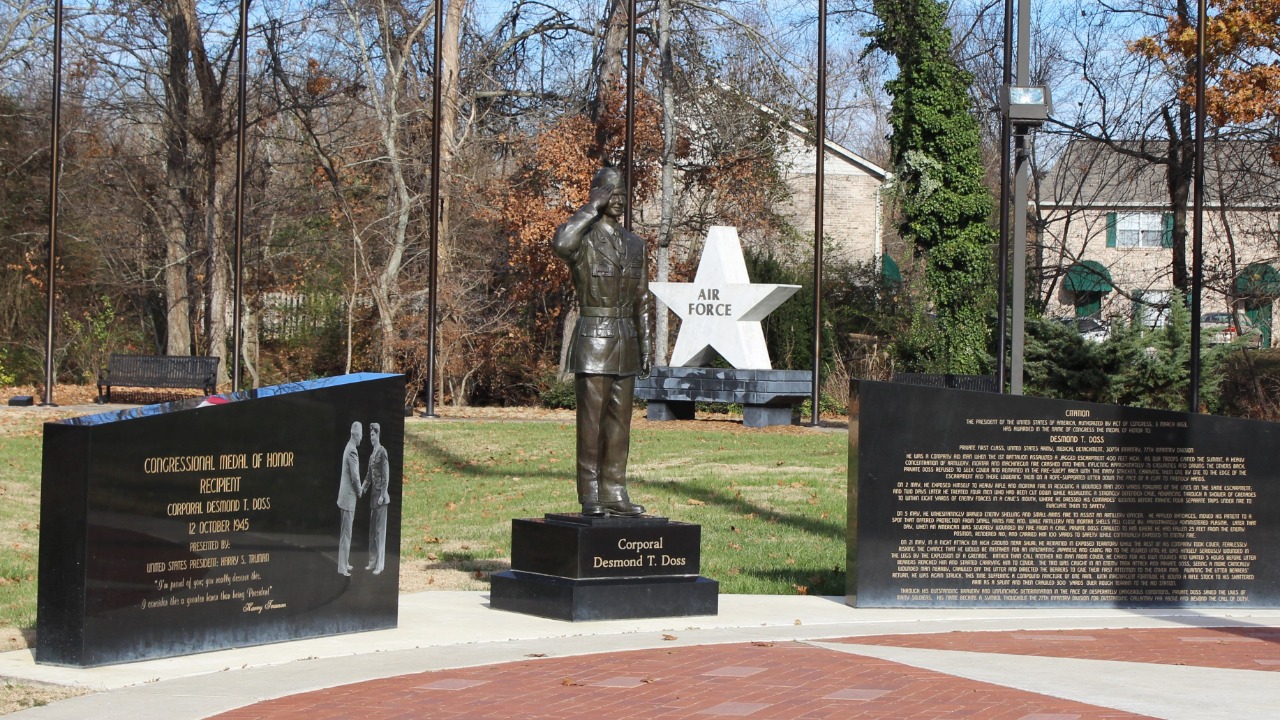
The Battle of Okinawa brought Doss and his regiment to the foot of the Maeda Escarpment, a 400 foot cliff that American troops had to scale using cargo nets before facing entrenched Japanese defenses on top. In May 1945, after his unit fought its way onto the plateau, it was met by intense machine gun and artillery fire that shredded formations and pinned survivors in place. When commanders finally ordered a retreat back down the cliff, dozens of wounded American soldiers were left scattered across the exposed ground, unable to move without being cut down.
Doss chose to stay behind alone on the plateau as the rest of the unit withdrew. Through the long hours that followed, he crawled and ran through the kill zone, searching for the wounded while enemy fire swept the ridge. Each time he found a man alive, he treated what he could on the spot, then dragged or carried the soldier to the escarpment’s edge. There he rigged a rope sling and lowered each casualty down the sheer face to waiting hands below. With every successful descent he prayed, “Lord, help me get one more,” then turned back into the darkness and gunfire. By the time he finally came down, he had saved an estimated seventy five men, a figure later cited in his Medal of Honor record.
Wounded, yet refusing rescue
The ordeal on Hacksaw Ridge did not end when the last man went over the edge. Days later, during another night attack on Okinawa, Doss was hit by shrapnel that tore into his legs and hip. True to his pattern, he refused to call another medic into the open to treat him, choosing instead to care for his own injuries while he lay exposed. According to his Medal of Honor citation, he waited roughly five hours before litter bearers could reach him, time he spent stabilizing himself as best he could under continuing fire.
When the stretcher team finally started carrying him toward safety, Doss spotted another soldier nearby who was more gravely wounded. He insisted that the bearers put him down and take the other man first, sacrificing his own chance at immediate treatment. Left alone again, he was struck by a sniper’s bullet that shattered his left arm. With his limb broken and his body already torn by shrapnel, he fashioned a splint using the stock of a rifle, the very kind of weapon he had refused to carry throughout the war, and then crawled roughly 300 yards over rough ground to reach the aid station. That sequence of choices, prioritizing others even while gravely hurt, became central to the official account of his heroism.
Medal of Honor and enduring legacy
For his actions on Okinawa, Desmond Doss received the Medal of Honor, the highest American award for valor in combat, becoming the first conscientious objector in United States history to be so recognized. At the White House ceremony, President Harry S. Truman presented the decoration and reportedly told him that he considered the honor of awarding it greater than being president. The citation highlighted Doss’s “outstanding bravery and unflinching determination in the face of desperately dangerous conditions,” language that captured both the scale of the danger and the persistence with which he faced it without a weapon.
Decades later, his story reached a global audience through the film Hacksaw Ridge, which cast Andrew Garfield as Doss and depicted the Maeda Escarpment fighting in harrowing detail. The production drew on accounts of his life that described how some real events were so extraordinary that filmmakers worried viewers would not believe them if shown exactly as they happened. Yet the core facts remained: a medic from Lynchburg, Virginia, who would not touch a gun, saved scores of men under fire, treated his own wounds rather than endanger others, and crawled to safety with a broken arm splinted by a rifle stock. In an era when military heroism is often associated with superior firepower or aggressive tactics, Doss’s record at Okinawa stands as a reminder that courage can also mean refusing to kill, holding to conscience, and going back into danger simply to bring one more person home alive.