
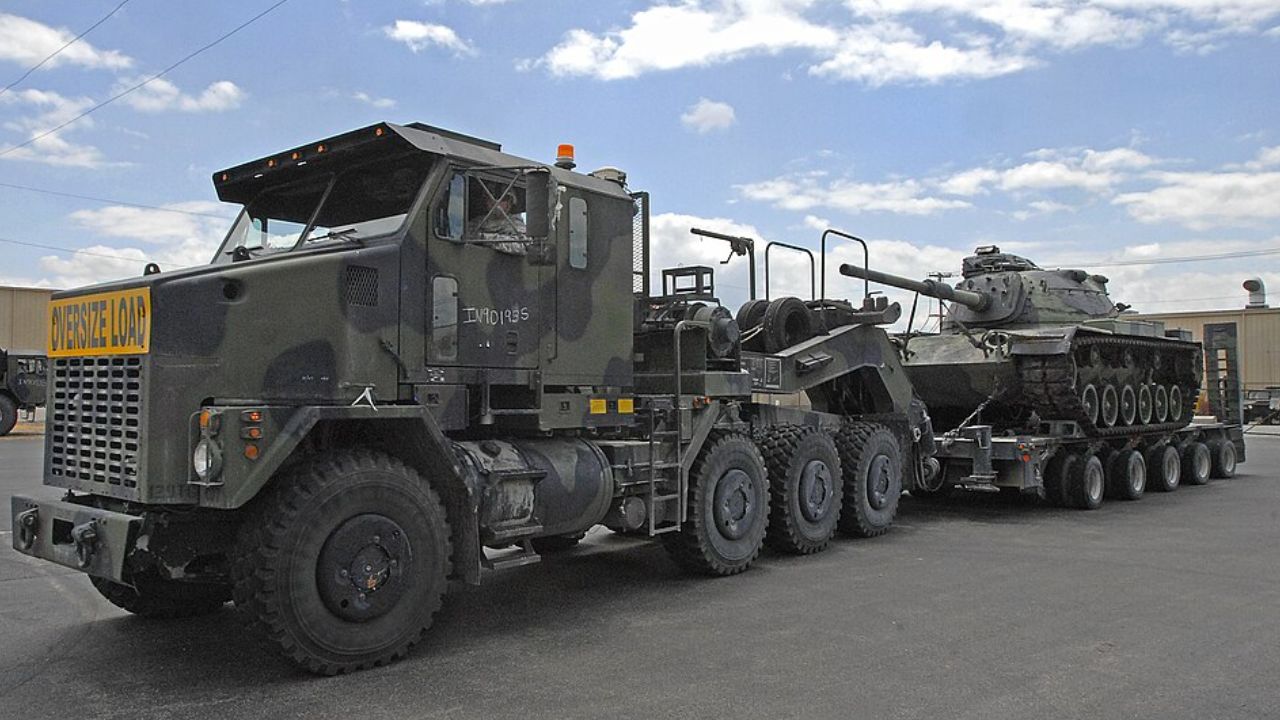
If you’ve ever watched footage of tanks rolling through a city and thought, “How did those things even get there?”—the answer is often less glamorous than the tank itself. It’s logistics, it’s timing, and it’s a lot of heavy metal moving in the right order. For the U.S. Army and its partners, one of the workhorses that made that happen was the M1070 Heavy Equipment Transporter, better known by crews as the tractor that hauled the real stars.
Built to move armored vehicles quickly without burning up their tracks or chewing through roadways, the M1070 helped turn “we need armor over there” from a wish into a schedule. In practice, it meant tanks and other heavy vehicles could arrive ready to fight, while crews arrived less exhausted, and maintenance teams got a fighting chance to keep up. It wasn’t flashy, but it was the sort of capability that quietly changes what commanders can realistically do.
A hauler with a very specific job
The M1070 is the prime mover in the Heavy Equipment Transporter (HET) system, typically paired with the M1000 semi-trailer. Think of it as a purpose-built big rig for the military, except the “cargo” might be a main battle tank weighing dozens of tons. Its whole reason for existing is to move heavy tracked vehicles over long distances faster and more safely than they can move on their own.
That matters because tanks are great at fighting, not at commuting. Long road marches wear down tracks, eat up fuel, and rack up maintenance hours that units would rather spend on training or readiness. Put the tank on a trailer and suddenly you’re saving the vehicle for the moment it’s actually needed.
Why not just drive the tank?
On paper, a tank can drive itself anywhere, and that’s true in the same way a person can jog across a country. You can do it, but you’ll arrive tired and with a lot of things that need fixing. Tracks and road wheels take a beating on pavement, and the vibration alone can loosen, stress, or wear components in ways that don’t show up until later.
There’s also the boring-but-real world of traffic management, bridge limits, road damage, and the small detail that tracked vehicles can be rough on civilian infrastructure. A transporter makes it easier to use established road networks without turning every movement into an engineering problem. Plus, it’s simply faster for repositioning across a theater when time matters.
The M1070 and the art of moving heavy things
The M1070 was designed around one clear requirement: handle enormous loads reliably, in ugly conditions, with soldiers who may be doing the job in the rain at 2 a.m. It’s an 8×8 tractor with the kind of torque and traction you’d hope for when you’re towing something that makes normal trucks look like toys. When paired with the M1000 trailer, the system can carry heavy armored platforms and other oversized equipment that would otherwise require complex rail or air planning.
In real operations, that capability translates into flexibility. Need to shift armor from one base to another without telegraphing a slow, noisy road march? Load up and go. Need to recover a vehicle that’s still operational but shouldn’t be driven further? A HET mission can solve that problem without turning it into a multi-day maintenance saga.
From training grounds to real-world deployments
Over the years, the M1070 became a familiar sight on major training rotations and overseas deployments, because heavy armor doesn’t magically appear at the right grid square. Units used the transporter to shuttle tanks, infantry fighting vehicles, and engineering gear between ports, railheads, depots, and forward positions. It’s the connective tissue between “strategic movement” and “tactical employment,” even if nobody puts that on a recruitment poster.
It also helped armies reduce wear on their fleets during long deployments. When you’re operating far from home, parts and time are precious, and unnecessary mileage is the enemy. A transporter can quietly save thousands of track miles across a brigade’s worth of vehicles, which adds up to real readiness.
Loading, securing, and the little details that matter
One of the underappreciated parts of a tank transporter’s job is not the driving, but everything that happens before the wheels turn. Loading a tracked vehicle onto a trailer isn’t hard in concept, but it demands careful alignment, proper ramp setup, and constant attention to safety. Then comes chaining and securing the load, because nobody wants 60-plus tons of armor shifting when the driver brakes.
Those tie-down routines are where professionalism shows. Crews follow strict procedures, check tension, verify connection points, and re-check after movement begins. It’s not glamorous work, but it’s the difference between a smooth convoy and an incident report that ruins everyone’s week.
Mobility isn’t just speed—it’s endurance
The M1070’s value is easy to miss if you only think of mobility as “how fast can the tank go.” In logistics, mobility is also endurance: how long can you keep moving combat power without breaking your own equipment or burning through your support capacity? A transporter lets armored units arrive with more of their service life intact, and it keeps maintenance crews focused on actual damage and wear from operations, not pointless road miles.
There’s also a human factor. Tank crews already deal with cramped spaces, noise, and long hours, and a road march can be exhausting before the fight even starts. Riding the transporter instead of clanking along on tracks can help crews show up sharper, which is a small advantage that becomes big when repeated across an entire formation.
A not-so-secret enabler of armored power
People tend to celebrate the tank, the aircraft, the missile system—the things that make the dramatic footage. But big military capabilities are often built on unglamorous platforms that haul, fuel, fix, and feed everything else. The M1070 sits right in that category: a specialized tool that makes heavy forces practical to deploy and reposition.
And it does it in a way that’s almost funny when you think about it. The tank is the symbol of brute strength, yet it frequently depends on a truck and trailer to get to work on time. It’s a reminder that modern military power isn’t just about having the toughest machine—it’s about moving it, sustaining it, and keeping it ready for when it actually counts.
What the M1070 represented for commanders and planners
For planners, the M1070 meant options. It enabled faster repositioning of heavy units, smoother coordination with port and rail infrastructure, and a more predictable tempo for large-scale movements. When commanders can move armor without draining readiness, they can take bolder approaches and respond to changing situations with less delay.
That’s why the M1070’s story is really a story about logistics as an operational advantage. It didn’t win attention the way a tank does, but it helped ensure tanks showed up where they were needed, when they were needed, in fighting shape. In the world of armored warfare, that’s not background noise—it’s the main plot, just told from the driver’s seat of a very heavy truck.