
Six companies now sit in the final stage of a Defense Department program built to answer one question about quantum computing: can anyone build a machine whose computational value exceeds its cost by 2033? DARPA announced on Oct. 7, 2026, that Atom Computing, Diraq, IBM and IonQ had advanced to Stage C of its Quantum Benchmarking Initiative, or QBI. They join Microsoft and PsiQuantum, which reached Stage C earlier through a pilot program.
The four newcomers bring four different hardware approaches, according to DARPA. Atom Computing, of Boulder, Colorado, works with scalable arrays of neutral atoms. Diraq, of Sydney, Australia, uses silicon CMOS spin qubits. IBM, of Yorktown Heights, New York, is pursuing modular superconducting processors, and IonQ, of College Park, Maryland, builds trapped-ion quantum computers.
DARPA’s Oct. 7 announcement states the program’s goal in one line: QBI “seeks to determine whether any quantum computing approach can achieve utility-scale operation – meaning its computational value exceeds its cost – by the year 2033.” Microsoft and PsiQuantum advanced after taking part in the Underexplored Systems for Utility-Scale Quantum Computing effort, or US2QC, which DARPA describes as a pilot precursor to QBI.
What Stage C tests
QBI moves organizations through three stages. DARPA’s program page describes Stage A as describing a utility-scale concept “that has a plausible path to realization in the near term,” and Stage B as developing a research and development plan capable of building it. Stage C is the verification step, where the company works with the government to show the concept can be built and operated as intended.
In the Oct. 7 announcement, DARPA said the yearlong Stage B examined each organization’s research and development plans, technical risks, mitigation strategies and the prototypes needed to show progress. “In Stage C, QBI’s government evaluation team will work alongside the organizations to test whether their proposed utility-scale systems can ultimately be constructed as designed and operated as intended,” the agency wrote.
Micah Stoutimore, QBI’s managing director, described the shift from paper to hardware in the same release:
“Stage C is where we begin moving from plans to proof. Our team will be closely scrutinizing the hardware and systems as they develop to determine whether the technology performs the way the models and roadmaps say it should.”
The money rises with each stage. The QBI program page lists awards of up to $1 million for Stage A, up to $15 million for Stage B and up to $300 million for Stage C.
A benchmark, not a contest
DARPA is explicit that QBI does not pick a single winner. “QBI is not a competition between companies; it is not intended to pick winners and losers,” the Oct. 7 release says. The program page describes its role as “unbiased third-party verification and validation of an organization’s path to a utility-scale quantum computer,” with results communicated “to other U.S. government stakeholders.”
That is the defense interest as DARPA itself frames it. The agency, the Pentagon’s research arm, describes its focus on the program page as “high-risk, high-reward R&D to maintain a technological advantage for the United States.” QBI’s job is to tell the government which commercial approaches, if any, hold up under independent scrutiny.
The field of candidates is still moving. Per DARPA, QBI has evaluated more than 20 companies since it launched in mid-2024, and Quandela joined Stage A in May 2026. The agency said it expects to select more companies from a recent Stage A solicitation and anticipates more promotions to Stage C.
“The quantum computing field is moving quickly, and we increasingly expect that someone will build a utility-scale quantum computer by 2033,” Stoutimore said in the release. “What we don’t yet know is which team or teams, or which technical approach or approaches, will get there.”
Promised versus tested
Nothing in DARPA’s announcement says any of the six companies has built a utility-scale machine. The release gives no qubit counts and no performance results. Stage C exists to find out whether the hardware matches what the companies’ roadmaps predict.
The companies’ own statements are claims, not test results. In an Oct. 7, 2026 release, IonQ said its Stage C agreement has a potential value of up to $300 million, with funding beyond the initial obligation dependent on future appropriations and DARPA funding actions. IonQ said it will provide multiple generations of its Superion systems for DARPA’s independent verification and validation, and that Stage C runs through 2029.
If IonQ’s timeline holds for the group, the government’s evaluation team will spend the next several years checking hardware against roadmaps, with DARPA’s 2033 question still open at the end of it.
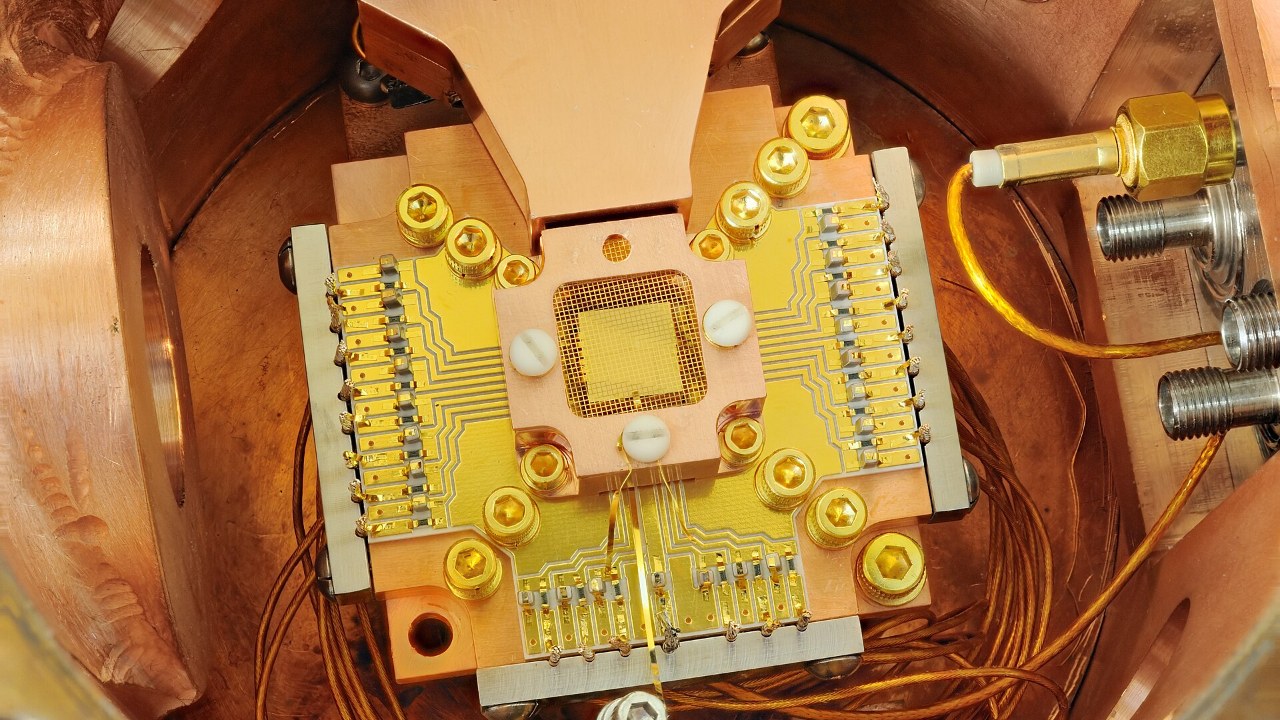
Top image: An ion-trap apparatus NIST physicists used in trapped-ion quantum research. It is not one of the QBI teams’ machines. Image Credit: National Institute of Standards and Technology — Public domain / Wikimedia Commons
This article was produced with the assistance of AI and reviewed by Combat Rated editors prior to publication.