
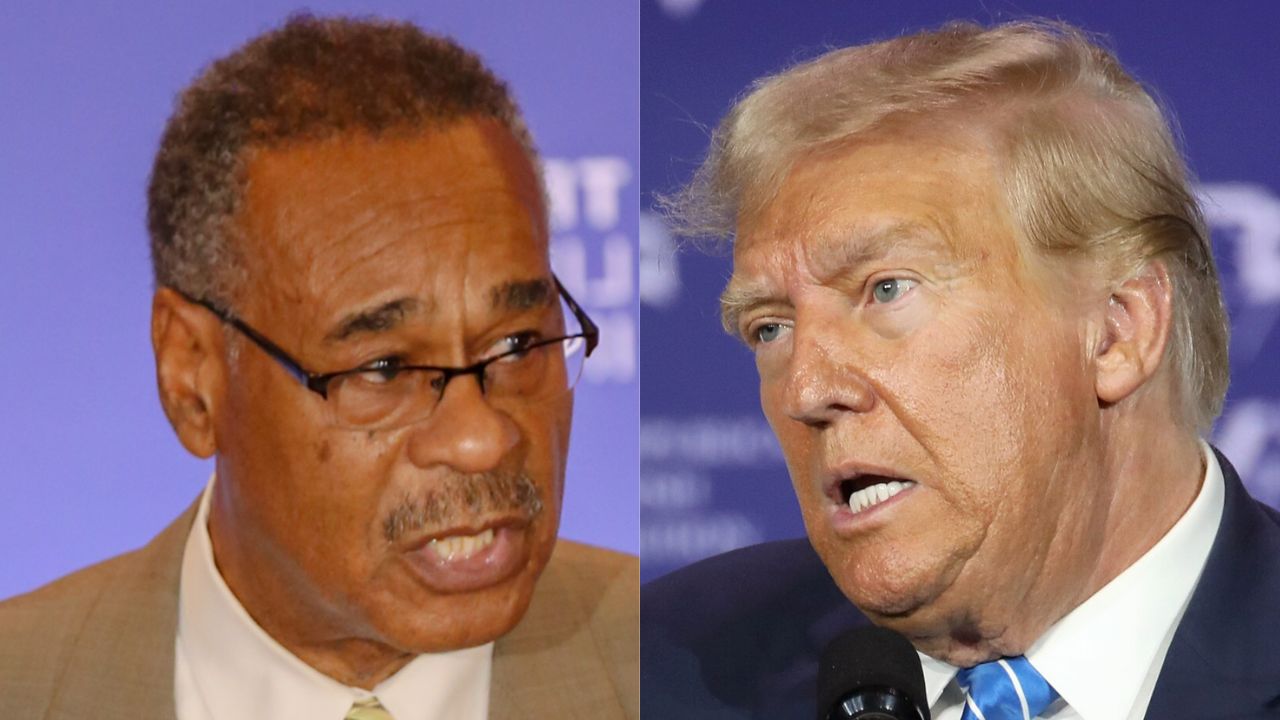
Representative Emanuel Cleaver accused President Donald Trump of prioritizing his relationship with Russian President Vladimir Putin over America’s European partners and Ukraine, warning that the administration’s approach could prolong the war and undermine U.S. national security. The Missouri Democrat made the criticism on November 20 as European governments faced renewed concerns about Russian military activity and Trump’s latest diplomatic engagement with Putin. His statement followed a report detailing Trump’s discussions with European leaders about the financial and human costs of continuing support for Ukraine.
Cleaver published his criticism on X while sharing a Politico report titled “After Putin talks, Trump tells Europe it could save lives and cash if Ukraine war ends.” The November 19 article described a telephone conversation between Trump and European leaders following his meeting with Putin and Chinese President Xi Jinping. It reported that Trump emphasized the potential savings for European countries if the war ended, while several European officials expressed caution about his assessment of Putin’s willingness to negotiate.
The complete post read:
“While innocent civilians are being killed in Ukraine, the president continues to side with Vladimir Putin over our partners in Ukraine and Europe.
His actions only embolden Putin, prolong this horrific war, and undermine America’s national security.”
The Politico report described Trump’s call with European leaders in Berlin on November 19, during which he discussed the costs associated with continued military and financial assistance to Ukraine. Several European officials briefed on the discussion said Trump had expressed concern about the billions being spent on weapons and other assistance. Some described his tone as critical of Europe’s continued support for Kyiv, while others characterized his remarks as an effort to emphasize the benefits of reaching a peace agreement.
The report also included the White House’s response to the characterization of Trump’s remarks. A White House official disputed suggestions that Trump had instructed European governments to stop funding Ukraine, saying the president had emphasized the financial and human costs of the war and had praised European leaders for their efforts. Trump’s envoys Steve Witkoff and Jared Kushner also told European officials that the administration remained committed to negotiations and wanted Europe involved in the process. The distinction matters because the report described differing interpretations of Trump’s remarks rather than an explicit announcement ending American assistance.
Cleaver’s criticism reflects a broader position he has expressed regarding Russia’s invasion and the treatment of Ukrainian civilians. On April 20, 2024, he supported the bipartisan national security assistance package that included approximately $60.8 billion in assistance for Ukraine. He argued that democracies must confront authoritarian aggression and supported providing Ukraine with additional weapons, ammunition and air-defense capabilities to resist Russia’s invasion.
In that statement, Cleaver invoked the historical consequences of appeasing dictators seeking to expand their power. He argued that the United States should stand with democratic allies and resist authoritarian aggression. His vote also supported humanitarian assistance for civilians affected by the war, including funding included in the broader international security package. The position established a public record of support for Ukraine that predates his latest criticism of Trump’s dealings with Putin.
Cleaver has continued to address Ukraine through congressional action. In June 2026, he voted in favor of H.R. 2913, the Ukraine Support Act, which passed the House on June 4 by a vote of 226-195. He also supported the resolution providing for consideration of the legislation. Those votes provided another indication of his support for maintaining congressional assistance to Ukraine as Russia’s invasion continued.
His position on the administration’s broader foreign policy has also involved concerns about congressional authority and American security. On March 5, 2026, Cleaver supported a War Powers Resolution seeking to restrict Trump’s unauthorized military campaign in the Middle East. Although that measure concerned Iran rather than Ukraine, it demonstrated his willingness to challenge the administration’s military decisions through Congress when he believed constitutional authority had not been adequately respected.
Cleaver has also directly criticized Trump’s public treatment of Putin. In a November 19 statement, he described the Russian president as a “murderous dictator and war criminal” and accused him of approving the intentional killing of Ukrainian civilians. Cleaver contrasted that description with Trump’s public reference to Putin as a friend during their recent meeting in China, calling the president’s approach “abominable.” His November 20 post continued that criticism by arguing that Trump’s relationship with Putin was damaging the United States’ standing with its European partners.
The senator and congressman’s concerns about European partnerships are particularly relevant to the Politico report. German Chancellor Friedrich Merz defended continued European assistance to Ukraine, arguing that military support was necessary to allow negotiations to proceed from a position of strength. Polish Prime Minister Donald Tusk also expressed caution about Trump’s confidence in Putin’s intentions, saying that the Russian president’s goodwill had yet to be demonstrated through concrete actions. Those remarks reflected the concerns among several European governments about the possibility of a settlement that could leave Ukraine vulnerable.
Cleaver’s reference to American national security also reflects the wider implications of Russia’s invasion for NATO and European stability. A weakened Ukraine could create additional security concerns for neighboring countries and place greater pressure on NATO members along the alliance’s eastern flank. His criticism is that American support for Ukraine is not simply a matter of assistance to a foreign government but also part of maintaining the security relationships that protect U.S. interests in Europe.
The November 20 statement therefore continues a pattern of public opposition to Russia’s invasion, support for congressional assistance to Ukraine and criticism of Trump’s approach toward Putin. Cleaver’s latest argument is that the administration’s diplomatic signals and treatment of European allies could encourage the Russian president to continue military operations rather than negotiate a settlement that respects Ukraine’s sovereignty. His record includes support for Ukraine assistance legislation, condemnation of Russian aggression and repeated criticism of what he views as Trump’s willingness to accommodate Putin.