
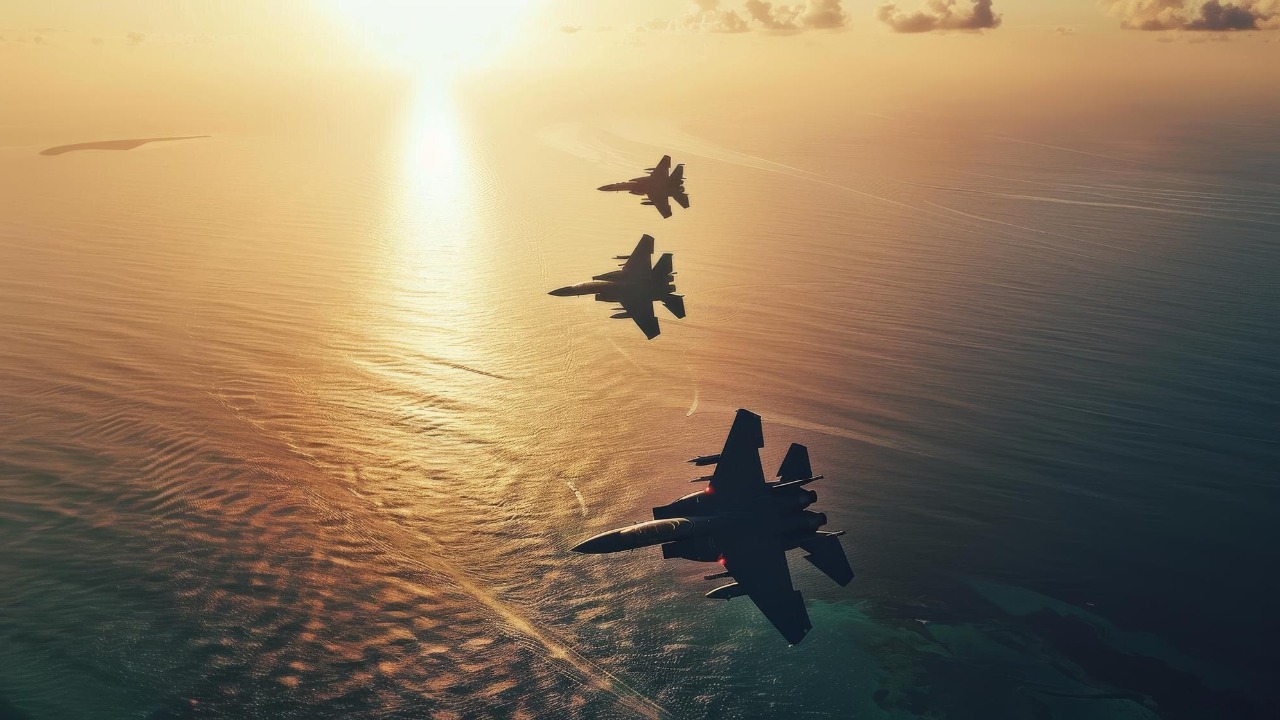
China’s military has announced that it forced a Philippine aircraft to leave the skies near a contested reef in the South China Sea, sharpening an already volatile standoff over one of the region’s most sensitive flashpoints. The encounter unfolded near Scarborough Shoal, a rich fishing ground claimed by both countries and patrolled heavily by Chinese forces, and it has quickly become another test of how far Beijing and Manila are prepared to push their competing claims. The incident also lands at a moment when both governments are trading increasingly sharp words over maritime rights and the risks of miscalculation.
China’s account of the aerial confrontation
Chinese authorities framed the latest run-in as a straightforward act of defense, saying their forces identified a Philippine aircraft approaching a disputed reef and ordered it to turn away. The Chinese military stated that the aircraft was warned it was entering Beijing-claimed airspace and was turned away after ignoring radio calls. A similar description of the encounter was carried in a maritime bulletin from Maritime Activity Reports, which cited a statement from China’s Southern Theater Command describing the action as a routine safeguard of sovereignty. That command, which oversees operations in the South China Sea, has repeatedly portrayed such intercepts as measured responses to what it calls foreign “provocations.”
Other official summaries confirmed the aircraft was Philippine and the intercept occurred near the shoal, a longstanding point of bilateral tension. Chinese briefings, relayed through multiple channels including BEIJING based correspondents, emphasized that the operation was conducted “in accordance with law” and that pilots followed standard rules of engagement. A separate account of the same statement noted that Chinese officials did not report any damage or injuries, suggesting that the confrontation remained limited to warnings and maneuvering rather than physical contact.
Scarborough Shoal’s legal and strategic fault lines
The encounter unfolded near Scarborough Shoal, a triangular reef and lagoon that sits within the Philippines’ exclusive economic zone but has been under effective Chinese control for more than a decade. The feature, also known in the Philippines as Panatag or Bajo de Masinloc, is prized for its rich fisheries and its location near key sea lanes, which has turned it into a symbol of national pride and strategic anxiety in both capitals. A separate reference entry on Scarborough underscores how the shoal has become shorthand for the broader contest over the South China Sea, where overlapping claims from China, the Philippines and other states collide with global trade interests.
International law has not resolved the dispute. A tribunal convened under the United Nations Convention on the Law of the Sea ruled that Scarborough Shoal is legally a rock rather than an island, which means it cannot generate its own exclusive economic zone even if a state exercises control over it. That same ruling rejected the legal basis of China’s expansive “nine dash line” claim, but Beijing has refused to accept the decision and continues to deploy coast guard and naval assets around the reef. Chinese forces, including units identified in maritime reporting as The Chinese Southern Theater Command, have used that presence to monitor and sometimes block Philippine vessels and aircraft, arguing that they are defending historic rights.
A pattern of close calls and contested narratives
The latest aerial intercept fits a broader pattern of increasingly hazardous encounters between Chinese units and Philippine forces around the shoal. Earlier, Philippine officials reported that a Chinese helicopter flew within 3 meters of a Philippine aircraft in the same general area, a distance so small that aviation experts described it as a near collision. Analysts have also highlighted a separate incident in which The CCG cutter Nanyu, supported by the PLAN destroyer CNS Guilin, tried to obstruct the Philippine vessel Suluan during a mission near the shoal, a maneuver described as highly dangerous. Philippine authorities reported a collision between a China Coast Guard vessel and a Philippine boat nearby, highlighting the risk of escalation during routine patrols.
Both sides use such incidents to support their narratives. Chinese statements emphasize that foreign forces entered what Beijing calls its ‘jurisdictional waters’ and airspace. Philippine agencies, by contrast, describe their activities as lawful patrols within the country’s own maritime zones, including a recent “routine maritime domain awareness” operation by the Philippine Coast Guard that was highlighted in a social media post referencing the CCG. The gap between these accounts is further illustrated by parallel write ups of the same aerial intercept both attributing the same core claims. Unverified based on available sources is any detailed Philippine account of this specific intercept, which leaves the public record tilted toward Beijing’s version of events.
Diplomatic fallout and regional stakes
The aerial confrontation has unfolded against a backdrop of increasingly combative diplomacy. In MANILA, The Chinese Embassy has spent the opening weeks of the year publicly criticizing Philippine officials over their statements on the West Philippine Sea, a term Manila uses for parts of the South China Sea within its exclusive economic zone. Commentators describe the situation as a delicate balancing act, with Manila needing to assert its rights while keeping negotiation channels open. The aerial intercept, by highlighting how quickly military assets from both sides are coming into contact, adds urgency to calls for clearer rules of engagement and better communication hotlines.