
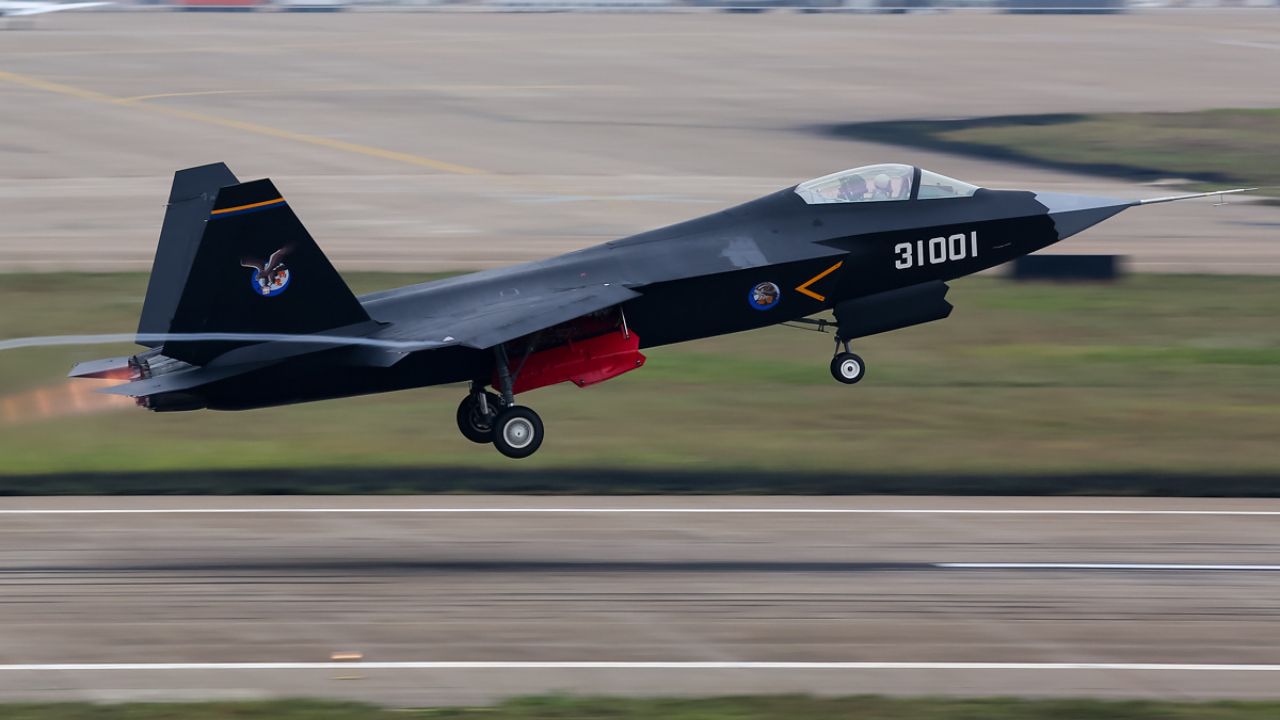
China’s latest stealth fighter is moving from the realm of prototypes into what appears to be a genuine production push, with new imagery, factory activity, and official messaging all pointing in the same direction. The J-35, developed for both carrier and land-based roles, now sits at the center of Beijing’s effort to field a broader fifth-generation fleet that can operate across the region and beyond. I see the emerging pattern as a deliberate attempt to translate years of testing into a sustained manufacturing program that will reshape the balance of airpower in East Asia.
From experimental airframe to production line
The clearest signal that the J-35 is no longer a mere demonstrator is the convergence of industrial and military indicators that point to serial output. Reports that China ready is to move the J-35 stealth fighter into mass production describe a program that has matured beyond isolated test aircraft and into a structured build plan, with the figure 35 now synonymous with Beijing’s next-generation ambitions. Complementing that narrative, another China ready account frames the coming three to five years as the window in which this fighter will transition into a regular feature of frontline units, rather than a curiosity seen only at airshows and test ranges. Taken together, these assessments suggest that planners in Beijing now view the J-35 as a program of record, not an experiment.
Industrial moves reinforce that impression. The Shenyang Aircraft Corporation, which sits under the Aviation Industry Corporation, has been identified as the core manufacturer, and its recent activity points to a ramp-up in capacity tailored to the 35 program. A social media post highlighting that SAC Signals First J-35 Production Aircraft of the new year, attributed to Shenyang Aircra, describes a “first flight” that is explicitly labeled as a production event rather than a prototype milestone. In my reading, that choice of language matters, because it aligns with earlier announcements that China officially launched serial production of the J-35, signaling that the aircraft has advanced beyond prototype status and into a phase where output volume becomes the key metric.
Factory muscle and a mega-complex built for scale
Behind the sleek airframe sits a rapidly expanding industrial base that I see as central to understanding how far Beijing intends to go with this fighter. Reporting on the main J-35 plant describes how China’s J-35 jet maker has pledged to double output in five years, a target that would be meaningless without a robust pipeline of orders and a clear political mandate. The same facility has been photographed with multiple 35 airframes parked at the airfield, a visual cue that the line is already turning out more than one or two test articles at a time. To my eye, that kind of visible inventory is exactly what one expects when a program crosses the threshold from bespoke prototypes to batch production.
The physical infrastructure has grown in tandem. A detailed account of a new complex in Shenyang notes that China has officially opened a 270,000-square-meter facility inside Shenyang Aerospace City in the Shen region, explicitly linked to expanding the stealth fighter fleet. In parallel, another report on the same production hub observes that They appeared to be fresh off the production line, lacking the tactical grey coating found on in-service aircraft, which suggests that the airframes seen on the tarmac are newly manufactured jets still awaiting final finishing. When I connect these dots, the picture that emerges is of a purpose-built mega-factory designed from the ground up to sustain high tempo output of the 35 family.
Variants for carriers and the Air Force
What makes the J-35 particularly consequential, in my view, is the way it has been tailored into distinct variants for different branches, indicating a long-term fleet concept rather than a one-off niche platform. Official military coverage explains that, Compared with its Air Force counterpart, the J-35A, the naval J-35 is specifically designed for aircraft carrier operations, and the same report stresses that the aircraft is newly manufactured. A separate technical analysis notes that the carrier version is Designed for operations aboard the Fujian The carrier, with electromagnetic catapult launches and arrested recoveries, placing it in the same conceptual space as the F-35C. These details underscore that naval planners are not simply adapting a land-based jet, but fielding a bespoke carrier aircraft that fits into a broader push to modernize deck aviation.
The land-based side of the family is evolving just as quickly. Reporting on early 2026 test activity notes that Chinese aircraft manufacturer Shenyang Aircraft has flown the first J-35A fighter jet for the local Air Force, describing the 35 family as a complementary platform to heavier stealth aircraft such as the J-20 and as a partial replacement for carrier-based J-15 fighters. Another account highlights that Shenyang Aircraft Corporation has already conducted a joint flight of two newly produced J-35 fifth generation fighters, a formation event that would be unnecessary if the program were still confined to one-off prototypes. In parallel, a separate social media post notes that the aircraft is being readied for entry into service with both the PLA Air Force and the Navy, reinforcing the impression that Beijing intends to field the 35 as a joint asset across services.
Stealth evolution, regional signaling, and what comes next
As I weigh the technical reporting, it is clear that the J-35 is not standing still in terms of design. A detailed breakdown of a distinctive green airframe notes that China’s advanced J-35 stealth fighter has begun the year with a new test flight, describing the aircraft as an upgraded prototype that showcases rapidly evolving naval aviation capabilities. That iterative approach fits with earlier accounts that Replacing the engine with more efficient indigenous choices became a priority for the Aviation Industry Corporation of China, a shift that would reduce reliance on foreign suppliers and tighten control over performance. In parallel, a separate report on unpainted airframes notes that the aircraft is The aircraft is being readied for frontline roles, which I interpret as a sign that the design has reached a level of maturity where incremental upgrades can be folded into a stable production baseline.
All of this unfolds against a wider strategic backdrop in which Beijing is seeking to narrow the qualitative gap with Western fifth-generation fleets. Official and analytical sources alike describe China as investing heavily in advanced aerospace, and the J-35 is now a central pillar of that effort. One assessment of the program’s trajectory notes that the aircraft is part of a broader plan by The Shenyang design bureau to field multiple fifth generation types, while another emphasizes that 35 is intended to operate alongside heavier stealth jets rather than replace them outright. In my judgment, the combination of serial production, carrier and land-based variants, and a sprawling 270,000-square-meter factory complex points to a long-term commitment that will shape regional airpower for decades, even as some aspects of the program’s ultimate scale remain unverified based on available sources.