
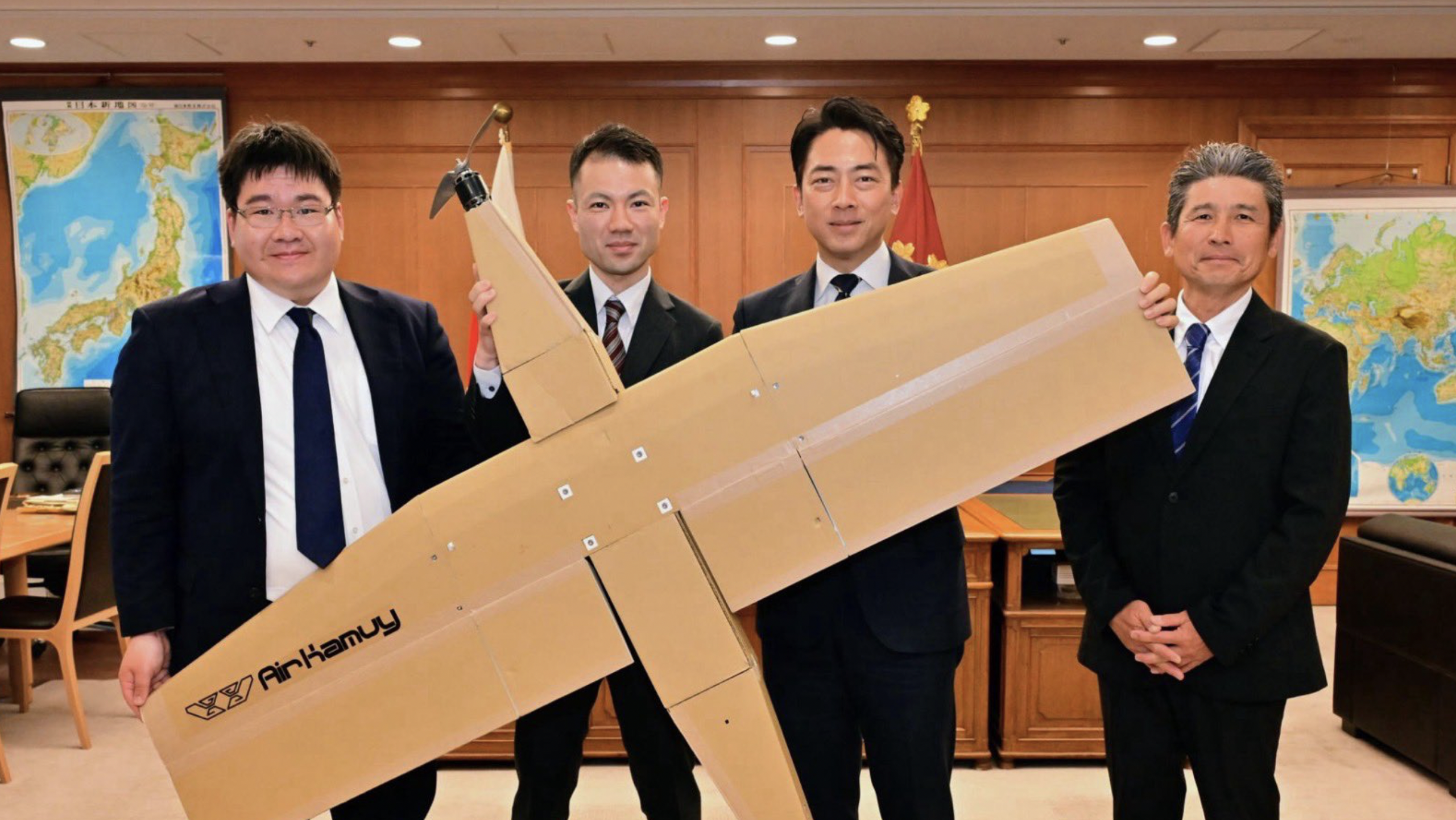
Japanese Defense Minister Shinjiro Koizumi met with representatives of Air Kamuy, the Nagoya-based startup producing military drones made from corrugated cardboard, in a meeting that underscores how seriously Tokyo is taking low-cost, expendable unmanned systems as a cornerstone of its defense strategy.
“In aiming to become the Self-Defense Forces that makes the most extensive use of unmanned assets, including drones, in the world, strengthening collaboration with startups enthusiastic about the defense sector is indispensable,” Koizumi wrote on his official X account on April 27. “Today, we were able to have an extremely in-depth discussion.”
Koizumi confirmed that the Japan Maritime Self-Defense Force is already using Air Kamuy’s drones operationally — as aerial targets in live-fire training exercises.
The Drone That Costs Less Than a Business-Class Flight
The Air Kamuy 150, the company’s flagship platform, is a fixed-wing drone built almost entirely from biodegradable corrugated cardboard treated with a water-resistant coating. It assembles in approximately five minutes from about 10 parts using adhesive tape, flies at 120 km/h for up to two hours, and is priced at roughly $2,000 — less than one-tenth the cost of conventional fixed-wing drones used by Japan’s military. When folded flat, approximately 500 units fit in a single standard shipping container, a logistics profile that makes mass deployment feasible in ways that conventional drones cannot match.
The choice of cardboard is not merely a cost-cutting measure. Cardboard does not reflect radar waves easily, giving the platform a degree of low-observable capability. It is biodegradable, minimizing environmental impact from training exercises and expendable missions. And crucially, it can be mass-produced using existing civilian supply chains. Air Kamuy CEO Takumi Yamaguchi has distilled the company’s design philosophy into a single line: every cardboard factory can become an arsenal.
Yamaguchi originally designed the platform for disaster surveying and mountain rescue operations before pivoting to defense applications after discussions with ministry officials who described their need for “cheap drones that can be mass-produced and fly for extended periods.”
Already in Active Service — As a Target
The Maritime Self-Defense Force’s adoption of the Air Kamuy platform as an aerial target is a significant threshold. For target drone applications — where the aircraft is designed to be shot down — expensive composite airframes make no economic sense. A drone that costs a fraction of a conventional unmanned platform, can be produced in large quantities, and performs its mission adequately before being destroyed fits the target drone role well. The adoption allows naval units to conduct more frequent and realistic anti-drone and missile defense training at a fraction of the cost of previous exercises.
The platform has also drawn interest well beyond Japan’s borders. Air Kamuy has received direct inquiries from several foreign militaries, though the company notes that Japan’s strict Three Principles on Transfer of Defense Equipment present regulatory hurdles that will take time to navigate.
Japan’s Defense Drone Spending Is Surging
The Koizumi meeting reflects a broader strategic shift underway in Tokyo. Japan’s Ministry of Defense fiscal 2026 budget request allocated ¥312.8 billion — roughly $2.1 billion — for “unmanned asset defense capabilities,” nearly triple the amount included in the initial fiscal 2025 budget. That investment is driven in part by the lessons Japan has absorbed from the wars in Ukraine and Iran, where cheap, mass-produced drones have fundamentally altered the economics and tactics of modern conflict.
Japan’s Ground Self-Defense Force has established dedicated drone-focused offices to advance operational planning and integration. The broader strategic concept, known as SHIELD — Synchronized, Hybrid, Integrated and Enhanced Littoral Defense — envisions a large-scale deployment of unmanned systems across all military branches to defend Japan’s extensive island chain from potential adversaries, principally China.
Air Kamuy exhibited the AirKamuy 150 at the Paris Air Show in June 2025, London’s DSEI in September 2025, and Australia’s Indo Pacific in November 2025 — all through Japan’s Acquisition, Technology & Logistics Agency booth, signaling official government endorsement of the company’s international profile.
The Fundraising Paradox
Despite the Ministry of Defense’s interest and active JMSDF deployment, Air Kamuy has struggled to raise private capital. While securing ¥100 million in April 2025, roughly two-thirds of approached investors declined, citing internal policies restricting investment in defense-related businesses. Japan’s postwar aversion to defense investment — combined with the longer capital recovery timelines inherent in hardware businesses — has made venture funding elusive even as the government accelerates military drone spending.
Koizumi’s public endorsement of the company, and his stated ambition to make Japan’s Self-Defense Forces the world’s leading user of unmanned assets, may help shift that calculus for investors.