
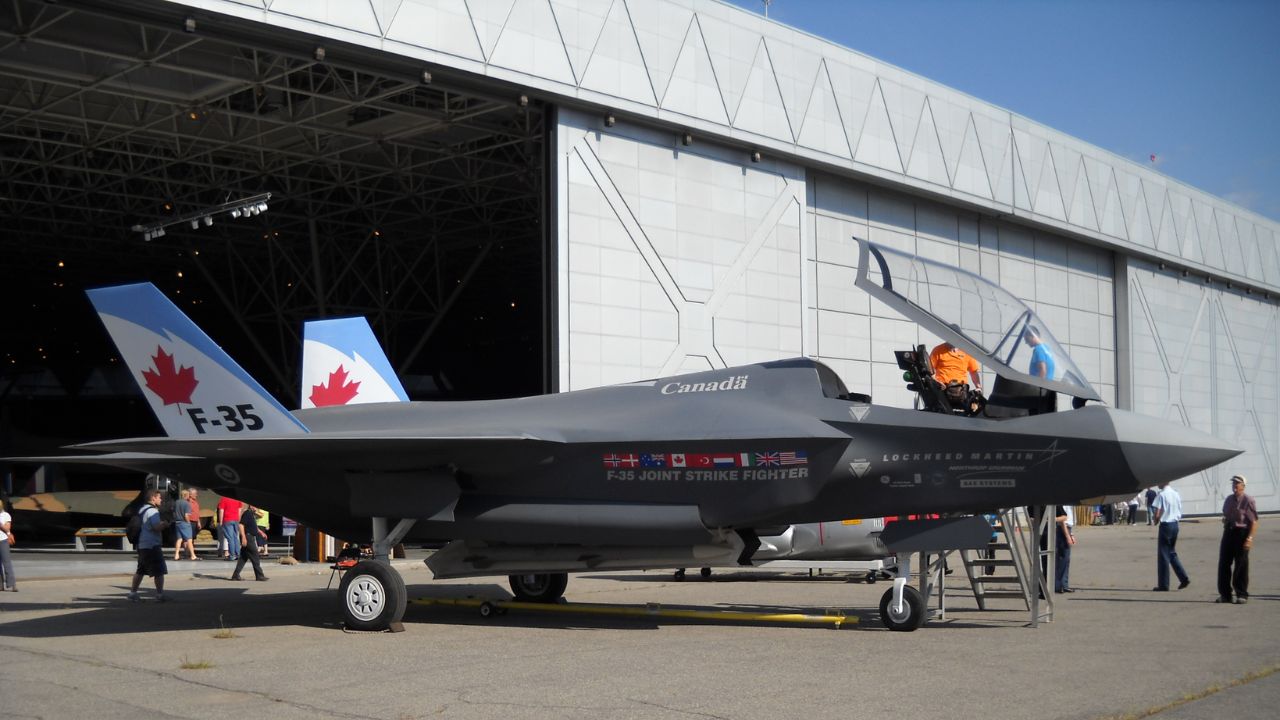
Canada is expanding its F-35 fleet by funding 14 additional jets, despite political friction over trade and continental defense. The move signals that Ottawa is not only sticking with the F-35, but accelerating parts of the purchase despite scrutiny of how the aircraft fits into NORAD security plans and tensions with key partners. The decision places Canada more firmly inside the F-35 club at a moment when both allies and domestic critics are questioning what that choice will cost in strategic autonomy and industrial leverage.
The new payments come while the government reviews its overall fighter strategy and evaluates whether the F-35 suits Canada’s airspace and industrial base. By funding long-lead components for 14 additional aircraft, officials are locking in a larger portion of the fleet before the review concludes, reducing alternative options and increasing reliance on a single American platform.
Carney’s commitment and the 14-jet expansion
Prime Minister Mark Carney has confirmed that Canada has started paying for long-lead components tied to 14 additional F-35A fighters, a step that moves the aircraft firmly from planning to production. These payments, which cover parts that must be ordered well ahead of final assembly, indicate that the government is treating the extra jets as a settled choice rather than a hypothetical option, even though the wider fighter review remains open. Carney’s public acknowledgment of the new spending signals that Ottawa is prepared to absorb political criticism in order to secure production slots and avoid delays in deliveries of the advanced aircraft.
This confirmation aligns with earlier reporting that Canada has already begun making payments for these 14 F-35As, with the funds tied to advance procurement actions that position the jets in the manufacturing queue. By moving early on these long-lead items, the government aims to ensure that the aircraft arrive in time to replace aging fighters and support allied operations, rather than waiting at the back of a crowded global order book. That approach is reflected in detailed accounts of how Carney’s government has structured the payments to keep production on schedule.
Locking in more jets amid an 88-plane plan
The extra 14 aircraft sit on top of Canada’s larger plan to acquire a full fleet of F-35s, a program that has already reshaped defense planning. Officials first outlined a goal of buying 88 F-35s as the backbone of the next-generation fighter force and later confirmed that entire package as the preferred path for replacing legacy jets. That broader commitment, described as Canada’s F-35 Deal, frames the new payments as part of a long-term shift toward a single, stealthy platform rather than a one-off purchase.
Within that context, the 14 additional jets represent an effort to secure specific production lots and delivery windows while the overall 88-aircraft program is still under review. Canada Pays for F-35 Long, Lead Items Despite Ongoing Fighter Jet Review describes how the government is proceeding with long-lead contracts at the same time as it reassesses aspects of the program, including cost, industrial participation, and delivery schedules. By making those early payments, Ottawa is betting that the benefits of locking in production outweigh the political risk of appearing to prejudge the review’s outcome.
Industrial stakes, trade tensions, and the supply chain
Behind the numbers lies a contentious industrial story, as Canadian firms seek a durable role in the F-35 supply chain amid trade frictions with partners. The fighter program has long promised domestic work on components and maintenance, but the balance between guaranteed contracts and competitive bidding has fueled anxiety among aerospace workers and provincial governments. Reports that Ottawa has discreetly put money down on long-lead components for 14 extra jets have sharpened questions about whether Canada is securing enough industrial benefit in return for deepening its financial commitment to the aircraft.
These concerns are amplified by revelations that sources familiar with the program say the federal government moved quietly to place the country further up the production queue for key parts. Reports on the payments for components suggest an effort to avoid public disputes over trade-offs between delivery speed and domestic manufacturing. At the same time, the long-standing participation of Canadian companies in the F-35 industrial base has tied local jobs to the health of the program, creating a political incentive to keep orders flowing even when trade tensions with allies complicate negotiations over workshare.
NORAD security worries and strategic alternatives
The choice to double down on the F-35 also intersects with deeper questions about how Canada should defend its vast airspace and contribute to NORAD. Critics argue that other fighters, such as Sweden’s JAS-39 Gripen, may offer better cost, Arctic performance, and sovereignty over mission systems, with some analysts suggesting Canada could choose the Gripen over the F-35 for domestic airspace defense. That debate reflects long-running unease over relying so heavily on a single American-built aircraft for both national defence and binational missions.
Supporters of the F-35 argue that interoperability with the U.S. and other allies, especially through NORAD and NATO, necessitates investing in the same fifth-generation platform. They argue that Canada’s decision to move ahead with payments for 14 more jets, even while the broader fighter review continues, demonstrates a recognition that the Lockheed Martin F-35A Lightning II is now the de facto standard for allied air forces. Analyses of how Canada is revisiting its commitment suggest that Washington views any wavering as a test of alliance commitments and national pride, which in turn raises the stakes for Ottawa’s choices.