
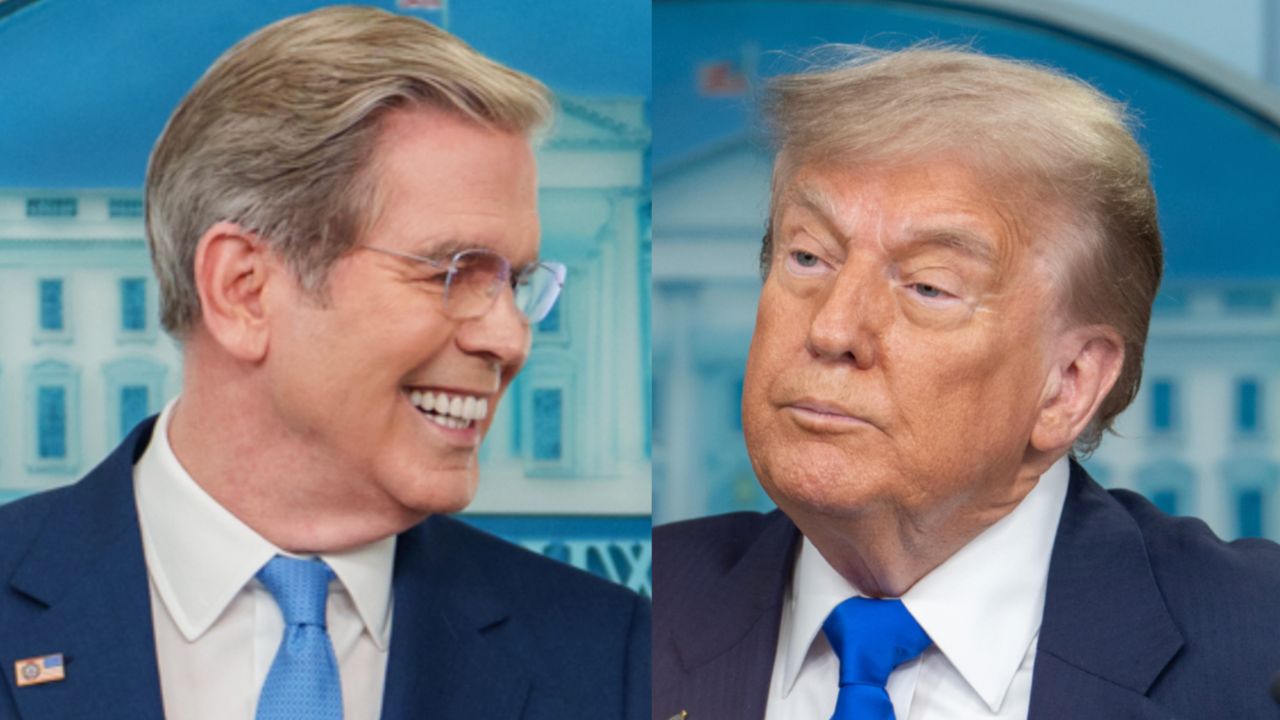
U.S. Treasury Secretary Scott Bessent said on Sunday that “no one has been tougher on Russian sanctions than President Trump,” and that “no sanctions were lifted” when President Donald Trump signed an executive order two days earlier waiving most of the penalties in a new Russia sanctions law. He spoke in an interview with Kristen Welker on NBC’s “Meet the Press.”
Welker asked why Trump was “rewarding a dictator who invaded Ukraine,” then played a clip from Bessent’s January 2025 confirmation hearing. In it, Bessent said, “I believe that the sanctions were not fulsome enough. I believe that the previous administration was worried about raising U.S. energy prices during an election season.” She asked whether Trump was “doing what you accused President Biden of doing.”
“First of all, Kristen, the sanctions were doubled. The Biden administration, in an act of incredible bravery, doubled the sanctions on the way out, in January of 2025,” Bessent replied. “But we did not take those down. President Trump sanctioned the two largest Russian energy companies, Rosneft and Lukoil, which dealt a catastrophic blow to the Russian energy industry. So no one has been tougher on Russian sanctions than President Trump.”
When Welker asked, “What has Putin done to deserve sanctions relief now?” Bessent said, “That’s not true. No sanctions were lifted on Friday. No sanctions were lifted.” Welker said a law “was supposed to put more sanctions in place” and that “the president effectively waived that.” Asked whether sanctions would be lifted, Bessent said, “There is a 60-day period so we can examine what’s going on. The only thing that has been lifted is the diesel embargo.”
The White House’s Rapid Response account posted a clip of the exchange at 10:12 a.m. EDT (1412 GMT), and “Meet the Press” posted the full interview on its X account shortly afterward.
The executive order, signed Friday, Oct. 16, waives the duties in sections 112 and 113 of the Lindsey O. Graham Sanctioning Russia and Iran Act of 2026. Those include a 500% tariff on Russian goods and 100% tariffs on goods from the largest buyers of Russian oil and gas. It also waives the sanctions and restrictions in sections 102(a), 102(d), 102(e), 103 through 111 and 117 of the law. The order says Trump certified to Congress that the waivers are “in the national interests of the United States.”
The order supports part of Bessent’s account. It says that “nothing in this order affects any sanctions or other measures” under earlier executive orders on Russia, “including with respect to all persons sanctioned under any such Executive Order.” That covers the Treasury Department’s Oct. 22, 2025, designation of Rosneft and Lukoil and the Biden administration’s Jan. 10, 2025, sanctions on Gazprom Neft, Surgutneftegas and more than 180 vessels. As Welker said, though, the order sets aside the additional sanctions and tariffs the new law provided for. It also sets no 60-day limit. The waivers stay in effect until the president or the secretary of state decides “further action is appropriate.”
The diesel measure Bessent mentioned was not part of Friday’s order. On Oct. 9, the day Trump and Russian President Vladimir Putin spoke by phone, the Treasury’s Office of Foreign Assets Control issued General License 135. It authorizes transactions, “including importation into the United States,” of Russian-origin diesel fuel through April 7, 2027.
Bessent’s 60-day reference matched remarks by Secretary of State Marco Rubio on Oct. 17. Rubio told reporters that Trump “wants to take the 60-day period of time to sort of analyze what imposing both sanctions and tariffs will mean to the global economy and even to the U.S. economy,” according to a State Department transcript.
In the same 2025 hearing exchange Welker cited, Bessent also told Senator Mark Warner that if Trump asked, he would be “100% on board for taking sanctions up, especially on the Russian oil majors, to levels that would bring the Russian Federation to the table,” according to the Senate Finance Committee hearing record.
On Sunday, Bessent also pointed to Europe. “I will point out the U.K. in May waived their embargo on diesel and jet fuel made with Russian crude. So, you know, where’s the outrage for the rest of the world?” he said. Britain did issue a general trade licence in May allowing imports of diesel and jet fuel refined from Russian crude in third countries. That licence came alongside a new ban on such fuels that took effect May 20. Britain’s direct ban on Russian oil products stayed in place, and in June the government set Jan. 1, 2027 as the licence’s latest end date.
“President Zelenskyy does not criticize his European partners. He seemed a bit disassembled in that interview. The Europeans are financing the Russian war machine,” Bessent said, adding that the United States imports $4 billion of Russian products, $1.8 billion of it fertilizer, and that “Europeans import more than ten times that.” Earlier in the interview he said Europeans “continue to gorge on Russian energy.” He said 136 of 140 cargoes from Russia’s Yamal LNG facility in the first half of the year went to Europe, and asked, “Why should the U.S. go it alone, Kristen?” Rapid Response posted that portion separately.
Lawmakers from both parties had criticized the order. On Oct. 17, Republican Senator John Cornyn of Texas wrote, “Lindsey would be appalled,” referring to the late Senator Lindsey Graham, the law’s namesake. Later that day he wrote, “Helping Putin in Ukraine is reckless. He would not stop with Ukraine and our NATO allies would be next.”
Republican Senator Thom Tillis of North Carolina wrote, “Beyond irresponsible. What part of enforcing a law passed 86-11 by the Senate does the President and his advisors not understand?” He added that Trump could lower energy prices “by solving the Iran problem, not by doing a solid for Vladimir Putin.”
Democratic Senator Chris Coons of Delaware wrote that “Trump’s appeasement of Putin is a vile betrayal” and that “Congress will demand answers.” Democratic Senator Mark Kelly of Arizona wrote that the White House “undoes all of that to let Russia off the hook,” adding, “That isn’t maximum pressure. It’s maximum retreat.” All four senators voted for the bill when the Senate passed it on Aug. 7, according to the roll call.
Criticism continued on Sunday. Senator Dave McCormick, a Pennsylvania Republican, said he “would not be in favor of giving a reprieve on sanctions,” according to a clip posted by “Fox News Sunday”. Several hours after Bessent’s interview, Republican Representative Don Bacon of Nebraska wrote, “Congress overwhelmingly passed tough sanctions on Russia & @POTUS signed them into law. Let’s finally use them instead of propping up Putin’s war machine.” None of these posts mentioned Bessent.
Earlier on the same program, Republican Senator James Lankford of Oklahoma defended the decision. He said the law lets the president weigh national interests and that Trump is “trying to walk this fine balance between trying to be able to put pressure on Russia but also to be able to help the American people.” Ukrainian President Volodymyr Zelenskyy, interviewed before Bessent, called the waiver “a really big support for Putin” and said “this diesel deal is very dangerous.”
Trump explained his reasoning later on Sunday. “I am in the process of negotiating Peace in the war between Russia and Ukraine, and don’t want to do anything that will drive, foolishly, Russia away from the bargaining table,” he wrote on Truth Social at 4:36 p.m. EDT, adding, “I can sign it later, or any time that I want!”
Bessent also disputed Zelenskyy’s statement, in his interview, that Ukraine’s generals and government believed the “message” to limit Starlink speeds in Ukraine came from the U.S. government. “President Trump and Secretary Rubio have categorically said that no one in the Trump administration did that. And I think it is very reckless for President Zelenskyy to make such a charge,” Bessent said. Asked about a break in intelligence sharing that Zelenskyy described, Bessent said, “I don’t know anything about that,” and that Zelenskyy “should be very careful about making statements like this that aren’t true.”
Rubio told reporters on Oct. 17, “No one at the White House ordered anyone to slow down internet or slow down speed so that certain drones couldn’t use it,” according to the State Department transcript. Zelenskyy had not responded to Bessent’s remarks on his X account as of early Monday.
Welker pressed Bessent three times on whether the United States considers Ukraine an ally. “Again, we provide three different things to Ukraine. So that’s what you do for an ally. We’re not providing those to Russia,” he said, before adding, “Again, I’m not the secretary of state. I’m not the president.”
The interview opened with inflation. Welker cited figures showing consumer prices rose 3.7% in September and gasoline was up 44% since the start of the war with Iran. Bessent said, “We have an energy shock,” and that core inflation had been “very flat.” Asked when the administration would take responsibility, he said, “Well, we will own the economy,” citing job growth and record household net worth. Asked whether gasoline prices would fall by the new year, he said it “will depend on what happens with the Iran conflict.”
The statements that “no one has been tougher on Russian sanctions” and that the waived measures were not “lifted” are Bessent’s. The executive order leaves earlier sanctions in place but waives the new law’s sanctions and tariffs with no end date, and the 60-day period Bessent and Rubio cited does not appear in it. The diesel authorization he called the one thing “lifted” was issued Oct. 9 under existing Russia sanctions regulations, not under Friday’s order. Britain’s diesel licence applies to fuel refined from Russian crude in other countries, while the U.S. license covers Russian-origin diesel. The figures on European payments to Russia, Yamal LNG cargoes and U.S. imports of Russian goods are Bessent’s; he did not cite a source for them in the interview. No Treasury release or post from Bessent’s or the Treasury’s X accounts responds to the lawmakers’ criticism directly, and the certification and report the order says were sent to Congress have not been made public.