
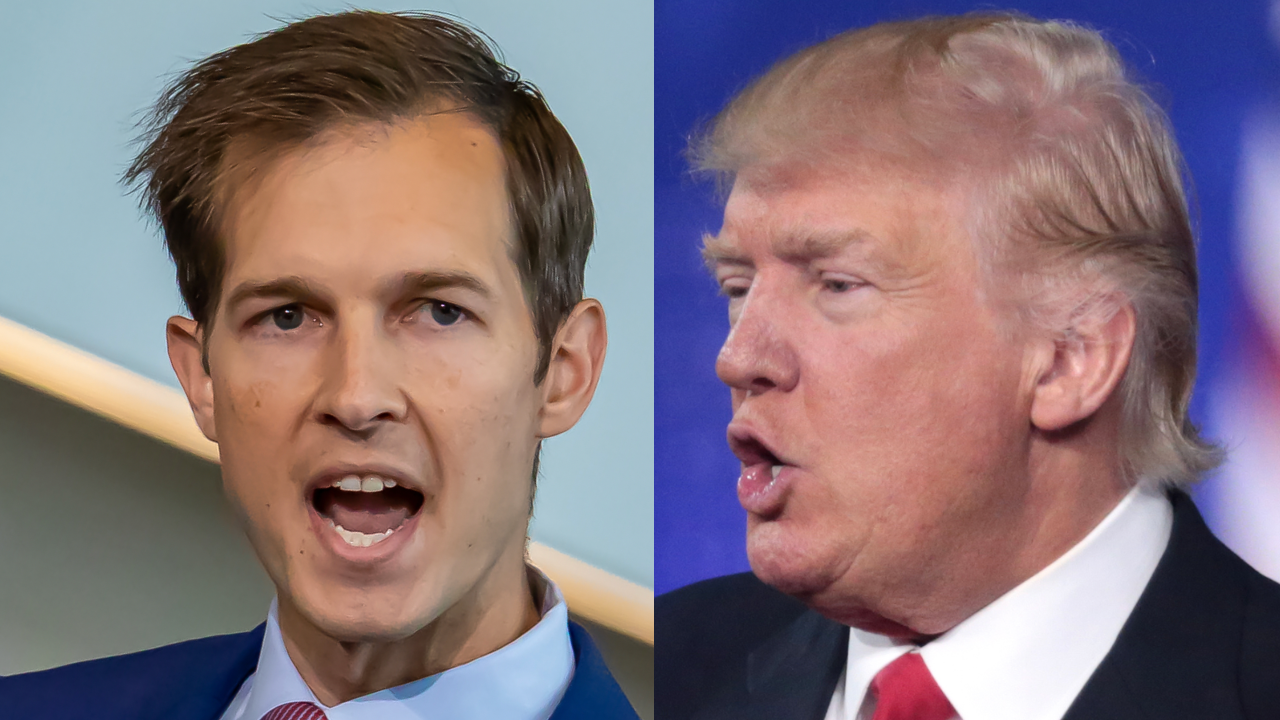
Rep. Jake Auchincloss said Monday that he delivered a direct message to President Trump on the network he knows Trump watches. “Donald Trump watches Fox, so I said it to him directly on Fox: you are the only president in U.S. history to start & lose a war by yourself,” Auchincloss wrote on X, sharing a clip from his Sunday appearance.
What Auchincloss Actually Said
Speaking on Fox News’ “The Sunday Briefing” with host Peter Doocy, Auchincloss addressed Trump directly. “I know Donald Trump watches your show, and so I will say to him directly, Mr. Trump, you are the 1st president in American history to start and lose a war by yourself. You have made America more weak, more alone, and less respected,” according to a transcript of the appearance on Fox News’ own site. He continued: “Congress has to take back the steering wheel from this impaired driver before we end up in a 3rd quagmire in the Middle East of the 21st century.”
His Specific Argument About the Escalation Pattern
Auchincloss laid out a detailed theory of why the U.S. is losing ground in the conflict. “That starts with ending the escalation. He keeps on trying to escalate vertically, meaning more effects on target. Iran escalates horizontally, bringing in other regional players, other infrastructure assets into the fight. Iran is winning that escalation ratchet,” he said. “We gotta stop it. We gotta negotiate transit through the Strait of Hormuz. Then we have to strengthen the Abraham Accords. But that is going to be a decadal process. It’s not gonna happen in this guy’s term because he’s too incompetent.”
Why Auchincloss’s Position Carries Particular Weight
Auchincloss’s criticism comes from an unusual vantage point among Democrats commenting on the war. A Marine Corps veteran who deployed to Afghanistan and Panama, he represents a Massachusetts district with a substantial Jewish population and has consistently described his politics as “pro-Israel, anti-Netanyahu” — a positioning distinct from the party’s more dovish or more hawkish flanks on Middle East policy.
A Recent, Deliberately Symbolic Vote
That positioning was on display weeks before his Fox News appearance, when Auchincloss voted against a foreign aid package that included assistance to Israel — a vote he explicitly framed as a statement about Iran, not about Israel itself. “I represent a pro-Israel, anti-Netanyahu district and this is a pro-Israel, anti-Netanyahu vote,” Auchincloss said, according to Jewish Insider’s reporting, arguing the vote functioned as opposition to the broader Iran war rather than to support for Israel.
His Earlier Puzzlement Over Trump’s Abraham Accords Demand
Auchincloss’s Sunday comments about needing to “strengthen the Abraham Accords” build on criticism he voiced in May, when Trump demanded that several Gulf and Middle Eastern countries join the Abraham Accords as a condition of ending the Iran war. Asked about the proposal on CNN, Auchincloss said, according to Mediaite’s report on the exchange: “I support the Abraham Accords. I think the Abraham Accords were a credible achievement of the first Trump administration. And I don’t know what that sentence means, though. The challenge with the Abraham Accords expansion is not that these countries share an aversion to Iran. They always have.” He noted the actual obstacle to expansion had long been securing Saudi Arabia’s participation, given unresolved issues in the West Bank — a challenge, in his view, Trump’s demand did not meaningfully address.
The “Vertical vs. Horizontal” Escalation Framing, in Context
Auchincloss’s distinction between Trump’s “vertical” escalation and Iran’s “horizontal” escalation reflects a documented pattern over the course of the war. U.S. and Israeli strikes have generally aimed at increasing damage to specific targets inside Iran — nuclear sites, military infrastructure, leadership — while Iran and its aligned forces have repeatedly widened the conflict’s geographic and political scope, including strikes on shipping in the Strait of Hormuz, attacks on Gulf state infrastructure, and continued activity from regional proxy forces.
A Split Among Former U.S. Officials on the Abraham Accords Question
Auchincloss’s underlying claim that the war has strained regional diplomacy is itself contested. Former U.S. Ambassador to Israel David Friedman told the House Foreign Affairs Committee in July that he did not believe Abraham Accords signatories viewed the Iran war as a “strategic blunder,” predicting the accords would expand once the war concluded “successfully and victoriously” for the United States — a direct rebuttal to the kind of argument Auchincloss and other Democrats have made about the war’s diplomatic costs.
Congress’s Repeated, Unsuccessful Attempts to Constrain the War
Auchincloss’s call for Congress to “take back the steering wheel” references an effort that has repeatedly failed to materialize in binding form. Multiple War Powers Resolutions aimed at ending unauthorized U.S. hostilities against Iran have been introduced since the war began in February, with some passing one chamber but none successfully constraining the administration’s conduct of the war to date.
Doocy’s Role and the Show’s Format
Auchincloss delivered his remarks as part of a broader appearance on “The Sunday Briefing” that also covered the rise of Democratic Socialist-aligned candidates ahead of primary elections and his own predictions for the 2028 Democratic presidential nomination, according to Fox News’ own description of the episode — meaning his Iran comments were one segment within a wider-ranging political discussion rather than an appearance solely focused on the war.
His Military Background, Specifically
Auchincloss’s status as a veteran adds a specific dimension to his “impaired driver” framing of Trump’s handling of the war. He served as an infantry and intelligence officer in the Marine Corps, with deployments that included Afghanistan and Panama, before entering electoral politics — a record he has invoked repeatedly in his public commentary on military and foreign policy matters, distinguishing his critique from that of colleagues without direct service experience.
Where This Leaves Things
As of Auchincloss’s Monday post, the war remained active without a comprehensive settlement, negotiations over the Strait of Hormuz continued without resolution, and Auchincloss’s specific prediction — that meaningfully repairing regional diplomacy would be “a decadal process” extending well beyond Trump’s current term — remained, by its own terms, a claim about the future that current events had not yet tested one way or the other.