
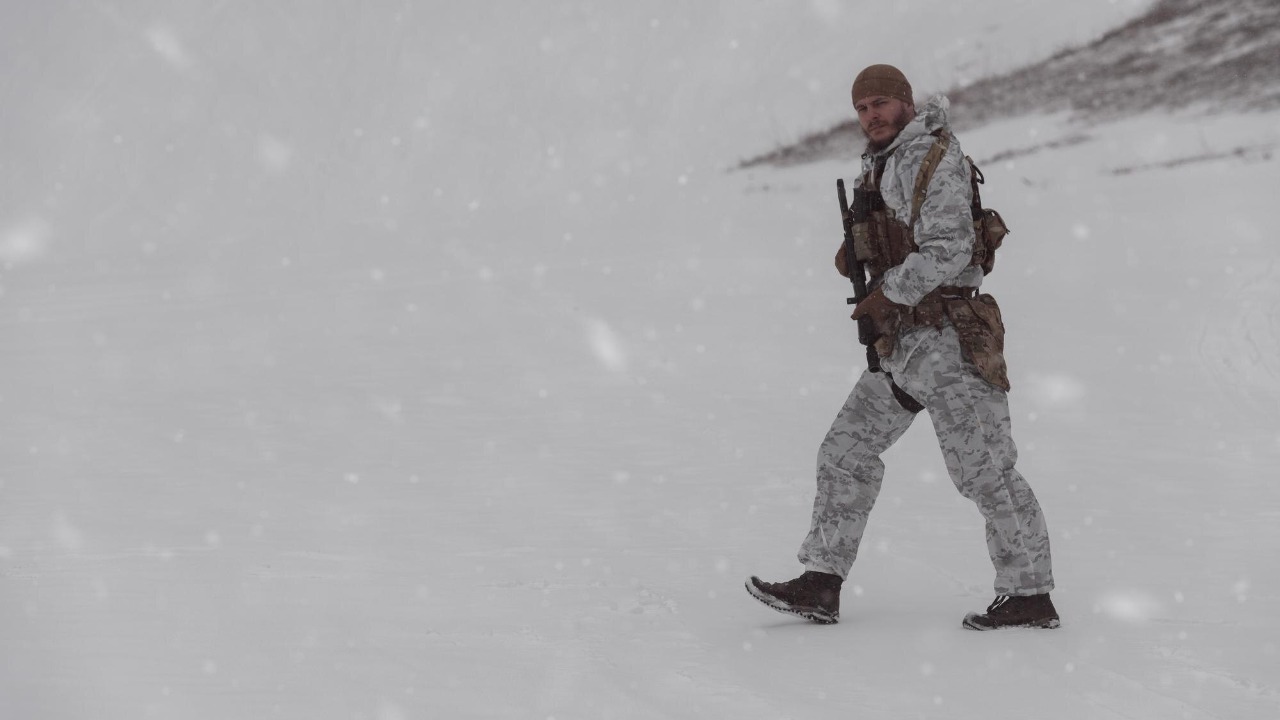
Russian troops on the Ukraine front have turned to an experimental white camouflage nicknamed the “Penguin” suit, hoping to vanish into winter terrain. Instead, the strange outfit has become a viral symbol of how quickly modern surveillance can expose even the most unusual battlefield tricks.
Footage and battlefield reports indicate that several Russian soldiers wearing the Penguin disguise were quickly detected and killed, underscoring how drones and thermal sensors are reshaping basic assumptions about concealment. What might once have passed as clever improvisation now looks more like a case study in how not to hide in a twenty-first-century war.
From viral clip to battlefield case study
The story of the Penguin suit began circulating widely after a video emerged of what commentators described as a Russian soldier wrapped in a bulky white outfit that resembled a cartoonish bird. In one widely shared clip, the figure trudges across snow while using standard infantry tactics, a scene that was presented as a glimpse of how a Russian Soldier was trying to adapt to the harsh winter front. That early footage, which appeared over the summer, framed the costume as a curiosity rather than a tested system, but it hinted at a broader trend of improvisation under fire, as seen in the purportedly experimental gear.
What might have remained a niche oddity soon evolved into a more serious pattern. Ukrainian units later reported that Russian troops were deploying a standardized white camouflage outfit on active sectors of the front, describing it as a dedicated Penguin system rather than a one-off costume. According to Ukrainian accounts, the suit was intended to blend soldiers into snow drifts and open fields, a goal that reflects how Jan winter conditions can both expose and protect infantry depending on their equipment. Yet the same reports suggest that the outfit’s distinctive outline and movement made it easier, not harder, for observers to track.
How the Penguin suit was supposed to work
Russian planners appear to have designed the Penguin suit as a specialized snow camouflage that could disrupt visual detection and reduce thermal signatures. The concept is straightforward: a white outer shell to match the snow, combined with insulating layers that might muffle body heat against cold ground. In theory, such a system could complicate the work of Ukrainian drone operators who scan for dark shapes or warm silhouettes against frozen terrain. The very name Penguin evokes a creature adapted to ice and snow, suggesting that the designers saw the suit as a way to turn the winter environment into a protective cloak for Russian troops.
On paper, the idea aligns with long-standing military practice, since armies have used white overalls and snow caps for decades. The difference on the Ukraine front is the density of aerial surveillance and the precision of modern targeting. Ukrainian forces now rely on small quadcopters and larger unmanned aircraft that feed real-time video and thermal imagery to artillery crews. In that context, the Penguin system had to defeat not only human eyesight but also sensors tuned to pick up subtle contrasts in heat and motion. Reporting on the trials of this gear suggests that the suit did not deliver on that promise, with Russia’s ‘Penguin’ camouflage instead turning its wearers into conspicuous shapes on open snow.
Ukrainian response and battlefield outcomes
Ukrainian units on the front line quickly adapted to the appearance of the new disguise. Rather than being fooled, drone operators began to treat the unusual white silhouette as a telltale sign of Russian movement. Ukrainian forces reported that they had identified and eliminated several Russian soldiers wearing the experimental outfit, describing how the suits were spotted and then targeted by a drone-guided system. In at least one engagement, Ukrainian troops stated that they killed at least two Russian soldiers in Penguin gear after tracking them across a snowy field, an account that highlights how the very uniform meant to provide cover instead drew focused attention, as described in reports on Russian troops using the suits.
Ukrainian officials and military-linked channels later framed these encounters as evidence that the Penguin concept had failed under real combat conditions. One prominent account stated that Ukrainian forces had identified and eliminated several Russian soldiers wearing the experimental snow camouflage, presenting the outcome as a cautionary tale about relying on unproven gear in a high-tech battlespace. The same messaging emphasized that the suits did not prevent detection by drones or thermal optics, and that the distinctive shape of the outfit made it easier to classify targets at a glance. This narrative, shared through Ukrainian channels such as Ukrainian forces updates, has turned the Penguin suit into a symbol of miscalculated innovation rather than battlefield ingenuity.
What the Penguin experiment reveals about modern war
The brief life of the Penguin suit on the Ukraine front illustrates how quickly battlefield innovation can be tested and discarded in an era of constant surveillance. Russian units attempted to exploit the Jan snow cover with a specialized disguise, but Ukrainian drones, thermal cameras, and networked targeting stripped away any advantage the outfit might have offered. Instead of vanishing into the landscape, soldiers in the white gear became case studies in how visual camouflage alone cannot offset the reach of sensors that read heat, movement, and pattern. The fact that a Russian soldier tried to hide from Ukrainian drones by wearing a penguin-like thermal cloak, only to be detected and struck on a snowy battlefield, underscores how unforgiving this environment has become, as seen in viral footage of a Russian attempt at such concealment.
The episode also highlights the growing role of social media in shaping perceptions of the war. Clips of the Penguin suit spread rapidly, turning a niche piece of equipment into a global talking point and inviting scrutiny from analysts and lay viewers alike. For Russian forces, the viral attention has been a public relations setback, casting their adaptation efforts as clumsy rather than clever. For Ukrainian units, the footage has served as both documentation and deterrent, signaling that new Russian tactics will be observed, recorded, and dissected almost in real time. As the conflict continues, the fate of the Penguin disguise stands as a reminder that in modern war, even the most unusual camouflage cannot hide from a camera in the sky.