
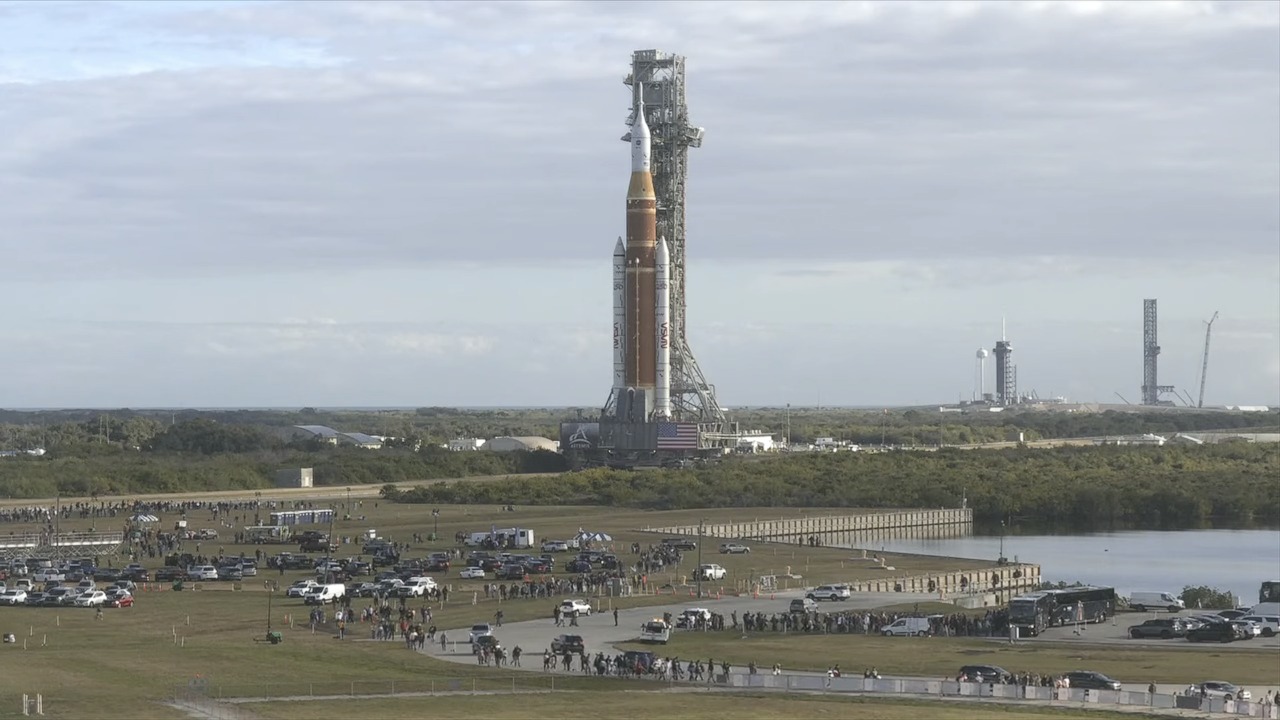
NASA’s latest Moon shot is no longer an abstract blueprint but a towering machine of metal, fuel lines, and software now standing exposed to the Florida sky. The Artemis II mega-rocket, designed to send astronauts around the Moon this winter, represents a multi-year, multi-state engineering effort. Its arrival at the pad turns a long-running construction project into an imminent test of whether the United States is truly ready to fly crews back into deep space.
Behind the floodlit photos is a story of scale, choreography, and risk management that rivals any previous human spaceflight campaign. From fabricating the core stage to the slow crawl across Kennedy Space Center, every step was planned to manage a vehicle taller than a football field and weighing millions of pounds. With the countdown now active, the focus shifts from building the rocket to proving that this intricate stack can perform as a single, reliable system.
The mega-rocket takes shape
The backbone of Artemis II is the Space Launch System, a heavy-lift booster whose core stage alone rises to a 66-feet tall upper section and forms part of a fully assembled, 212-foot-tall rocket stage. The orange core, built at NASA’s Michoud Assembly Facility, houses cryogenic tanks and avionics to power and guide four RS-25 engines during the critical ascent phase. Above it, the Orion spacecraft and its launch abort system complete a stack that, with boosters attached, reaches a 322-foot-tall profile, turning the vehicle into a skyscraper on wheels.
Getting that core stage from factory floor to launch pad has been a campaign in its own right. The first Artemis II Core Stage was documented “on the move” when, on July 16, 2024, NASA shifted the SLS hardware as part of a carefully sequenced rollout. That journey culminated at Kennedy Space Center, where the integrated Space Launch System, or SLS, now stands vertical on the pad in Florida. The scale of the build reflects a broader institutional bet, as NASA publicly commits to “Future Artemis Missions With More SLS Rocket Stages,” locking in this architecture for multiple flights beyond Artemis II.
From Vehicle Assembly Building to Launch Complex 39B
The final act of construction unfolded not in a clean room but on crawler tracks. Earlier this month, NASA began the slow roll of the fully stacked Artemis II rocket from the vehicle assembly building at Kennedy Space Center, a process that started on a Saturday in January. The crawler-transporter carried the 322-foot-tall Artemis II stack out to the coastal launch complex, a trip that took nearly 12 hours and turned the spaceport into a moving construction site. As the rocket crept across Kennedy Space Center, Engineers monitored clearances, structural loads, and umbilical connections that had to flex without failing.
Once the integrated rocket and spacecraft reached the pad, NASA’s own rollout notes stressed that “According to NASA, ‘Once the integrated rocket and spacecraft reach the launch pad, NASA will immediately begin a long checklist’,” underscoring that rollout is the start of a new phase rather than a ceremonial finish. The Artemis II stack now occupies Launch Complex 39B, a historic pad identified in mission documentation as the Launch Complex where the mission is staged. Images show the Artemis II Space Launch System and Orion illuminated at night, with NASA describing the Artemis II Space, SLS, and Orion as a single towering silhouette against the coastal horizon.
Inside the rollout: weight, hardware, and human oversight
Up close, the rollout was less a parade and more a controlled stress test of the entire ground system. The Artemis II stack consists of the SLS core, twin solid rocket boosters, and the Orion capsule, a combination that, according to one technical account, weighs roughly 3.5 million pounds. That mass rode atop what has been described as the heaviest vehicle on Earth, with the mobile launcher platform moving in lockstep. But in this case, the platform itself traveled with the rocket to the pad because it contains, among other critical systems, the umbilical cables and access arms that will feed power, fuel, and crew access right up to liftoff.
NASA’s own summary of the rollout emphasizes that Artemis II reached its pad after a painstaking overnight crawl across Kennedy Space Center, a journey that took nearly 12 hours from start to finish. The same account notes that NASA’s Artemis II rocket has reached its launch pad after this slow-motion trek, with Engineers overseeing every meter of progress. A related briefing frames the event with the formal “Date: January 19, 2026, Source: NASA,” underscoring that, by that point, Artemis II had officially transitioned from assembly project to launch pad asset.
Countdown choreography and what comes next
With the rocket now exposed to sea air and scrutiny, attention has shifted to the dense checklist that must be cleared before launch. NASA has indicated that the Artemis II mission could lift off as soon as early February, with one planning document notes that the launch window could open in February, with February 6 identified as the first opportunity. That same briefing stresses that there are backup opportunities in March and April, a reminder that schedule flexibility is built into the plan.