

The BMPT “Terminator” arrived on the battlefield with a reputation that bordered on science fiction, marketed as a heavily armed guardian angel for Russian tanks in the most dangerous urban kill zones. Its real combat record in Ukraine, however, has exposed a stark gap between the mythology of an “invincible” support vehicle and the messy reality of modern high-intensity warfare.
Instead of reshaping the front, the Terminator has appeared only in tiny numbers, in roles that often ignore its original design logic, and under fire from precision artillery and drones that care little about branding. The result is a case study in how a visually intimidating machine can capture imaginations while delivering only marginal battlefield effect.
From Soviet lessons to “invincible” branding
The BMPT (Boyevaya Mashina Podderzhki Tankov) grew out of hard lessons from the Soviet and Russian experience in Afghanistan and Chechnya, where tanks were chewed up by infantry with anti-tank weapons firing from upper floors and side streets. Designers set out to build a dedicated tank escort that could saturate those angles of attack, and The BMPT Terminator concept was explicitly linked to the Soviet and Afghan War era, when standard Infantry Fighting Vehicles struggled to protect heavy armor in cities. The result was a vehicle that looked purpose built for dense urban battlefields, with a low profile turret bristling with guns and missiles.
That visual impact has been central to the Terminator’s myth. Promotional material and fan commentary have framed it as a kind of armored superhero, a specialized answer to every threat that had humbled tanks in Grozny or Kabul. One detailed overview notes that the Terminator’s name is tied to its anti-personnel role and that it is built on the familiar T-72 or T-90 chassis, explicitly citing the figure 72 and crediting the presentation to Jun, reinforcing the idea that this is a main battle tank’s armor with a far more aggressive weapons fit. That combination of familiar hull and exotic turret helped sell the narrative that Russia had finally cracked the code of urban tank support.
Firepower and protection: what the Terminator is on paper
On specification sheets, the BMPT looks like a designer’s answer to every infantry threat a tank commander fears. The vehicle mounts twin 30 mm autocannons, four anti-tank guided missiles and automatic grenade launchers, giving it the ability to engage infantry in buildings, light armor and even heavier vehicles at the same time. Official descriptions emphasize that The BMPT has armor protection equal to an MBT and is able to fire at multiple targets simultaneously, a rare combination of survivability and volume of fire in one chassis.
The platform’s mission profile is equally ambitious. It was conceived as a vehicle designed for supporting tanks and other armored fighting vehicles in urban areas, with its weapons and armor tuned to survive in close-in city combat where threats can appear from any direction. That role is spelled out in reference material that describes how The BMPT was designed for supporting tanks and other AFVs in urban areas and armored to survive in urban combat. In theory, such a machine should be the ideal escort for Russian MBTs pushing through apartment blocks or industrial zones, suppressing every window and alley where an anti-tank team might lurk.
How the “urban warfare beast” actually fights in Ukraine
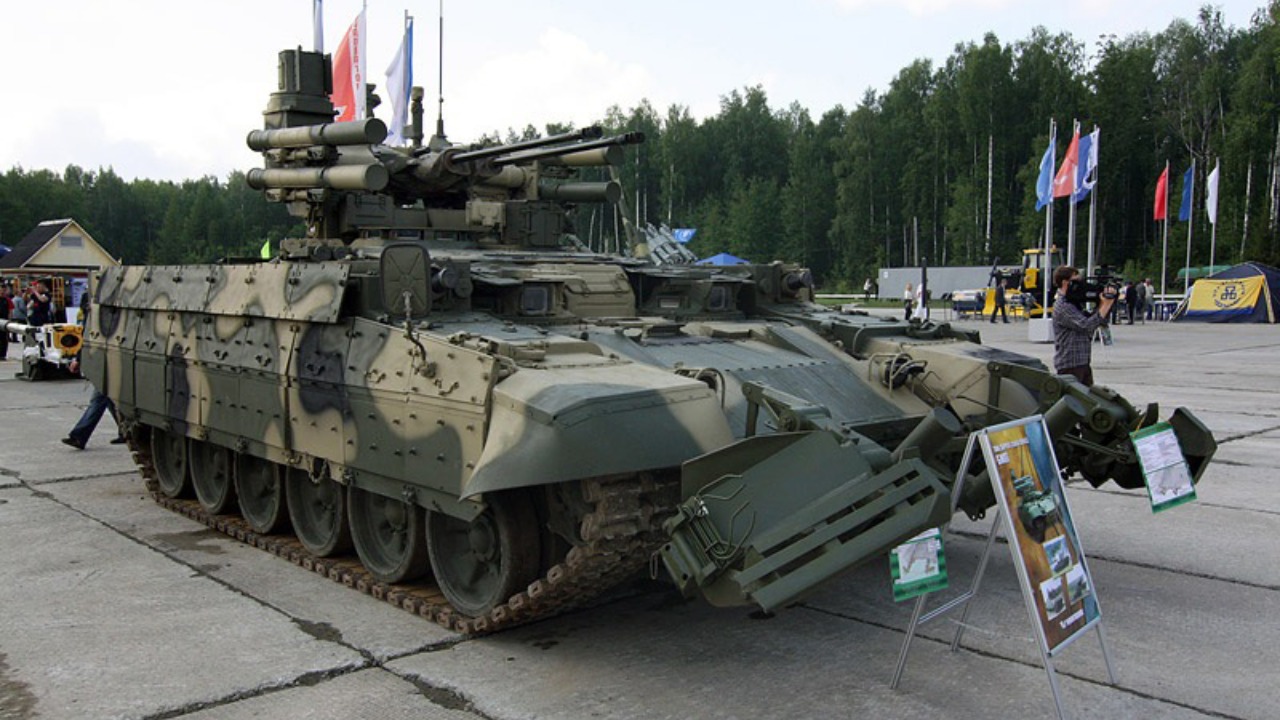
Reality has been less cinematic. When the BMPT finally appeared in Ukraine, it did so in very small numbers and often far from the dense cityscapes it was built to dominate. Analysts tracking the war note that the BMPT Terminator was built for urban warfare and later deployed to Ukraine, but that its operational impact has been limited by extremely low production numbers and the way it has been used. One detailed assessment of BMPT Terminator operations stresses that the vehicle was built for urban warfare yet has been committed in a conflict dominated by long-range fires and open fields, a mismatch that blunts its theoretical strengths.
Combat footage and commentary from the front lines reinforce that disconnect. One night video from the area of a Ukrainian village is accompanied by a blunt verdict that this “very theoretical concept” of a vehicle designed for urban combat has proven useless on the open battlefield, a criticism captured in a discussion where a user begins with the word Very to describe the concept’s shortcomings. Another clip of the BMPT Terminator in combat prompted one observer to admit, “Its my first time ever seen this seen in combat and I thought they were reserved for parade,” a reaction recorded in a thread where the original poster uses the word Its and is answered by PKM-supremacy, underscoring how rare the vehicle’s appearance has been even after years of war.
Limited numbers, limited doctrine, limited effect
The BMPT’s muted impact is not just about terrain. It is also about scale and doctrine. Reports on Russian procurement point out that only a small batch of these vehicles has been produced, with estimates in the low double digits, and that Kazakhstan remains the only foreign operator. A recent analysis of Russia’s armored programs notes that, however impressive the concept, their BMPT “Terminator” operational impact has been limited by extremely low production numbers and that the current war has exposed reduced combat effectiveness in modern high-intensity warfare, a judgment embedded in a piece that begins with the word However. Without mass, even a well designed support vehicle cannot reshape the front.
There is also growing evidence that Russian units have struggled to integrate the BMPT into coherent tactics. One Ukrainian expert, speaking in a video analysis, notes that the Terminator is designed to primarily defeat anti-tank forces but, contrary to expectation, they did not seem to make a decisive difference, a point introduced with the word But. Online armor enthusiasts echo that skepticism. In one detailed Comments Section, users debate whether the BMPT-72 Terminator is even an IFV, with one remark flatly stating “It’s not a IFV,” a classification dispute captured in a thread labeled Comments Section that highlights confusion over what tactical niche the vehicle is supposed to fill.
From “superweapon” hype to fading presence
The contrast between the Terminator’s early hype and its current visibility is striking. A recent roundup of Russian “superweapons” notes that “The BMPT hasn’t been used in combat in over a year” and, judging by everything, seems to be busy mainly filming movies, a withering assessment that begins with the phrase The BMPT. Another strategic review of Russia’s armored forces argues that the BMPT “Terminator” might have no future, pointing to industrial constraints and doctrinal confusion, and frames the vehicle’s story as one where the Terminator image and Russian State Media fanfare collided with battlefield challenges that hamper its effectiveness, a narrative captured in an analysis that highlights Terminator imagery and Russian State Media promotion.
Even sympathetic observers concede that the machine has not lived up to its billing. One detailed breakdown of Russian armor performance in Ukraine notes that The Russian invasion has highlighted poor performance of many systems and that the BMPT Terminator, while not to be toyed with at close range, has not changed the fact that Russian armor has been left burning in fields with burnt out husks, a judgment embedded in a piece that opens with Summary and Key Points. In other words, the Terminator is dangerous in a firefight but not transformative in a war shaped by drones, precision artillery and electronic surveillance.
Myth-making, fan culture and the gap with reality
Part of the BMPT’s enduring aura comes from how it looks and how it is presented to the public. Scale modelers and military YouTubers have embraced it as a star subject, with one popular build video opening with the line “this thing is a monster like it really looks mean doesn’t it” as Dan welcomes viewers back to Hearn’s channel, a reaction captured in a clip of the MENG 1/35 BMPT Terminator kit. Another glossy video describes it as “The DEADLIEST War Machine” in the middle of a brutal war in Ukraine, leaning heavily on dramatic music and visuals of the vehicle rolling through smoke to sell the idea that a new war machine has arrived on the battlefield, a framing seen in footage labeled with Oct and centered on Ukraine.
That fan-driven myth-making collides with more sober battlefield commentary. In one discussion of why the BMPT has had no effect on the war, a user named The-25th-Dragon begins a critique with the word Unfortunately, arguing that even if the vehicle were capable on paper, its inaccuracy and the way it is fielded undermine its potential. At the same time, promotional histories still describe the BMPT as Russia’s Supposedly Invincible Armored Fighting Vehicle, a phrase that appears in a detailed overview of BMPT development that strings together the words Terminator, Russia, Supposedly, Invincible and Armored Fighting Vehicle Development of the BMPT Terminator BMPT Ter. The gap between that language and the vehicle’s modest, sporadic presence at the front is where the myth of the Terminator now sits: powerful on paper, striking on camera, and yet, in the unforgiving arithmetic of Ukraine’s battlefields, just another armored vehicle struggling to survive.