
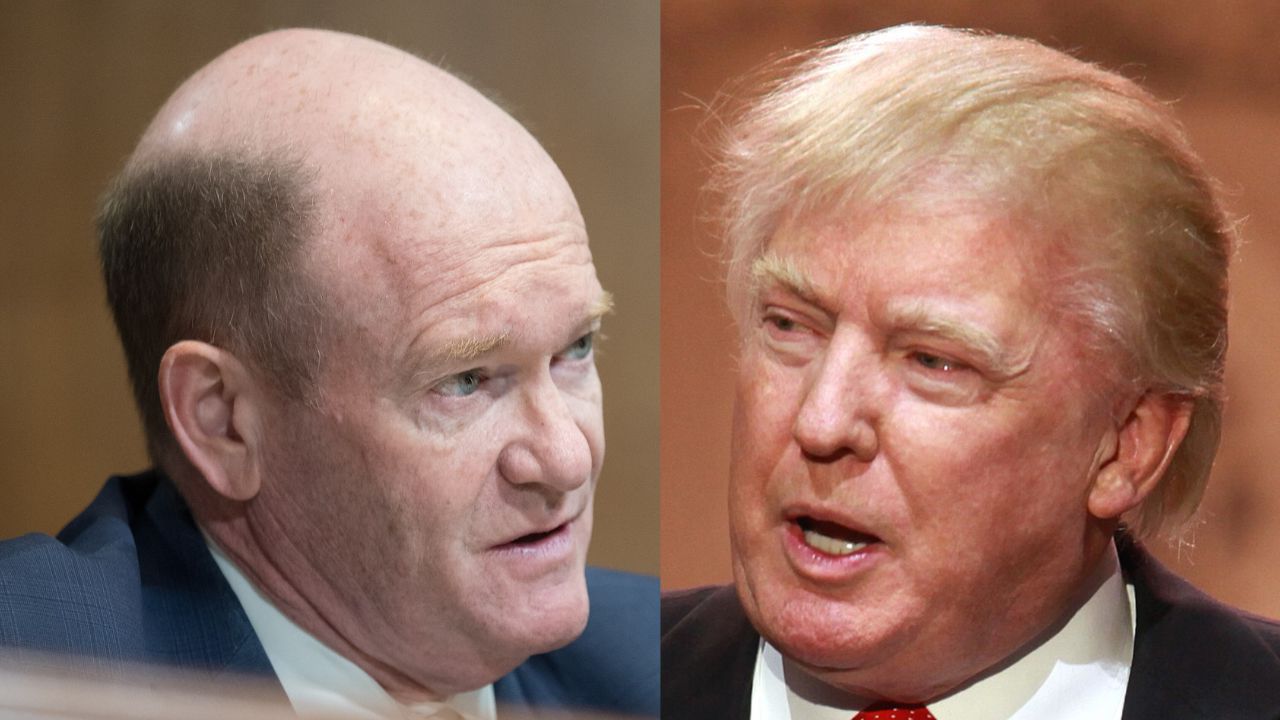
Senator Chris Coons accused President Donald Trump of encouraging Russian President Vladimir Putin to continue his military aggression against Ukraine, warning on November 20 that the administration’s approach could undermine NATO’s collective security as Russian weapons came down in neighboring Poland. Coons described the situation as a predictable and dangerous consequence of Trump’s diplomatic engagement with Putin, arguing that the president’s public signals toward the Russian leader risk emboldening Moscow at a time when European security remains under pressure. His criticism followed a major Russian bombardment of Ukraine and reports of Russian missiles and a suspected drone entering Polish territory.
Coons published his criticism on X while sharing an Associated Press report titled “Russian missiles land in Poland, as Europe held military drills nearby. NATO calls it a violation.” The article described the incidents in southeastern Poland, where two Russian missiles and a suspected jet-powered drone came down as European forces participated in military exercises preparing for a possible postwar mission in Ukraine. Coons connected the developments to Trump’s recent interactions with Putin and the broader implications for NATO’s security commitments.
The complete post read:
“Predictable and deeply dangerous outcome from Trump signaling to his “friend” Putin that it’s ok to continue his brutal aggression against Ukraine and testing the limits of NATO’s collective security.
I will keep standing for freedom over agression and tyranny.”
The Associated Press report described Polish Prime Minister Donald Tusk’s assessment that the incidents appeared to represent an intentional Russian provocation. One missile reportedly came down approximately 35 kilometers from the location of European military exercises, while another was identified as a Kh-101 cruise missile. NATO Secretary-General Mark Rutte characterized the incident as a grave violation of Polish airspace and connected it to Russia’s continuing war against Ukraine.
The incidents occurred during a major Russian nighttime assault on Ukraine. Ukrainian President Volodymyr Zelenskyy said Russian forces launched more than 400 drones and over 110 missiles, killing at least eight civilians and injuring more than two dozen. The Associated Press reported that the attacks came amid continuing diplomatic discussions involving Washington, Moscow and Kyiv, with the potential terms of a peace agreement still unresolved. Poland’s situation also raised questions about NATO’s response mechanisms, including Article 4 consultations and the alliance’s collective-defense provision under Article 5.
The timing of Coons’ statement was particularly significant because Trump had recently met with Putin and Chinese President Xi Jinping in China. The AP report noted that the meetings took place shortly before the Russian attacks and that U.S. officials were continuing discussions about a possible settlement. A separate Politico report described Trump’s subsequent call with European leaders, during which he discussed the financial and human costs of continuing the war and expressed optimism about Putin’s willingness to negotiate.
Coons has consistently opposed allowing Russia to secure concessions through military aggression. On February 24, 2026, marking the fourth anniversary of Russia’s full-scale invasion, he warned against negotiating an agreement that would effectively reward Putin for the invasion. Coons argued that Ukraine should not be abandoned at the negotiating table after resisting Russian forces for years. He also criticized the Trump administration for what he described as bowing to Russian interests instead of applying additional pressure on Moscow.
Coons has also supported direct engagement with Ukrainian officials. On February 19, 2026, he traveled to Odesa alongside Senators Jeanne Shaheen, Sheldon Whitehouse and Richard Blumenthal. The delegation reiterated congressional support for Ukraine and discussed additional military and economic assistance, sanctions against Russia and the need to strengthen Ukraine’s position in any eventual negotiations. The visit was particularly significant because it marked the first Senate delegation visit to Odesa since Russia’s 2022 full-scale invasion.
His position has also extended to economic pressure on Moscow. On July 23, 2026, Coons joined a bipartisan group of senators in introducing the Senator Lindsey O. Graham Sanctioning Russia Act of 2026, legislation designed to increase economic pressure on Russia and countries helping finance its war effort. The initiative sought to strengthen sanctions against purchasers of Russian oil and gas, making it more difficult for Moscow to sustain its military campaign through energy revenues.
Coons subsequently joined another bipartisan effort directly challenging Trump’s dealings with Putin. On October 13, 2026, he and several Republican and Democratic senators wrote to Trump urging him to rescind an agreement allowing Russian-origin diesel fuel to enter global markets. The lawmakers argued that allowing Russian petroleum products to circulate more freely could weaken American security interests and benefit the Russian government while its invasion continued. They also urged Trump to enforce the sanctions authorities established under the newly enacted Russia and Iran sanctions legislation.
The senator’s October letter also outlined his position on what an acceptable peace agreement should involve. Coons and his colleagues argued that any negotiated settlement must preserve Ukraine’s sovereignty, democratic institutions and ability to determine its own future. Their position was that economic pressure should be used to strengthen negotiations rather than provide Moscow with relief before it makes meaningful concessions. The letter directly challenged the administration’s decision to accommodate Russian economic interests while the war continued.
The issue of NATO’s collective security is another central part of Coons’ criticism. His November 20 statement specifically warned that Trump’s treatment of Putin could test the alliance’s security commitments. Russia’s reported entry into Polish airspace brought that concern into immediate focus because Poland is a NATO member. Although Article 5 does not automatically activate following every airspace violation, it establishes the alliance’s commitment to treat an armed attack against one member as an attack against all.
Coons’ latest statement therefore reflects a position he has articulated through congressional visits, bipartisan sanctions legislation, direct letters to Trump and repeated public statements supporting Ukraine. His central argument is that negotiations must not reward Russian aggression or weaken the security of American allies. By connecting Trump’s relationship with Putin to the latest developments in Poland, Coons is warning that the consequences of the administration’s Russia policy could extend beyond Ukraine and affect the broader NATO alliance.