
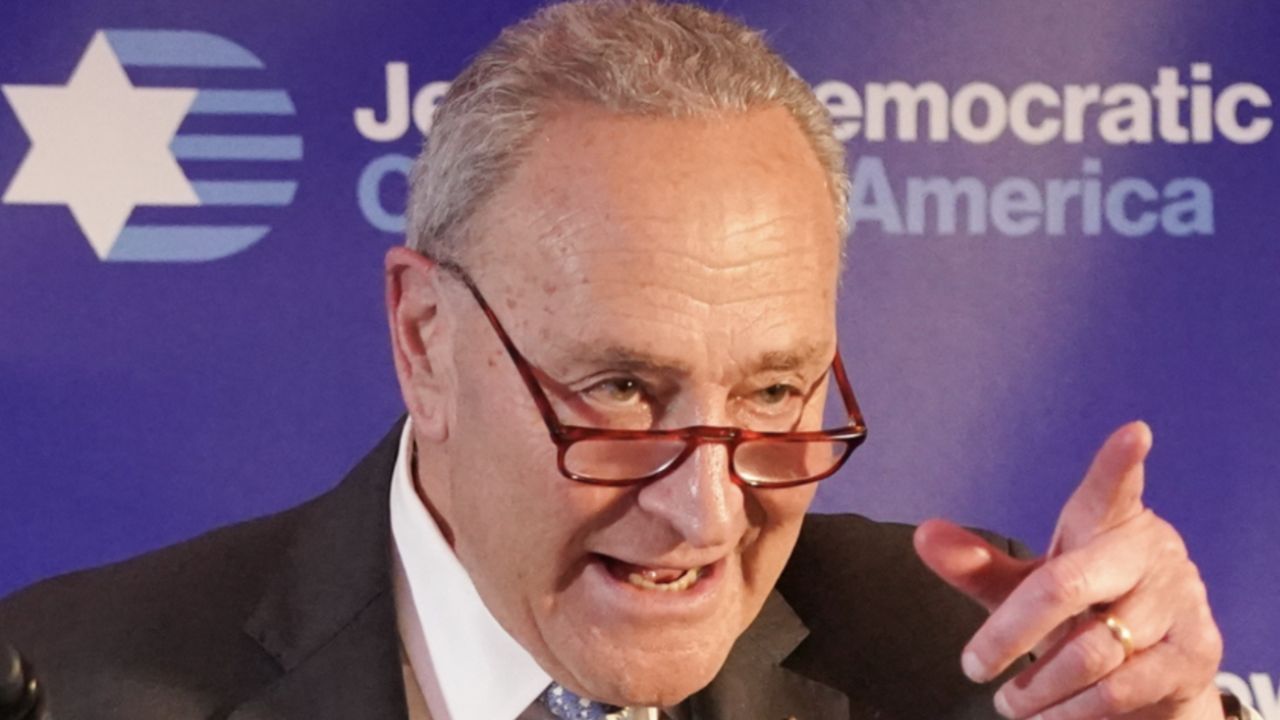
Senate Minority Leader Chuck Schumer accused President Donald Trump and Commerce Secretary Howard Lutnick of putting personal financial interests ahead of American national security on November 20, following the disclosure of federal export-control records showing that the Trump administration approved nearly 880,000 advanced artificial intelligence chips for Chinese companies. Schumer’s criticism focused on the administration’s decisions involving sensitive semiconductor technology, potential connections between approved Chinese recipients and the country’s military, and what he characterized as financial conflicts involving Trump, Lutnick and wealthy business interests. The allegations represent another escalation in Schumer’s ongoing campaign against the administration’s AI chip export policies.
Schumer made the remarks in a November 20 post on X, attaching and directing attention to a report by The Hill titled “Trump administration approved shipment of nearly 900,000 AI chips to China.” The article detailed information disclosed by the House Foreign Affairs Committee, including approvals involving Nvidia’s H200 processors and comparable AMD chips. Schumer’s post specifically singled out Trump and Lutnick, accusing them of benefiting financially while exposing American security interests to potential harm.
The complete post read:
“Trump and Lutnick sold out America’s national security to make a quick buck for themselves and their billionaire buddies.
They get rich and America gets screwed.”
The House Foreign Affairs Committee’s November 19 disclosure provided the central factual basis for the criticism. A Commerce Department Bureau of Industry and Security summary showed that the agency approved 879,868 covered integrated circuits for Chinese companies across 21 license applications as of May 11, 2026. The approved chips included Nvidia’s H200 processors and AMD’s MI325X equivalents. The committee also disclosed that applications covering approximately 3.44 million chips had been submitted during the period.
The approvals included 75,000 chips for Alibaba, 150,000 for Tencent and its subsidiaries, 43,000 for Baidu and 4,000 for BYD. The committee identified all four companies as appearing on the Defense Department’s June 2026 list of Chinese military companies. The disclosure also identified additional entities listed in certain Nvidia applications as potential data-center installers. Importantly, the approvals represent export licenses and do not independently establish that every approved chip was ultimately shipped to China.
The distinction between licensing and completed shipments is important to understanding the controversy. Nvidia told The Hill that its review and licensing process lasted more than six months and that approvals were subject to strict conditions and limited volumes. The company also said it had subsequently stopped shipping H200 chips to China. AMD stated that it complied with applicable U.S. export-control laws and maintained procedures intended to ensure compliance. The House committee’s disclosure, however, has renewed questions about how the Commerce Department evaluated potential military diversion risks.
Schumer’s criticism is not a new position on semiconductor exports. He has repeatedly argued that American advanced chips and semiconductor manufacturing equipment should not be made available to China because of their potential military applications and importance to the global artificial intelligence race. On December 9, 2025, Schumer delivered Senate floor remarks opposing Trump’s decision to permit Nvidia to export H200 processors to China. He argued that the technology could strengthen China’s military capabilities and undermine America’s competitive position.
In September 2026, Schumer again publicly challenged the administration’s approach before Trump’s meeting with Chinese President Xi Jinping. He urged Trump to prevent China from obtaining advanced American chips and manufacturing equipment, arguing that allowing access to those technologies could weaken the United States’ advantage in artificial intelligence. Schumer also pointed to bipartisan legislation intended to strengthen export restrictions and prevent technology transfers that could benefit China’s semiconductor industry.
Among the legislative efforts Schumer has promoted is the Multilateral Alignment of Technology Controls on Hardware Act, known as the MATCH Act. Introduced on April 3, 2026, by Schumer and Republican and Democratic senators, the legislation seeks to strengthen restrictions on China’s access to advanced semiconductor manufacturing equipment by coordinating controls with international partners. Schumer argued that preventing China from acquiring critical manufacturing technology was necessary to protect American technological leadership and national security.
Schumer has also promoted the AI OVERWATCH Act and the Chip Security Act as additional measures addressing advanced chip exports and potential technology diversion. In his November 20 Senate floor remarks, he urged Congress to advance all three legislative efforts, arguing that existing export-control procedures had failed to adequately prevent sensitive American technology from reaching Chinese entities. He also called for congressional oversight of the administration’s decisions and further scrutiny of how export licenses were approved.
The financial-interest allegations in Schumer’s criticism have also appeared in his recent statements. On November 16, he delivered Senate floor remarks accusing Trump and Lutnick of placing their financial interests ahead of national security. Schumer specifically raised concerns about Trump’s reported Nvidia stock holdings and Lutnick’s family business interests involving foreign data-center projects. These were allegations and concerns advanced by Schumer, rather than findings of a congressional investigation establishing that either official personally profited from the specific export approvals.
Schumer also raised questions about the relationship between Nvidia’s former chief executive Jensen Huang, the Trump administration and the decisions surrounding Chinese access to advanced chips. In recent Senate remarks, he called for congressional scrutiny of reported foreign espionage concerns involving the American technology industry and questioned whether corporate influence affected the administration’s export-control decisions. He urged intelligence committees to receive briefings and called for administration officials and Huang to answer questions before Congress.
The November 20 dispute therefore brings together several issues Schumer has repeatedly raised: restrictions on advanced AI technology, China’s military ambitions, enforcement of American export controls, potential conflicts of interest and congressional oversight of national security decisions. His latest post did not provide additional evidence establishing that Trump or Lutnick personally received money from the approved licenses. Instead, it reiterated his broader accusation that the administration’s policies benefit wealthy interests at the expense of American security. The House committee’s disclosure has provided a new basis for congressional scrutiny of those decisions.