
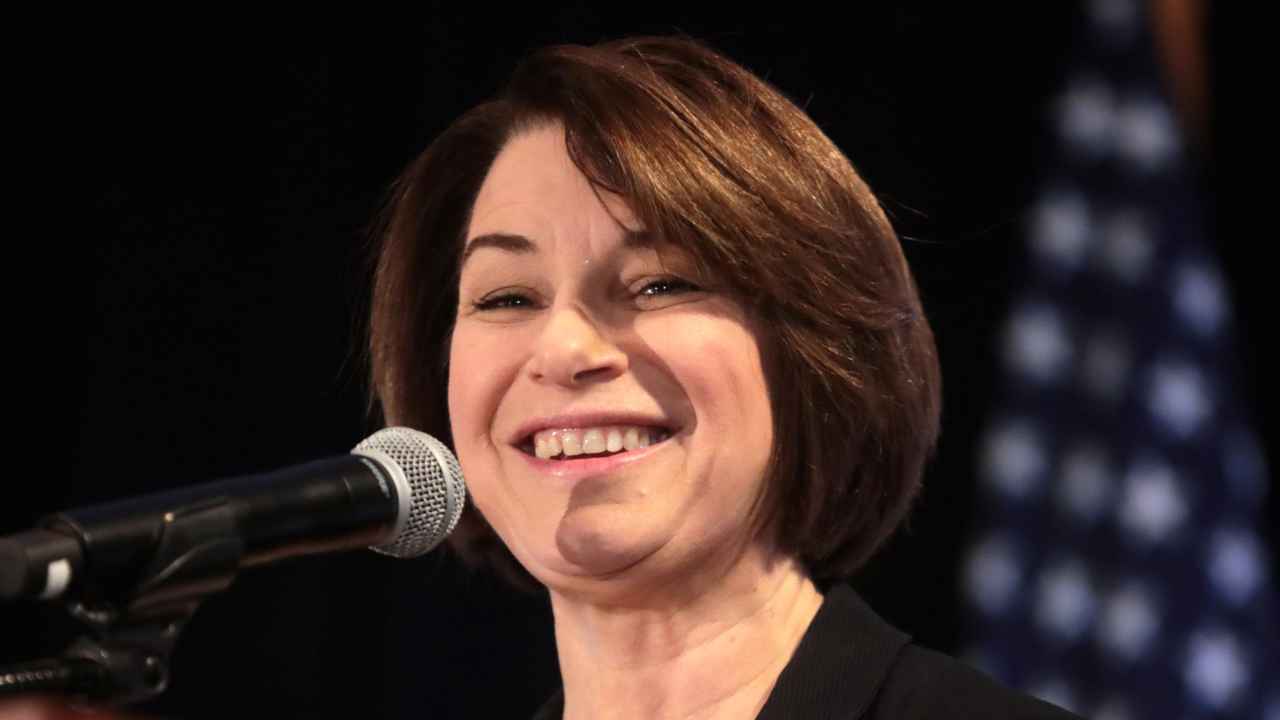
Minnesota Gov.-elect Amy Klobuchar is preparing to renew a legislative effort to restrict certain semiautomatic firearms and ammunition magazines, joining Democratic state lawmakers and families affected by the 2025 Annunciation school shooting who spent much of the past year pressing for changes to Minnesota’s gun laws.
Klobuchar, who won the November 3 gubernatorial election, said at a November 4 news conference that passing gun-safety legislation would be among her incoming administration’s leading priorities.
“Well, I think the gun safety bill is going to get passed, and I am so excited to be working with the leaders on this, and it certainly should be one of our top priorities,” Klobuchar said.
Her remarks signaled renewed support for legislation that passed the Minnesota Senate in May but failed to advance through the evenly divided House of Representatives.
The effort has been led by state Sen. Zaynab Mohamed, who became the chief author of the Senate’s comprehensive firearms package, alongside Sen. Ron Latz, Senate Majority Leader Erin Murphy and other Democratic lawmakers.
House Democrats, including Reps. Emma Greenman and Brad Tabke, separately advanced proposals addressing semiautomatic firearms and large-capacity magazines. Parents of children killed or injured in the Annunciation shooting have organized public demonstrations, testified before lawmakers and made the issue a central part of the gubernatorial campaign.
The November election changed the political circumstances surrounding the proposal. Democrats will control the governorship and both legislative chambers when the 2027 session begins, creating a clearer path for legislation that previously encountered Republican opposition.
Klobuchar Promises to Sign the Senate’s Gun Safety Package
Klobuchar made firearm restrictions an explicit commitment during her campaign for governor.
In her published public safety platform, Klobuchar pledged to sign the gun-safety package approved by the Minnesota Senate, including provisions to strengthen firearm storage standards, restrict assault weapons and improve school security.
Her platform also emphasizes due process and the rights of lawful gun owners, alongside efforts to keep firearms away from people considered dangerous.
The governor-elect’s position builds on her longstanding support for federal gun-control measures during her service in the U.S. Senate.
Her official Senate policy record identifies assault weapons restrictions, expanded background checks and measures addressing domestic violence as priorities.
Klobuchar supported the Bipartisan Safer Communities Act of 2022, which expanded certain background-check procedures for younger firearm purchasers, strengthened restrictions involving domestic violence and provided funding for mental health and school safety programs.
Her current proposal would involve state-level restrictions beyond those enacted in the 2022 federal law.
At the November 4 news conference, Klobuchar acknowledged that the previous Minnesota Senate package could be amended before final passage, but said she hoped its central provisions would remain intact.
Sen. Zaynab Mohamed Led the Comprehensive Firearms Bill
State Sen. Zaynab Mohamed, a Democrat representing Minneapolis, became the chief author of Senate File 4067, the comprehensive firearms legislation approved in May.
According to the Minnesota Legislature’s official bill record, the proposal was introduced March 2, 2026, and passed the Senate on May 4 by a vote of 34–33.
The legislation initially listed Sen. Ron Latz as chief author. Mohamed assumed that role on April 28 as lawmakers prepared the consolidated firearms package for a final Senate vote.
The official record identifies Mohamed, Latz, Sandra Pappas, Bonnie Westlin and Bobby Joe Champion as the bill’s five Senate authors.
In a May 4 statement issued with Senate Democratic leaders, Mohamed defended the legislation as an attempt to reduce gun violence while investing in schools and mental health services.
The package addressed semiautomatic military-style assault weapons, large-capacity ammunition magazines, firearm storage, privately manufactured weapons and extreme risk protection orders.
It also included appropriations for school safety programs, mental health services and violence prevention initiatives.
Mohamed’s role is significant because she was not merely a public supporter of the legislation. She was its designated chief author when the Senate approved the package.
Ron Latz and Erin Murphy Helped Advance the Senate Package
Sen. Ron Latz, a Democrat from St. Louis Park, was another central figure in the legislation’s development.
Latz served as the original chief author of SF 4067 and remained a co-author after Mohamed assumed the lead position.
As a senior lawmaker involved in public safety legislation, Latz helped advance proposals regulating firearms and strengthening Minnesota’s legal response to gun violence.
Senate Majority Leader Erin Murphy also publicly backed the package and defended the chamber’s decision to bring it to a vote.
In the Senate DFL’s May 4 announcement, Murphy cited the Annunciation school shooting and other incidents of violence as reasons lawmakers needed to act.
The legislation passed with all 34 Senate Democrats voting in favor and all 33 Republicans voting against it.
The narrow result demonstrated both the Democratic caucus’s support for the measure and the opposition it faced from Republican legislators.
Sen. Mary Kunesh also supported the package and promoted its school safety provisions. In a May 4 statement, Kunesh highlighted funding for school safety improvements as an important component of the broader legislation.
House Democrats Emma Greenman and Brad Tabke Advanced Separate Proposals
Democratic lawmakers in the Minnesota House pursued related firearm restrictions before the Senate approved its consolidated package.
Rep. Emma Greenman authored House File 3433, which proposed restrictions on the possession of specified semiautomatic military-style assault weapons.
Rep. Brad Tabke authored House File 3402, a separate proposal addressing possession of large-capacity ammunition magazines.
Both bills appeared on the House Public Safety Finance and Policy Committee’s February 24 agenda, which also listed testimony from parents affected by the Annunciation shooting, medical professionals and gun-rights representatives.
The proposals failed to advance after a 10–10 committee vote, reflecting the House’s even division between Democrats and Republicans.
The legislative setback was separate from the Senate’s later passage of SF 4067, but both efforts involved similar debates over restrictions on semiautomatic firearms and ammunition magazines.
Other Democratic lawmakers supported additional measures addressing firearm storage, school security and mental health services.
The House proposals and Senate package demonstrate that the push for new restrictions did not originate with Klobuchar’s election. State lawmakers had already spent months developing and debating the legislation.
Parents of Annunciation Victims Became Leading Advocates
Families affected by the August 27, 2025, shooting at Annunciation Catholic Church and School in Minneapolis have been among the most visible advocates for the legislation.
Two children, 10-year-old Harper Moyski and 8-year-old Fletcher Merkel, were killed when a gunman opened fire during a school Mass. Other children and adults were injured.
Harper’s parents, Jackie Flavin and Mike Moyski, became prominent advocates for firearm restrictions, repeatedly meeting with lawmakers and urging the Legislature to act.
The couple participated in legislative hearings and public demonstrations, arguing that the state needed stronger measures to prevent similar attacks.
They also appeared on the February 24 House committee testimony schedule for the proposed assault weapons and magazine restrictions.
Other Annunciation parents established the Annunciation Light Alliance, a nonpartisan advocacy organization formed in February 2026 to promote school safety and gun violence prevention.
The organization says it works with policymakers, educators, religious leaders and community members to develop measures intended to protect children.
Its advocacy has included public demonstrations at the Minnesota Capitol, testimony before legislative committees and efforts to maintain attention on the victims and survivors of the shooting.
The group describes itself as nonpartisan, although individual members have participated in political campaigns and endorsed candidates based on their positions on firearm legislation.
Annunciation Parents Endorsed Klobuchar During Governor’s Race
The dispute over firearms legislation became a prominent issue in the final weeks of Minnesota’s gubernatorial campaign.
On October 22, Flavin and Moyski appeared with Klobuchar at a Minneapolis campaign event and endorsed her candidacy.
The parents accused Republican gubernatorial nominee and House Speaker Lisa Demuth of failing to honor what they said was a commitment to allow a House floor vote on gun legislation.
Demuth disputed their characterization of the discussions, maintaining that she had not promised the legislation would advance through the House.
The disagreement followed months of tension between families seeking a vote and Republican lawmakers who opposed the proposed firearms restrictions.
Demuth and other Republicans argued that the legislation would burden lawful firearm owners and supported alternative approaches emphasizing school security and enforcement of existing laws.
Klobuchar, meanwhile, made passage of the Senate package part of her campaign’s public safety agenda.
The families’ involvement gave the legislation a prominent role in the election debate, although their advocacy began well before the gubernatorial campaign’s final weeks.
Medical Organizations and Law Enforcement Personnel Also Supported Restrictions
Support for the proposed legislation extended beyond elected officials and victims’ families.
The Minnesota Medical Association publicly supported SF 4067, describing gun violence as a public-health issue and endorsing restrictions on assault-style firearms and large-capacity magazines.
In a May 7 statement, the association highlighted the legislation’s proposed investments in school safety and mental health programs.
The organization described the package as a priority and supported its combination of firearm regulations and prevention measures.
Law enforcement personnel also appeared at legislative hearings to support stronger restrictions.
Among them was Minneapolis police Lt. Andrew Schroeder, the lead detective assigned to the Annunciation shooting investigation, who testified during a March Senate committee hearing.
His testimony emphasized the recurring impact of gun violence on police officers, victims and families.
These statements reflected the positions of the individuals and organizations involved. They did not establish unanimous support among Minnesota law enforcement agencies or medical professionals.
What the Senate’s Proposal Would Restrict
The 2026 Senate package would regulate certain semiautomatic rifles, pistols and shotguns defined by specified operating characteristics and physical features.
It would also restrict large-capacity ammunition magazines, defined in the Senate-approved version as magazines capable of holding more than 17 rounds.
The official legislative text proposed limits on dealer sales and a certification system for people already possessing covered firearms or magazines.
Existing owners would generally have been required to obtain certification from the Bureau of Criminal Apprehension and renew it every three years.
The legislation also proposed changes to firearm storage requirements, restrictions on privately manufactured firearms and revisions to Minnesota’s extreme risk protection order procedures.
School safety funding, mental health services and violence prevention programs were included in the broader package.
The Senate’s official analysis details the appropriations, enforcement mechanisms, exemptions and certification requirements.
Supporters argue that these measures could reduce the risk and severity of gun violence. Opponents contend that restrictions on commonly owned firearms and magazines would infringe constitutional rights without adequately addressing the causes of violent crime.
Democratic Election Victories Change Legislative Prospects
The proposal’s failure in 2026 was largely a consequence of the Legislature’s narrow partisan divisions.
Although Democrats controlled the Senate, the House was divided equally between the two parties, preventing several firearm restrictions from advancing.
Democratic gains in the November 3 elections gave the party control of both chambers beginning in January 2027.
Combined with Klobuchar’s victory, the results mean Democrats will control the Legislature and governor’s office during the next session.
That alignment gives supporters a clearer opportunity to reintroduce legislation resembling SF 4067, although the 2026 bill itself does not automatically carry over into the new legislative session.
Lawmakers will need to introduce new legislation, move it through the relevant committees and secure passage in both chambers before Klobuchar can sign it.
Any final measure could differ from the Senate-approved 2026 proposal, particularly in its definitions of restricted firearms, treatment of existing owners and implementation requirements.
Gun-Rights Groups Prepare to Oppose Renewed Legislation
The National Rifle Association and Minnesota Gun Owners Caucus have signaled that they will oppose renewed efforts to restrict semiautomatic firearms and ammunition magazines.
In a November 5 statement, the Minnesota Gun Owners Caucus warned that the Democratic election victories increased the likelihood of firearm restrictions advancing in 2027.
The organization criticized the 2026 Senate proposal’s restrictions on firearm sales, magazine capacity and continued possession of covered weapons.
The NRA subsequently shared video of Klobuchar’s remarks, accusing her of seeking to restrict firearms under the justification of public safety.
Gun-rights advocates argue that restrictions on commonly owned firearms could violate the Second Amendment and impose new legal obligations on people who acquired their weapons lawfully.
Supporters maintain that the proposed restrictions are intended to prevent future shootings and reduce the availability of weapons they consider especially dangerous.
The constitutional validity of any new law would depend on its final provisions and applicable judicial precedent. Passage could also produce litigation over firearm classifications, possession restrictions and certification requirements.
Next Steps for Klobuchar and Legislative Sponsors
When the Minnesota Legislature convenes on January 12, 2027, supporters will have an opportunity to introduce a new firearms package.
Mohamed and other lawmakers involved in the 2026 legislation provide an established legislative foundation, while Klobuchar’s campaign commitment places the governor’s office behind renewed efforts.
The Annunciation Light Alliance, victims’ families and medical organizations are also positioned to continue advocating for the restrictions and accompanying school safety measures.
But neither the governor-elect nor legislative supporters have announced a final 2027 bill containing every provision of the previous Senate package.
The central question is whether Democrats can translate their new governing majority into agreement on the specific restrictions, exemptions and enforcement mechanisms that divided lawmakers earlier this year.
For Klobuchar, the issue is already part of her promised early agenda.
“I think the gun safety bill is going to get passed,” she said.