
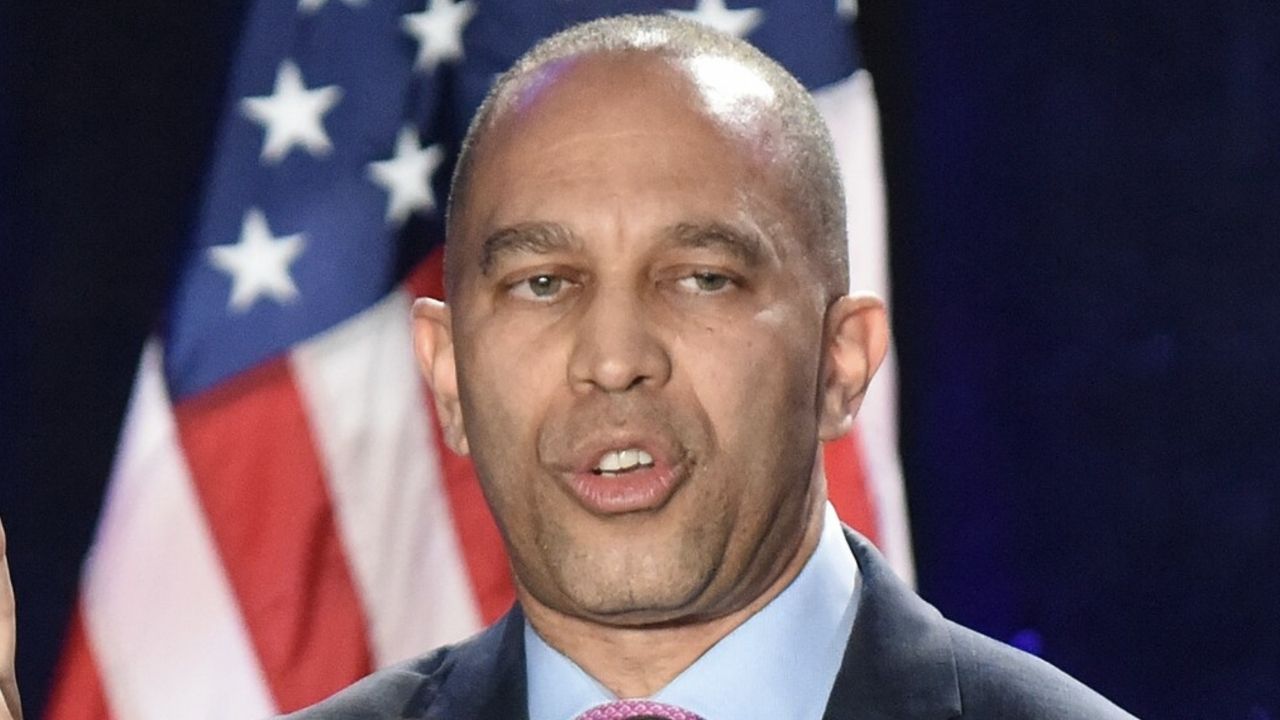
House Democratic Leader Hakeem Jeffries delivered a brief but pointed message following the Democratic Party’s sweeping victories in the 2026 midterm elections, declaring that the movement behind the results was “Too big to rig.” His statement invokes the language of election fraud frequently used by President Donald Trump while presenting the Democratic victory as an unmistakable expression of the American electorate.
Jeffries posted the following message on X Wednesday morning:
“Too big to rig.
Thank you, America.”
The post followed Democrats’ victories in both chambers of Congress. Reuters reported that Democrats gained at least 25 House seats and secured a Senate majority of at least 54-44, delivering a substantial reversal of Republican control in Washington.
Jeffries’ phrase “Too big to rig” carries a broader political context because Trump has repeatedly claimed that elections were rigged or unfair when results did not favor him. Jeffries’ statement turns that language toward the Democratic victory, suggesting that the scale of the electoral outcome was too large to be manipulated or denied.
The Democratic leader has previously criticized Trump for questioning election integrity. In July 2026, Jeffries accused the president of calling into question free and fair elections before ballots had been cast, arguing that election administration should remain under state and local authority.
Jeffries also opposed Republican voting legislation in September 2026, describing a House measure tied to the SAVE America Act as an effort to rig the midterm elections. His office said Democrats would continue fighting what they characterized as voter suppression and restrictions on eligible voters.
The leader’s criticism has extended to Trump’s executive actions concerning mail-in voting. In August 2026, Jeffries argued that the president could not unilaterally determine how states administer elections, maintaining that election regulation remains subject to constitutional limits and state authority.
Jeffries has also framed the midterm elections as a referendum on Trump’s administration. In an October interview, he argued that Trump’s economic policies, tariffs, health care decisions and the administration’s handling of the Iran war were all effectively on the ballot.
The Democratic leader’s election message follows a consistent pattern of portraying Trump’s administration as a threat to democratic institutions and public accountability. His official statements have focused on election administration, voting rights, the cost of living and what he describes as corruption within the executive branch.
The election results now give Jeffries a substantially different role in the House. As Democratic leader, he will be positioned to help direct the party’s legislative strategy and coordinate committee oversight efforts. The Democratic majority also gives the party the authority to set the chamber’s agenda and pursue investigations into administration actions.
Jeffries has previously said Democrats would pursue accountability if they regained control of the House. In August 2026, he said the party had not ruled out impeachment and that investigations would be guided by the facts, the law and the Constitution.
The phrase “Too big to rig” therefore serves as both a celebration of the election outcome and a statement about Jeffries’ broader position on election integrity. It suggests that the Democratic movement’s electoral strength was decisive, while echoing a political vocabulary often used by Trump to challenge election results. Jeffries’ message does not identify a specific instance of attempted election manipulation in the 2026 contest.
Jeffries concluded with “Thank you, America,” acknowledging voters whose decisions changed the balance of power in Congress. The election gives Democrats new opportunities to investigate the administration, advance legislation and challenge Trump’s policies. Whether the party can translate the victory into sustained political and legislative results will depend on how it uses its newly secured majorities.